


How Foreigners Can Register a Company in Nepal: Complete 2025 Guide
How Foreigners Can Register a Company in Nepal has become an increasingly important query as Nepal continues to liberalize its investment climate. This comprehensive guide addresses the complete process for non-resident Nepalis (NRNs) and foreign nationals seeking to establish a business presence in Nepal without being physically present throughout the entire registration process.
The foreign company registration Nepal landscape has evolved significantly with the implementation of online systems through the Office of the Company Registrar (OCR) portal. As of 2025, the process requires navigating multiple government touchpoints while maintaining compliance with the NPR 20 million minimum investment requirement for foreign investors.
This guide provides authoritative information based on the current legal framework, including the Companies Act 2063, Non-Resident Nepali Act 2064, and Foreign Investment and Technology Transfer Act (FITTA) 2019, to ensure your NRN business setup proceeds smoothly and in full compliance with Nepalese regulations.
Understanding Nepal’s Legal Framework for Foreign Investment
Before diving into the company incorporation for non-residents, it’s essential to understand the three primary legal instruments that govern foreign investment in Nepal. These laws establish the rights, responsibilities, and procedures that foreign investors must follow.
Companies Act 2063: Foundation for Company Registration
The Companies Act 2063 (2006) serves as the foundational legislation governing all company formations in Nepal. It establishes the Office of the Company Registrar (OCR) as the primary authority responsible for company incorporation, structure, and registration procedures.
Under this act, foreigners can register a company in Nepal through either a private limited company or a public limited company structure. The act outlines specific provisions regarding foreign shareholding, director requirements, and compliance obligations that must be followed during the registration process.
Non-Resident Nepali Act 2064: Special Provisions for NRNs
The Non-Resident Nepali Act 2064 (2008) provides special privileges to NRNs, granting them equal business rights as resident Nepali citizens. This is particularly significant as it allows NRNs to maintain 100% ownership in certain business sectors where other foreign investors might face restrictions.
For NRNs seeking company incorporation in Nepal, this act provides additional benefits including:
- 100% ownership capability in most sectors
- Profit repatriation rights
- Investment protection guarantees
- Special economic zone privileges
Foreign Investment and Technology Transfer Act 2019: Investment Guidelines
The Foreign Investment and Technology Transfer Act (FITTA) 2019 regulates foreign capital inflow into Nepal and sets the minimum investment threshold of NPR 20 million for foreign investors. This act requires foreign investors to obtain prior approval from the Department of Industry before proceeding with company registration.
FITTA also outlines the sectors where foreign investment is encouraged, restricted, or prohibited, providing clarity on business opportunities available to foreign investors in Nepal.
Eligibility Criteria for Foreign Investors in Nepal
Not everyone can simply decide to register a company in Nepal as a foreigner. Specific eligibility criteria must be met, and understanding these requirements is the first step toward successful company incorporation.
Who Can Register a Company in Nepal?
The following categories of individuals and entities are eligible to register a company in Nepal:
- Non-Resident Nepalis (NRNs): Nepali citizens holding foreign citizenship as defined by the NRN Act 2064
- Foreign nationals: Individuals of foreign nationality seeking to invest in Nepal
- Foreign companies: Existing foreign entities seeking to establish a subsidiary or branch office in Nepal
- Foreign institutional investors: Investment funds and financial institutions from abroad
Each category has specific requirements and privileges under Nepalese law, with NRNs generally enjoying more favorable terms compared to other foreign investors.
Minimum Investment Requirements
As of 2025, the minimum investment requirement for foreigners registering a company in Nepal is set at NPR 20 million (approximately USD 150,000). This requirement applies to both NRNs and other foreign investors, with certain exceptions for specific industries or special economic zones.
The minimum investment must be:
- Deposited in a bank account in Nepal
- Verified by the Nepal Rastra Bank
- Documented in the company registration application
- Maintained as working capital for the business
Step-by-Step Process for Company Registration in Nepal
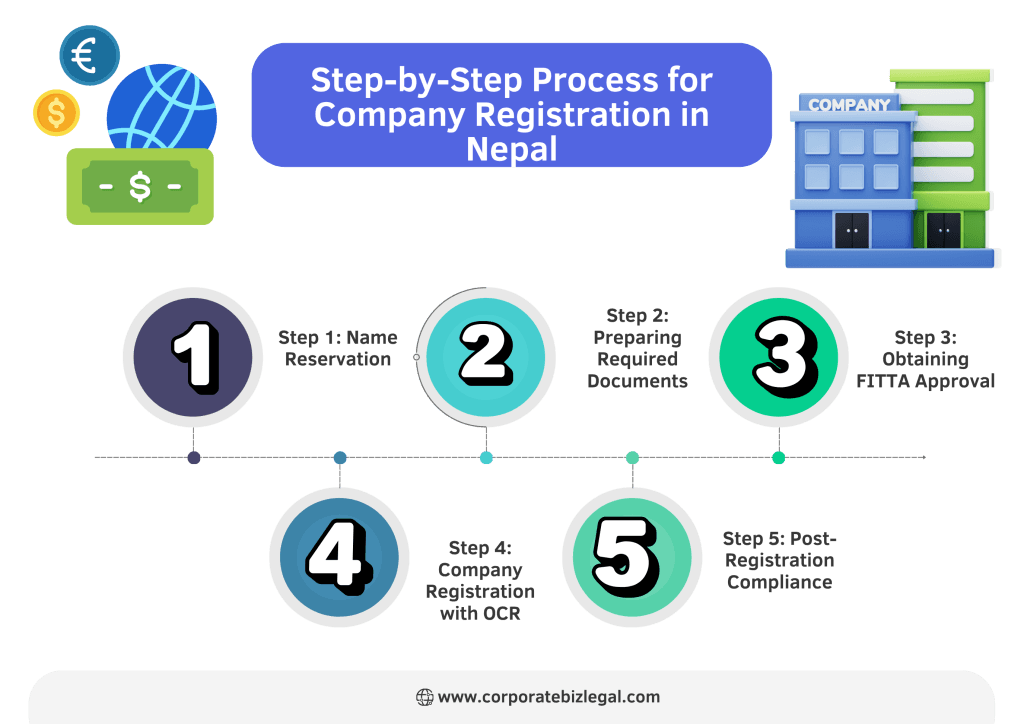
The process of foreign company registration Nepal follows a structured sequence of steps that must be completed in order. Each step involves specific documentation, approvals, and interactions with government authorities.
Step 1: Name Reservation
The first step in how foreigners can register a company in Nepal is reserving a unique company name through the OCR online portal. The name reservation process requires:
- Submission of at least three proposed company names in order of preference
- Verification that the proposed names are not already registered or similar to existing companies
- Payment of the name reservation fee (approximately NPR 500)
- Approval from the OCR, which is typically granted within 2-3 working days
Once approved, the reserved name is valid for 90 days, during which the registration process must be completed.
Step 2: Preparing Required Documents
Document preparation is a critical phase in the NRN business setup process. The required documents vary slightly based on the investor category but generally include:
- For individual foreign investors:
- Scanned copy of passport
- Scanned copy of visa (if applicable)
- Curriculum vitae (CV)
- Recent passport-sized photographs
- Proof of address in home country
- Bank reference letter
- For NRN investors:
- All documents required for individual foreign investors
- Proof of Nepali origin (citizenship certificate of parents/grandparents)
- NRN identification card (if available)
- For foreign corporate investors:
- Certificate of incorporation from home country
- Memorandum and articles of association
- Board resolution authorizing investment in Nepal
- Audited financial statements for the last two years
All documents must be notarized in the country of origin and attested by the Nepalese embassy or consulate in that country.
Step 3: Obtaining FITTA Approval
Before proceeding with company registration, foreign investors must obtain approval from the Department of Industry under FITTA. This step involves:
- Submission of the FITTA application form
- Detailed business plan outlining the proposed investment
- Project report with financial projections
- Source of funds declaration
- Investment commitment letter
The Department of Industry typically processes FITTA applications within 15-20 working days, after which an approval letter is issued. This letter is a prerequisite for company registration with the OCR.
Step 4: Company Registration with OCR
Once FITTA approval is obtained, the actual company incorporation for non-residents can proceed with the OCR. This step includes:
- Preparation of Memorandum of Association (MoA) and Articles of Association (AoA)
- Submission of all required documents to the OCR
- Payment of registration fees based on authorized capital
- Verification of documents by OCR officials
- Issuance of Certificate of Incorporation
The OCR has streamlined this process through its online portal, allowing for digital submission of documents and electronic payment of fees. The entire registration process typically takes 7-10 working days after document submission.
Step 5: Post-Registration Compliance
After receiving the Certificate of Incorporation, several post-registration compliance steps must be completed:
- Permanent Account Number (PAN) registration with the Inland Revenue Department
- VAT registration if the annual turnover is expected to exceed NPR 5 million
- Business license from the local municipality or ward office
- Industry registration with the Department of Industry
- Foreign investment recording with Nepal Rastra Bank
These registrations are essential for the company to operate legally and conduct business activities in Nepal.
Remote Registration Process for NRNs
For NRNs and foreign investors unable to travel to Nepal, the remote registration process provides a viable alternative to establish a business presence without physical presence throughout the entire procedure.
Power of Attorney Requirements
The cornerstone of remote registration is the Power of Attorney (PoA), which authorizes a representative in Nepal to act on behalf of the foreign investor. The PoA must:
- Be drafted on stamp paper of appropriate value
- Clearly specify the powers being delegated
- Be signed by the foreign investor in the presence of a notary public
- Be attested by the Nepalese embassy or consulate in the investor’s country of residence
- Be registered with the concerned authorities in Nepal upon arrival
The PoA enables the local representative to complete all registration procedures, sign documents, and make necessary payments on behalf of the foreign investor.
Document Attestation Procedures
Proper document attestation is crucial for the foreign company registration Nepal process. The standard attestation procedure involves:
- Notarization by a notary public in the country of origin
- Authentication by the Ministry of Foreign Affairs in the country of origin
- Attestation by the Nepalese embassy or consulate in that country
- Verification upon submission to relevant authorities in Nepal
This multi-layered attestation process ensures the authenticity of documents submitted by foreign investors and is mandatory for all NRN business setup applications.
Timeline and Cost Breakdown
Understanding the timeline and costs involved in how foreigners can register a company in Nepal is essential for proper planning and resource allocation.
Table: Company Registration Timeline
| Step | Duration | Notes |
|---|---|---|
| Name Reservation | 2-3 working days | Online submission through OCR portal |
| Document Preparation | 7-14 days | Depends on investor’s location and responsiveness |
| FITTA Approval | 15-20 working days | May require additional information |
| Company Registration | 7-10 working days | After FITTA approval |
| Post-Registration Compliance | 5-7 working days | PAN, VAT, and business license registration |
| Total Timeline | 36-54 working days | Approximately 7-11 weeks |
Table: Estimated Cost Breakdown for Company Registration
| Item | Approximate Cost (NPR) | Notes |
|---|---|---|
| Name Reservation | 500 | Non-refundable |
| FITTA Application Fee | 15,000 | For foreign investment approval |
| Company Registration Fee | 15,000-50,000 | Based on authorized capital |
| Legal Documentation | 20,000-50,000 | MoA, AoA, and PoA preparation |
| PAN Registration | 1,000 | Tax identification number |
| VAT Registration | 2,000 | If applicable |
| Business License | 3,000-10,000 | Varies by municipality |
| Professional Fees | 50,000-200,000 | For legal and consulting services |
| Total Estimated Cost | 106,500-328,500 | Excluding minimum capital investment |
Common Challenges and Solutions
Despite the streamlined procedures, foreigners registering a company in Nepal often encounter specific challenges. Being aware of these issues and their solutions can help ensure a smoother registration process.
Challenge 1: Time Zone Coordination
NRNs and foreign investors often face difficulties coordinating with Nepal-based representatives due to significant time zone differences.
Solution: Establish clear communication protocols with designated response times. Utilize project management tools that allow for asynchronous communication and document sharing.
Challenge 2: Embassy Attestation Delays
The requirement for embassy attestation of documents can cause significant delays, particularly in countries where the Nepalese embassy has limited staff or resources.
Solution: Begin the attestation process well in advance. Consider using professional document attestation services that specialize in handling embassy requirements. If possible, visit the embassy in person to expedite the process.
Challenge 3: Bank Account Opening Requirements
Opening a corporate bank account in Nepal typically requires the physical presence of at least one director, creating challenges for remote registration.
Solution: Some banks now allow account opening with a properly notarized and attested PoA. Research banks with more flexible policies or consider making a short trip to Nepal specifically for this purpose.
Challenge 4: Address Verification
The local ward office may require physical verification of the registered business address, which can be challenging for remote investors.
Solution: Engage a local representative who can facilitate this process. Consider using a virtual office service that provides address verification as part of their package.
Post-Registration Compliance Requirements
After successfully completing the company incorporation for non-residents, maintaining compliance with Nepalese regulations is an ongoing responsibility that requires attention to several key areas.
Annual Compliance Obligations
- Annual Return Filing: Must be filed with the OCR within 3 months of the company’s anniversary date
- Tax Return Filing: Annual income tax return must be filed with the Inland Revenue Department
- Statutory Audit: Financial statements must be audited by a registered auditor in Nepal
- Board Meetings: Minimum of four board meetings must be conducted annually
- Annual General Meeting: Must be held within 6 months of the fiscal year-end
Foreign Investment Reporting Requirements
Foreign investors must comply with specific reporting requirements to maintain their foreign investment status:
- Quarterly Investment Status Report: Submitted to the Department of Industry
- Annual Foreign Investment Report: Detailed report on investment utilization and business performance
- Repatriation Documentation: Required for any profit or capital repatriation
- Change in Shareholding Reporting: Must be reported and approved by concerned authorities
Conclusion
How Foreigners Can Register a Company in Nepal is a process that has become increasingly streamlined in recent years, particularly with the implementation of online registration systems. While the procedure involves multiple steps and interactions with various government authorities, proper planning and professional guidance can ensure a smooth registration experience.
For NRNs and foreign investors seeking to capitalize on Nepal’s growing economy, understanding the legal framework under the Companies Act 2063, NRN Act 2064, and FITTA 2019 is essential. By following the step-by-step process outlined in this guide and addressing common challenges proactively, investors can successfully establish their business presence in Nepal.
If you’re considering company incorporation in Nepal and require professional assistance with the registration process, our team of experienced legal consultants specializes in helping NRNs and foreign investors navigate the complexities of Nepalese business regulations. Contact us today for a personalized consultation and take the first step toward establishing your business in Nepal.Data Tables
Table: Company Registration Timeline
| Step | Duration | Notes |
|---|---|---|
| Name Reservation | 2-3 working days | Online submission through OCR portal |
| Document Preparation | 7-14 days | Depends on investor’s location and responsiveness |
| FITTA Approval | 15-20 working days | May require additional information |
| Company Registration | 7-10 working days | After FITTA approval |
| Post-Registration Compliance | 5-7 working days | PAN, VAT, and business license registration |
| Total Timeline | 36-54 working days | Approximately 7-11 weeks |
Table: Estimated Cost Breakdown for Company Registration
| Item | Approximate Cost (NPR) | Notes |
|---|---|---|
| Name Reservation | 500 | Non-refundable |
| FITTA Application Fee | 15,000 | For foreign investment approval |
| Company Registration Fee | 15,000-50,000 | Based on authorized capital |
| Legal Documentation | 20,000-50,000 | MoA, AoA, and PoA preparation |
| PAN Registration | 1,000 | Tax identification number |
| VAT Registration | 2,000 | If applicable |
| Business License | 3,000-10,000 | Varies by municipality |
| Professional Fees | 50,000-200,000 | For legal and consulting services |
| Total Estimated Cost | 106,500-328,500 | Excluding minimum capital investment |
Table: Document Requirements for Foreign Investors
| Document Type | Individual Foreign Investor | NRN Investor | Foreign Corporate Investor |
|---|---|---|---|
| Passport Copy | Required | Required | Required for directors |
| Proof of Address | Required | Required | Required for company |
| Bank Reference Letter | Required | Required | Required |
| CV/Resume | Required | Required | Required for directors |
| Proof of Nepali Origin | Not applicable | Required | Not applicable |
| Certificate of Incorporation | Not applicable | Not applicable | Required |
| Board Resolution | Not applicable | Not applicable | Required |
| Audited Financial Statements | Not applicable | Not applicable | Required |
| PoA for Remote Registration | Optional | Optional | Optional |
FAQ Section
Can foreigners own 100% of a company in Nepal?
How long does it take to register a company in Nepal as a foreigner?
What is the minimum investment required for foreigners to register a company in Nepal?
Can NRNs register a company in Nepal while living abroad?
What are the tax implications for foreign-owned companies in Nepal?
Can profits be repatriated from Nepal to the investor’s home country?
Conclusion
How Foreigners Can Register a Company in Nepal is a process that has become increasingly streamlined in recent years, particularly with the implementation of online registration systems. While the procedure involves multiple steps and interactions with various government authorities, proper planning and professional guidance can ensure a smooth registration experience.
For NRNs and foreign investors seeking to capitalize on Nepal’s growing economy, understanding the legal framework under the Companies Act 2063, NRN Act 2064, and FITTA 2019 is essential. By following the step-by-step process outlined in this guide and addressing common challenges proactively, investors can successfully establish their business presence in Nepal.
If you’re considering company incorporation in Nepal and require professional assistance with the registration process, our team of experienced legal consultants specializes in helping NRNs and foreign investors navigate the complexities of Nepalese business regulations. Contact us today for a personalized consultation and take the first step toward establishing your business in Nepal.
Also Read
- Manpower License in Nepal
- Education Consultancy Registration in Nepal
- Procedural of FDI in Nepal
- Travel Agency Registration in Nepal
Corporate Biz legal and Company Darta Nepal is the best and most credible company registration in Nepal and expert Law firm in Nepal
Was this article helpful?
Let us know what you think!