


Foreign Investment in Nepal: A Comprehensive Legal Framework Guide
Introduction
How to invest in Nepal as a foreigner has become one of the most searched queries as Nepal positions itself as an emerging investment destination in South Asia. Foreign investment plays a crucial role in Nepal’s economic development, contributing to job creation, technology transfer, and infrastructure development. The Government of Nepal has established comprehensive legal frameworks to facilitate foreign investment in Nepal, making it increasingly accessible for international investors to participate in various sectors of the economy.
The Foreign Investment and Technology Transfer Act (FITTA), 2019 serves as the primary legislation governing foreign investment, replacing the earlier 1992 act to create a more investor-friendly environment. Understanding the legal requirements, procedures, and restrictions is essential for any foreign investor considering business opportunities in Nepal. This comprehensive guide provides detailed information on how foreigners can invest in Nepal, covering legal frameworks, sector-specific regulations, registration procedures, ownership structures, and compliance requirements.
Nepal’s strategic location between India and China, combined with its abundant natural resources, young workforce, and growing domestic market, presents significant opportunities for foreign investors. However, navigating the legal landscape requires thorough understanding of applicable laws, regulations, and procedural requirements.
Government Sites to Vist before investing in Nepal
- Department of Industry
- Department of commerce
- Office of company registrar
- Inland revenue department
- Nepal investment board
- SEBON
- Nepal Rastra Bank
What is Foreign Investment in Nepal?
Foreign investment in Nepal refers to capital, technology, or expertise brought into Nepal by foreign nationals, foreign entities, or non-resident Nepali citizens for business purposes. The Foreign Investment and Technology Transfer Act (FITTA), 2019 defines foreign investment comprehensively, establishing clear parameters for what constitutes foreign investment under Nepali law.
Legal Definition of Foreign Investment
According to Section 2(d) of FITTA, 2019, foreign investment includes:
- Direct equity investment by foreign nationals or foreign entities in Nepali companies
- Investment through reinvestment of earnings derived from foreign investment
- Investment made by non-resident Nepali citizens in foreign currency
- Loans and credits extended by foreign investors to their invested enterprises
- Technology transfer agreements with financial implications
The Act specifically recognizes foreign investment as any investment made by foreign nationals, foreign companies, non-resident Nepalis, or foreign governments in various forms including equity, loans, or technology transfer arrangements.
Who Qualifies as a Foreign Investor?
Under FITTA, 2019, the following entities qualify as foreign investors:
- Foreign nationals: Individuals who are not citizens of Nepal
- Foreign companies: Legal entities incorporated outside Nepal
- Foreign institutions: Organizations, foundations, or institutional investors registered abroad
- Non-resident Nepali (NRN) citizens: Nepali citizens permanently residing abroad who invest in foreign currency
- Foreign government entities: Government-owned corporations or sovereign funds from other countries
Types of Foreign Investment Permitted
The legal framework recognizes several forms through which foreigners can invest in Nepal:
Direct Foreign Investment (FDI): Equity participation in Nepali companies through share purchases, either during company formation or through subsequent investment rounds. Foreign investors can hold shares in private limited companies, public limited companies, or partnership firms depending on sector-specific regulations.
Foreign Portfolio Investment: Investment in securities listed on Nepal Stock Exchange, subject to regulations of Securities Board of Nepal (SEBON). Portfolio investment allows foreign institutional investors to participate in Nepal’s capital markets within prescribed limits.
Technology Transfer Arrangements: Agreements involving transfer of technical knowledge, expertise, patents, trademarks, or industrial processes in exchange for royalties, fees, or equity participation. Such arrangements must be registered with the Department of Industry.
Joint Venture Investments: Collaborative arrangements between foreign investors and Nepali partners for establishing new enterprises or expanding existing businesses. Joint ventures are particularly common in sectors requiring local knowledge or where foreign ownership restrictions apply.
Why Invest in Nepal? Investment Opportunities and Advantages
Foreign investment in Nepal presents compelling opportunities driven by favorable government policies, strategic geographic position, and untapped market potential. Understanding these advantages helps foreign investors make informed decisions about entering the Nepali market.
Strategic Geographic Location
Nepal’s position between two of the world’s largest economies—India and China—provides unique market access opportunities. Foreign investors can leverage Nepal as a gateway to reach combined markets exceeding 2.8 billion consumers. The Transit Treaty between Nepal and India facilitates movement of goods, while emerging connectivity with China through border points creates additional trade corridors.
Investment Incentives and Benefits
The Government of Nepal provides various incentives to attract foreign investment:
Tax Holidays and Concessions: Industries established in specified areas receive income tax exemptions ranging from 3 to 7 years depending on location. Remote and underdeveloped regions offer longer tax holiday periods. The Income Tax Act, 2058 provides detailed provisions for tax incentives available to foreign-invested enterprises.
Customs Duty Exemptions: Import of machinery, equipment, and raw materials for export-oriented industries receives customs duty exemptions or reductions. The Industrial Enterprises Act, 2020 specifies categories of industries eligible for such benefits.
Repatriation Guarantees: Section 7 of FITTA, 2019 guarantees foreign investors the right to repatriate invested capital, profits, dividends, and proceeds from sale of business or shares in convertible foreign currency after payment of applicable taxes. This protection provides essential security for foreign capital.
Infrastructure Support: Special Economic Zones (SEZs) and Industrial Districts provide developed infrastructure including utilities, transportation access, and streamlined administrative services. The Special Economic Zone Act, 2016 establishes frameworks for SEZ development and operation.
Sector-Specific Opportunities
Nepal presents attractive investment opportunities across multiple sectors:
Hydropower and Renewable Energy: With theoretical hydropower potential exceeding 83,000 MW and developed capacity below 2,000 MW, Nepal offers enormous opportunities in power generation. The Government actively promotes foreign investment in hydropower through various incentive packages.
Tourism and Hospitality: Home to eight of the world’s fourteen highest peaks including Mount Everest, Nepal’s tourism sector attracts millions of visitors annually. Investment opportunities exist in hotels, resorts, adventure tourism, and related services.
Agriculture and Agro-Processing: With approximately 65% of the population engaged in agriculture, Nepal offers opportunities in commercial farming, organic agriculture, food processing, and agricultural technology.
Information Technology and BPO Services: Growing IT infrastructure and availability of educated English-speaking workforce create opportunities in software development, IT services, and business process outsourcing.
Manufacturing and Export Industries: Access to regional markets through trade agreements creates opportunities in manufacturing sectors including textiles, handicrafts, processed foods, and light manufacturing.
What Laws Govern Foreign Investment in Nepal?
Understanding the legal framework governing foreign investment is crucial for compliance and successful business operations. Nepal has established comprehensive legislation addressing various aspects of foreign investment.
Primary Legislation
Foreign Investment and Technology Transfer Act (FITTA), 2019: This Act serves as the principal legislation governing foreign investment. It replaced the Foreign Investment and Technology Transfer Act, 1992 to create a more liberal and investor-friendly environment. The Act covers approval procedures, investment sectors, ownership limits, repatriation rights, and investor protections.
Key provisions of FITTA, 2019 include:
- Section 3: Establishes sectors open for foreign investment
- Section 4: Specifies minimum investment thresholds
- Section 5: Details approval procedures for foreign investment
- Section 6: Addresses technology transfer arrangements
- Section 7: Guarantees repatriation rights
- Section 8: Provides dispute resolution mechanisms
Industrial Enterprises Act, 2020: This comprehensive legislation governs establishment and operation of industrial enterprises in Nepal, including foreign-invested industries. It consolidates provisions previously scattered across multiple acts, creating a unified framework for industrial operations.
The Act addresses:
- Industry registration and licensing procedures
- Incentives and facilities for industries
- Industrial zones and special economic areas
- Pollution control and environmental compliance
- Labor and employment regulations
- Export-oriented industries
Company Act, 2063 (2006): This Act governs formation, registration, management, and dissolution of companies in Nepal. Foreign investors establishing companies must comply with provisions of this Act regarding:
- Company formation requirements
- Share capital and ownership structures
- Director and shareholder requirements
- Corporate governance standards
- Financial reporting and auditing
- Shareholder rights and protections
Sector-Specific Legislation
Various sectors have specific laws governing foreign investment:
Nepal Rastra Bank Act, 2058 (2002): Regulates foreign investment in banking and financial sectors. The Act establishes licensing requirements, capital adequacy norms, and operational standards for foreign banks and financial institutions.
Insurance Act, 2049 (1992): Governs foreign investment in insurance sector, specifying licensing procedures, capital requirements, and operational regulations for insurance companies with foreign participation.
Tourism Act, 2035 (1978): Regulates investment in tourism-related enterprises including hotels, travel agencies, and adventure tourism operators. Foreign investors must obtain tourism industry licenses from Ministry of Culture, Tourism and Civil Aviation.
Mines and Minerals Act, 2056 (1999): Governs exploration and extraction of mineral resources. Foreign investment in mining requires special permissions and compliance with environmental and social safeguards.
Special Economic Zone Act, 2073 (2016): Establishes framework for development and operation of Special Economic Zones, offering streamlined procedures and additional incentives for foreign investors establishing enterprises within SEZs.
Investment Approval Authority
The Department of Industry (DOI) under the Ministry of Industry, Commerce and Supplies serves as the primary authority for foreign investment approval and facilitation. The Department maintains the Foreign Investment and Technology Transfer Registry, processes applications, issues approval certificates, and monitors compliance.
For certain sectors, additional approvals from sectoral regulators are required:
- Nepal Rastra Bank: Banking and financial services
- Securities Board of Nepal: Capital markets and securities
- Insurance Board: Insurance and reinsurance services
- Nepal Telecommunications Authority: Telecommunications services
- Department of Mines and Geology: Mining and mineral exploration
Where Can Foreigners Invest? Permitted and Restricted Sectors
The Foreign Investment and Technology Transfer Act, 2019 adopts a negative list approach, meaning foreign investment is permitted in all sectors except those specifically prohibited or restricted. Understanding these classifications is essential for determining investment opportunities.
Sectors Open for Foreign Investment
Foreign investors can invest in most sectors of Nepal’s economy without restrictions, subject to minimum investment requirements and registration procedures. Major sectors fully open include:
Manufacturing Industries: Foreign investment is welcomed across manufacturing sectors including textiles, garments, food processing, pharmaceuticals, chemicals, cement, steel, and electronics. The Industrial Enterprises Act, 2020 provides comprehensive framework and incentives for manufacturing investments.
Tourism and Hospitality: Hotels, resorts, restaurants, travel agencies, adventure tourism, and related services are fully open. Foreign investors can hold 100% equity in tourism enterprises meeting minimum investment thresholds specified in FITTA, 2019.
Hydropower and Energy: Power generation, transmission, and distribution projects welcome foreign investment. The Government particularly encourages investment in hydroelectric projects through various incentive packages under the Hydropower Development Policy.
Information Technology: Software development, IT services, data centers, BPO operations, and technology-enabled services are fully open to foreign investment with no ownership restrictions.
Agriculture and Agro-Processing: Commercial farming, horticulture, livestock farming, fisheries, and agricultural product processing welcome foreign participation, contributing to food security and agricultural modernization.
Infrastructure Development: Construction, real estate development, roads, bridges, and infrastructure projects are open, subject to compliance with relevant building codes and land ownership regulations.
Healthcare Services: Hospitals, clinics, diagnostic centers, pharmaceutical manufacturing, and healthcare services are open to foreign investment, addressing Nepal’s growing healthcare needs.
Education Services: Private schools, colleges, vocational training institutes, and educational technology services can receive foreign investment, subject to quality standards set by education authorities.
Restricted Sectors
Certain sectors have restrictions on foreign ownership percentage or require special permissions:
Financial Services: Foreign investment in banking and financial institutions is permitted but subject to sector-specific regulations. Nepal Rastra Bank Act, 2058 and related directives specify:
- Foreign banks can establish operations through joint ventures with Nepali partners
- Foreign ownership in commercial banks initially limited to 20%, gradually increasable to 51% subject to Nepal Rastra Bank approval
- Foreign institutional investors can hold up to 20% in financial institutions listed on stock exchange
Insurance Services: Foreign investment permitted up to 50% in insurance and reinsurance companies. The Insurance Board regulates foreign participation under the Insurance Act, 2049.
Securities Business: Foreign investment in securities businesses (merchant banking, securities trading) is restricted. Securities Board of Nepal (SEBON) regulates foreign participation in capital market intermediaries.
Airlines and Aviation: Domestic airlines require majority Nepali ownership. Foreign investment permitted up to 49% in domestic aviation companies under the Civil Aviation Act.
Mass Media: Broadcasting and print media have foreign investment restrictions to maintain local content and cultural values. Foreign ownership generally limited to 25-50% depending on media type.
Prohibited Sectors
Section 3 of FITTA, 2019 and related regulations prohibit foreign investment in following sectors:
Cottage Industries: Small-scale traditional industries reserved for Nepali citizens to protect traditional livelihoods. The Industrial Enterprises Act, 2020 defines cottage industries as those with minimal mechanization and traditional production methods.
Personal Services: Barber shops, beauty parlors, tailoring shops, and similar personal service businesses are restricted to protect local employment opportunities.
Arms and Ammunition: Manufacturing or trading of weapons, explosives, and military equipment prohibited for foreign investors due to national security considerations.
Radioactive Materials: Production, processing, or trading of radioactive and nuclear materials restricted under national security laws.
Retail Trading: Small-scale retail trading businesses below specified investment thresholds reserved for domestic entrepreneurs to protect local retail markets.
Investment in Land and Real Estate
Foreign investment in land ownership faces significant restrictions under Nepalese law:
Land Ownership Prohibition: Section 3(7) of the Land (Rights Management) Act prohibits foreign nationals and foreign companies from purchasing or owning land in Nepal. This constitutional restriction protects national sovereignty and prevents foreign land acquisition.
Lease Arrangements: Foreign investors can lease land for business purposes:
- Industrial land can be leased for up to 50 years, renewable
- Commercial property leases permitted for business operations
- Lease agreements must be registered with local land revenue office
- Lease payments subject to taxation under prevailing laws
Real Estate Development: Foreign investors can participate in real estate development through:
- Construction of commercial buildings on leased land
- Development of industrial facilities and infrastructure
- Apartment construction for sale (buyers obtain ownership of built structures, not land)
- Joint ventures with Nepali partners who own land
The Industrial Enterprises Act, 2020 facilitates land lease for industrial purposes, with streamlined procedures for long-term lease arrangements in industrial zones.
How Much Investment is Required? Minimum Investment Thresholds
The Foreign Investment and Technology Transfer Act, 2019 establishes minimum investment thresholds that foreign investors must meet to qualify for foreign investment approval. These requirements ensure that foreign investment contributes meaningfully to Nepal’s economic development.
Minimum Investment Requirements
Section 4 of FITTA, 2019 specifies minimum investment amounts:
For Foreign Nationals and Companies:
- Minimum investment of NPR 50 million (approximately USD 375,000) for foreign investors establishing businesses in Nepal
- This threshold applies to equity investment in companies or enterprises
- Investment can be made in cash, kind (machinery, equipment), or technology
- Investment must be brought through banking channels and properly documented
For Non-Resident Nepali (NRN) Investors:
- Minimum investment of NPR 30 million (approximately USD 225,000) for Non-Resident Nepali citizens
- NRN investors enjoy lower threshold recognizing their citizenship status
- Investment must be made in convertible foreign currency
- NRN status must be verified through Non-Resident Nepali Association or diplomatic missions
Investment Valuation Methods
The Act recognizes multiple forms of investment that count toward minimum thresholds:
Cash Investment: Direct equity investment in Nepali Rupees equivalent to foreign currency brought through banking channels. Nepal Rastra Bank exchange rates at time of transaction apply for conversion calculations.
Investment in Kind: Machinery, equipment, raw materials, and components imported for business operations count toward investment if:
- Valuation conducted by DOI-approved valuers
- Customs valuation documents provided
- Items are essential for business operations
- Depreciation calculated from date of import
Technology and Intellectual Property: Transfer of technology, patents, technical know-how, trademarks, or technical services can constitute investment when:
- Technology valuation conducted by independent valuers
- Technology transfer agreement registered with DOI
- Valuation methodology transparent and verifiable
- Technology transfer contributes to business operations
Sector-Specific Investment Requirements
Certain sectors impose additional minimum investment requirements beyond FITTA thresholds:
Banking and Financial Services: Nepal Rastra Bank requires substantially higher capital for banking licenses:
- Commercial banks: Minimum paid-up capital NPR 8 billion
- Development banks: NPR 2.5 billion
- Finance companies: NPR 1.5 billion
Insurance Companies: Insurance Board requires:
- Life insurance: Minimum paid-up capital NPR 2 billion
- Non-life insurance: NPR 1 billion
Hydropower Projects: Department of Electricity Development requires minimum investment based on project capacity:
- Projects below 1 MW: NPR 100 million
- Projects 1-10 MW: NPR 500 million
- Projects above 10 MW: Capacity-based calculations
Tourism Infrastructure: Department of Tourism specifies:
- Five-star hotels: Minimum NPR 500 million
- Four-star hotels: NPR 250 million
- Tourism resorts: NPR 100 million
Exemptions from Minimum Investment
Certain categories may receive exemptions or reduced thresholds:
Technology Transfer Agreements: Pure technology transfer without equity investment may not require minimum investment if approved based on technology value and contribution to industrial development.
Expansion of Existing Investment: Existing foreign-invested enterprises expanding operations may not face minimum investment requirements for additional investment rounds.
Exports and Employment-Intensive Industries: Export-oriented industries or those creating significant employment may receive case-by-case consideration for threshold adjustments.
How to Register Foreign Investment: Step-by-Step Procedure
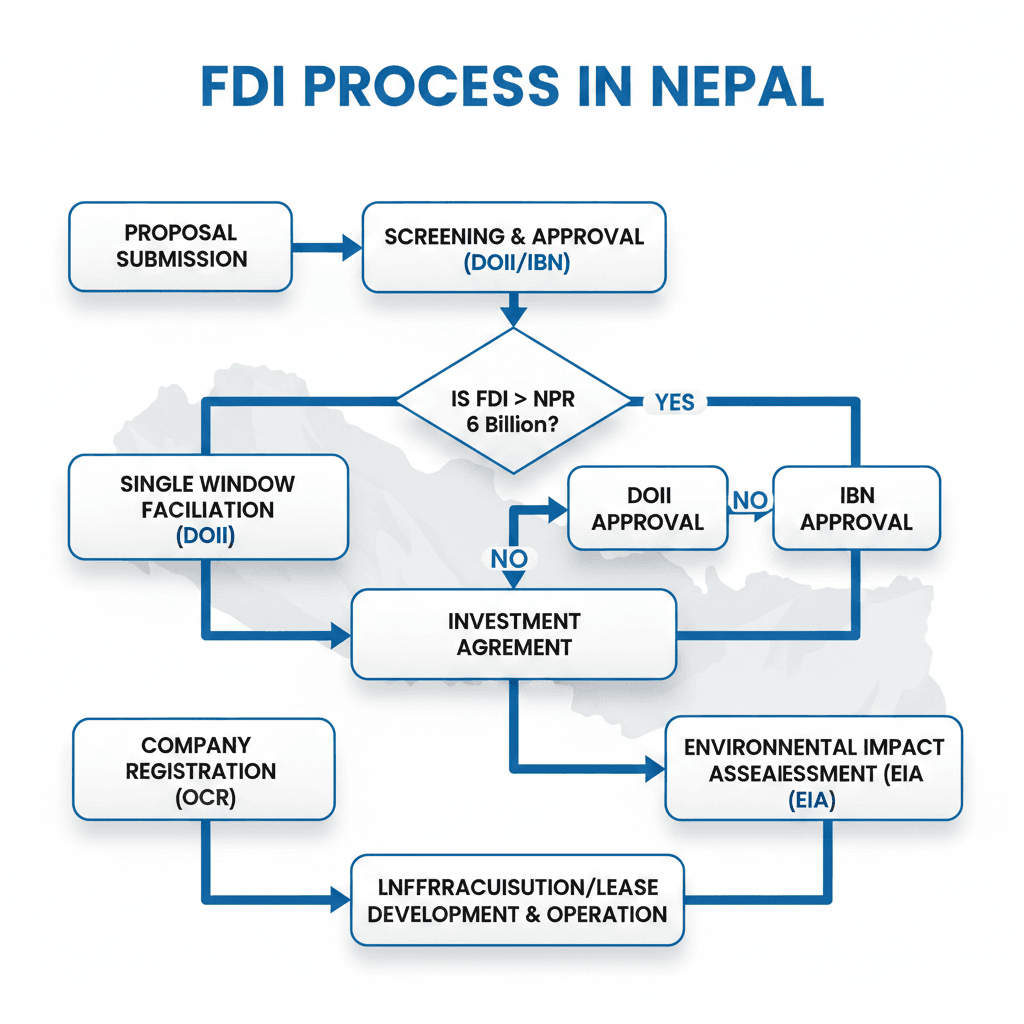
Understanding how to invest in Nepal as a foreigner requires detailed knowledge of registration procedures. The Department of Industry (DOI) has established systematic processes for foreign investment approval and company registration.
Pre-Registration Requirements
Before applying for foreign investment approval, foreign investors must complete preliminary steps:
Business Plan Preparation: Develop comprehensive business plan including:
- Project description and objectives
- Market analysis and competitive positioning
- Technical and operational details
- Financial projections and funding sources
- Employment generation estimates
- Environmental and social impact assessment
Sector-Specific Clearances: For regulated sectors, obtain preliminary clearances:
- Nepal Rastra Bank: Banking and financial services
- Securities Board: Investment advisory or securities business
- Insurance Board: Insurance services
- Nepal Telecommunications Authority: Telecommunication services
Partner Identification (for joint ventures): Identify and formalize arrangements with Nepali partners through:
- Memorandum of Understanding
- Joint Venture Agreement
- Shareholder agreements detailing rights and responsibilities
Foreign Investment Approval Process
Step 1: Application Submission to Department of Industry
Foreign investors must submit application for foreign investment approval to DOI with following documents:
For Foreign Company Investors:
- Application form prescribed by DOI
- Certificate of incorporation from home country
- Memorandum and Articles of Association
- Board resolution authorizing Nepal investment
- Audited financial statements (last two years)
- Business plan and project feasibility study
- Passport copies of foreign directors/shareholders
- Power of attorney if applying through representative
For Individual Foreign Investors:
- Prescribed application form
- Passport copy with valid visa
- Bank statement showing financial capacity
- Business plan and project proposal
- Educational and professional credentials
- Police clearance from home country
For Non-Resident Nepali Investors:
- NRN card or certificate from NRN Association
- Proof of foreign currency investment source
- Nepali citizenship certificate
- Passport and resident visa from current country
Step 2: Document Verification and Review
DOI examines submitted documents for:
- Completeness and accuracy
- Compliance with minimum investment thresholds
- Sector eligibility for foreign investment
- Alignment with national priorities
The Department may request additional information or clarifications during this stage. Section 5 of FITTA, 2019 requires DOI to process applications within 7 working days for complete submissions.
Step 3: Foreign Investment Approval
Upon satisfactory review, DOI issues Foreign Investment Approval Certificate specifying:
- Approved investment amount
- Business sector and activities
- Foreign ownership percentage
- Validity period (typically one year for company registration)
- Conditions and compliance requirements
The approval certificate is essential for subsequent company registration and obtaining necessary licenses.
Step 4: Company Registration
After receiving foreign investment approval, investors must register company with Office of Company Registrar (OCR) under Company Act, 2063:
Required Documents for Company Registration:
- Foreign Investment Approval Certificate from DOI
- Company name reservation certificate
- Memorandum of Association
- Articles of Association
- Shareholders’ agreement (for multiple shareholders)
- Directors’ consent letters
- Citizenship certificates (Nepali directors) or passport copies (foreign directors)
- Office premises agreement (lease or ownership documents)
- PAN registration certificate
Registration Process:
- Submit application with prescribed fees
- OCR verifies documents and compliance with Company Act
- Registration certificate issued typically within 3-5 working days
- Company receives unique registration number and PAN
Step 5: Industry Registration
After company registration, obtain Industry Registration Certificate from DOI:
Required Documents:
- Company registration certificate
- Foreign investment approval certificate
- MOA and AOA
- Project feasibility report
- Land lease or ownership documents (for industrial projects)
- Environmental assessment (if required)
Industry registration provides access to various facilities and incentives under the Industrial Enterprises Act, 2020.
Step 6: Tax Registration
Register with Inland Revenue Department for tax purposes:
- Obtain Tax Identification Number (TIN)
- Register for VAT (if annual turnover exceeds NPR 5 million)
- Register for income tax
- Comply with tax filing requirements
Step 7: Sector-Specific Licenses
Obtain operational licenses from relevant authorities:
- Department of Tourism: Tourism enterprises
- Department of Food Technology and Quality Control: Food and beverage businesses
- Department of Drug Administration: Pharmaceutical companies
- Nepal Rastra Bank: Banking and financial institutions
- Municipality/Municipal Office: Business operating licenses
Timeline for Complete Registration
Typical timeline for complete registration process:
StageDurationAuthorityForeign Investment Approval7-15 working daysDepartment of IndustryCompany Registration3-5 working daysOffice of Company RegistrarIndustry Registration5-7 working daysDepartment of IndustryTax Registration1-3 working daysInland Revenue DepartmentSector-Specific LicensesVaries (7-30 days)Respective AuthoritiesTotal Estimated Time3-8 weeks-
Investment Fund Transfer
After obtaining necessary approvals and registrations, transfer investment funds:
Banking Procedures:
- Open corporate bank account in Nepal
- Transfer foreign currency through authorized banking channels
- Banks convert foreign currency to NPR at prevailing exchange rates
- Obtain bank certificates showing fund receipt
- Submit fund transfer documentation to DOI for record
Nepal Rastra Bank monitors foreign exchange transactions, and compliance with foreign exchange regulations is mandatory.
Post-Registration Compliance
After registration, foreign-invested companies must comply with:
Department of Industry Requirements:
- Submit annual progress reports
- Report changes in shareholding, directors, or business activities
- Renew industry registration certificate periodically
Tax Compliance:
- File monthly/quarterly VAT returns
- Submit annual income tax returns
- Maintain proper accounting records
- Conduct statutory audits
Company Registrar Requirements:
- Hold annual general meetings
- File annual returns
- Update beneficial ownership information
- Report director changes
What Ownership Structures Are Permitted?
Understanding permitted ownership structures for foreign investment in Nepal is crucial for business planning and compliance. The legal framework allows various ownership configurations depending on sector and investment type.
100% Foreign Ownership
Foreign investors can establish wholly foreign-owned enterprises in most sectors where foreign investment is permitted without restrictions:
Eligible Sectors for 100% Foreign Ownership:
- Manufacturing industries (textiles, pharmaceuticals, electronics, etc.)
- Information technology and software services
- Tourism and hospitality services
- Export-oriented industries
- Infrastructure development
- Wholesale trading (meeting minimum investment thresholds)
- Agriculture and agro-processing
- Renewable energy projects
Legal Requirements:
- Meet minimum investment threshold of NPR 50 million
- Obtain foreign investment approval from DOI
- Register company under Company Act, 2063
- Comply with sector-specific regulations
- Maintain proper documentation of investment source
Advantages of 100% Foreign Ownership:
- Complete control over business decisions
- Simplified profit distribution
- No partner disputes or conflicts
- Direct implementation of corporate strategies
- Easier repatriation of profits and capital
Joint Venture Structures
Joint ventures between foreign and Nepali investors are common, particularly in sectors requiring local knowledge or where foreign ownership is restricted:
Types of Joint Venture Arrangements:
Equity Joint Ventures: Foreign and Nepali partners hold shares in registered company according to agreed ownership percentages. Shareholder agreements govern:
- Ownership percentages and share valuation
- Board representation rights
- Decision-making procedures
- Profit distribution mechanisms
- Exit strategies and share transfer provisions
Contractual Joint Ventures: Partners collaborate based on contractual arrangements without forming separate legal entity. Such arrangements specify:
- Contribution of each party (capital, technology, expertise)
- Profit-sharing ratios
- Management responsibilities
- Intellectual property rights
- Contract duration and renewal terms
Minimum Foreign Ownership in Joint Ventures: While there’s no prescribed minimum foreign ownership percentage in most sectors, foreign investment must meet the minimum threshold of NPR 50 million to qualify for foreign investment approval.
Partner Selection Considerations:
- Complementary skills and resources
- Financial stability and reputation
- Industry experience and market knowledge
- Commitment to venture success
- Compatible business cultures and values
Partnership Firms with Foreign Investment
Foreign investors can participate in partnership firms subject to specific conditions:
General Partnership: Foreign nationals can be general partners in partnership firms registered under Partnership Act, 2020. However:
- All partners have unlimited liability
- Foreign partner must obtain foreign investment approval
- Partnership deed must be registered with DOI
- Minimum investment requirements apply
Limited Partnership: Foreign investors can be limited partners with liability restricted to their investment amount. The Partnership Act allows:
- Foreign limited partners to invest in Nepali limited partnerships
- Limited partners not participating in daily management
- At least one general partner with unlimited liability required
Ownership Through Subsidiaries
Foreign companies can establish wholly-owned subsidiaries in Nepal:
Subsidiary Company Structure:
- Foreign parent company holds 100% shares in Nepali subsidiary
- Subsidiary registered as separate legal entity under Company Act
- Subsidiary operates independently with own board of directors
- Financial and operational reporting to parent company
- Transfer pricing regulations apply for inter-company transactions
Branch Office Restrictions: Foreign companies generally cannot establish branch offices in Nepal for commercial operations. However, representative offices may be permitted for liaison purposes with Nepal Rastra Bank approval.
Listed Company Investment
Foreign investors can purchase shares of companies listed on Nepal Stock Exchange (NEPSE):
Portfolio Investment Regulations:
- Foreign institutional investors can invest in listed securities
- Securities Board of Nepal (SEBON) regulates portfolio investment
- Aggregate foreign ownership in listed companies generally limited to 20%
- Individual foreign investors face sector-specific ownership limits
- Investment through registered stockbrokers required
Foreign Investment Limit Table:
SectorMaximum Foreign OwnershipManufacturing100%Tourism & Hospitality100%Information Technology100%Commercial Banks51% (gradual increase from 20%)Insurance Companies50%Finance Companies75%Hydropower100%Airlines (Domestic)49%Media & Broadcasting25-50%Securities BusinessRestricted
When to Invest? Investment Timing and Market Conditions
Determining when to invest in Nepal requires analysis of economic conditions, policy environment, seasonal factors, and strategic timing considerations. Understanding these elements helps optimize investment decisions.
Economic Indicators to Monitor
GDP Growth Rates: Nepal’s economic growth trajectory influences investment attractiveness. Recent years have shown GDP growth averaging 4-6% annually, with projections for acceleration as infrastructure develops and political stability strengthens.
Inflation Rates: Monitoring inflation helps assess economic stability. Nepal Rastra Bank targets inflation around 6-7%, influencing purchasing power and operational costs.
Exchange Rate Stability: Nepal Rupee is pegged to Indian Rupee (1 INR = 1.6 NPR), providing relative exchange rate stability. However, NPR fluctuates against other currencies based on INR movements.
Foreign Exchange Reserves: Adequate foreign exchange reserves (currently sufficient for 7-8 months of imports) indicate economic stability and ability to support foreign investment repatriation.
Policy Environment Assessment
Government Investment Policies: Nepal’s successive governments have maintained commitment to foreign investment promotion. The enactment of FITTA, 2019 and Industrial Enterprises Act, 2020 demonstrates policy continuity favoring foreign investment.
Political Stability: Nepal’s transition to federal democratic republic has brought greater political stability, though monitoring political developments remains important for risk assessment.
Bilateral Investment Treaties: Nepal has signed Bilateral Investment Promotion and Protection Agreements (BIPPAs) with multiple countries including India, China, France, Germany, UK, and others, providing additional investor protections.
Sectoral Opportunities by Timing
Hydropower Sector: Best investment timing:
- Dry season (October-May): Ideal for construction activities
- Project development lead time: 3-7 years depending on capacity
- Power Purchase Agreements (PPAs) increasingly available
- Government prioritizing energy export to India
Tourism Sector: Seasonal considerations:
- Peak tourist seasons (September-November and March-May) demonstrate market potential
- Post-COVID recovery creating opportunities
- Government targeting 2 million annual tourists
- Infrastructure improvements underway
Agriculture and Agro-Processing:
- Post-harvest season (November-January) shows supply chain dynamics
- Growing domestic and export markets
- Organic agriculture gaining international recognition
- Government support for agricultural modernization
Manufacturing and Export Industries:
- Trade agreements with India and China providing market access
- Growing domestic consumption patterns
- Preference agreements with EU and USA
- Industry-specific incentive packages available
Fiscal Year and Budget Considerations
Nepal’s fiscal year runs from mid-July (Shrawan) to mid-July following year. Budget announcements typically occur in May, introducing:
- Tax policy changes
- Investment incentive modifications
- Sector-specific allocations
- Infrastructure development priorities
Timing investment after budget clarity can help leverage new incentives and understand tax implications.
Seasonal and Cultural Factors
Festival Seasons: Major festivals (Dashain in September-October, Tihar in October-November) involve extended holidays affecting business operations. Planning around festival seasons helps smooth initial operations.
Weather Patterns:
- Monsoon season (June-September): Construction activities challenging in some regions
- Dry season (October-May): Optimal for infrastructure development
- Winter (December-February): Cold weather affecting mountain region operations
Market Entry Timing Strategies
First-Mover Advantages: Entering emerging sectors early can provide:
- Market leadership positioning
- Better site/location selection
- Partnership with premium local entities
- Brand recognition advantages
Fast-Follower Approach: Waiting for market validation may reduce risks:
- Learning from pioneer experiences
- Proven market demand
- Established supply chains
- Refined regulatory frameworks
Long-term Strategic Positioning: Nepal’s economy is developing, making it suitable for investors with:
- 5-10 year investment horizons
- Patience for market maturation
- Commitment to market development
- Risk tolerance for emerging markets
How to Repatriate Profits and Capital?
Section 7 of FITTA, 2019 provides comprehensive guarantees for profit and capital repatriation, addressing a critical concern for foreign investors. Understanding repatriation procedures ensures smooth fund transfers while maintaining legal compliance.
Guaranteed Repatriation Rights
The Act guarantees foreign investors’ rights to repatriate:
Profits and Dividends: Net profits after tax payment can be repatriated in convertible foreign currency. Companies must:
- Declare dividends through board resolution
- Comply with Company Act provisions for dividend distribution
- Deduct applicable taxes at source
- Obtain tax clearance certificates
- Transfer through authorized banking channels
Principal Investment Amount: Original invested capital can be repatriated upon:
- Business closure or liquidation
- Sale of shares to another investor
- Reduction of capital (with regulatory approval)
- Complete compliance with tax obligations
Proceeds from Share Sales: When foreign investors sell their shares to Nepali or other foreign investors, sale proceeds (after capital gains tax) can be repatriated.
Royalties and Technical Fees: Payments under technology transfer agreements can be remitted abroad after:
- Deduction of applicable withholding tax
- Verification of technology transfer agreement registration
- Compliance with payment terms specified in registered agreement
Loan Repayments: Loans provided by foreign shareholders to their invested companies can be repaid and repatriated per loan agreement terms.
Repatriation Procedure
Step 1: Tax Clearance
Before repatriating funds, obtain tax clearance:
- File income tax returns for relevant periods
- Pay all due taxes (corporate income tax, withholding tax, VAT)
- Obtain Tax Clearance Certificate from Inland Revenue Department
- Certificate confirms no outstanding tax liabilities
Step 2: Application to Nepal Rastra Bank
Submit repatriation application to Nepal Rastra Bank through commercial bank:
Required Documents:
- Foreign investment approval certificate
- Company registration certificate
- Tax clearance certificate
- Board resolution approving profit distribution/repatriation
- Audited financial statements
- Bank statement showing fund source
- Foreign investment registration certificate from DOI
Step 3: NRB Approval
Nepal Rastra Bank reviews application to verify:
- Legitimacy of funds being repatriated
- Compliance with foreign exchange regulations
- Payment of applicable taxes
- Accuracy of documentation
NRB typically processes applications within 7-15 working days for complete submissions.
Step 4: Foreign Exchange Transaction
After NRB approval:
- Commercial bank converts NPR to foreign currency
- Exchange rate at time of transaction applies
- Bank charges and commissions deducted
- Funds transferred to designated foreign account
- Transaction documentation provided for records
Taxation on Repatriation
Dividend Taxation: Section 88 of Income Tax Act, 2058 imposes:
- 5% withholding tax on dividend distribution to foreign shareholders
- Tax deducted at source before repatriation
- Tax treaty provisions may reduce rates (check applicable tax treaty)
Capital Gains Tax: Sale of shares attracts capital gains tax:
- 5% on short-term capital gains (shares held less than one year)
- 5% on long-term capital gains (shares held over one year)
- Tax calculated on difference between sale price and acquisition cost
Interest on Foreign Loans: Interest paid to foreign lenders subject to:
- 15% withholding tax on interest payments
- Tax treaties may provide reduced rates
- Verification of loan registration with Nepal Rastra Bank required
Royalty and Technical Fee Taxation:
- 15% withholding tax on royalty payments
- 15% on technical service fees
- Technology transfer agreement registration mandatory
Repatriation Restrictions and Limitations
While FITTA, 2019 guarantees repatriation rights, certain restrictions apply:
Documentation Requirements: Complete documentation mandatory for all repatriations. Inadequate documentation causes delays or rejections.
Source Verification: Funds must be verified as legitimate profits, capital, or proceeds from operations. Nepal Rastra Bank scrutinizes sources to prevent money laundering.
Tax Compliance: Outstanding tax liabilities prevent repatriation approval. Complete tax compliance essential.
Foreign Exchange Availability: Though rare, extreme foreign exchange shortages could temporarily affect repatriation timelines.
Bilateral Investment Treaty Protections
Nepal’s Bilateral Investment Promotion and Protection Agreements (BIPPAs) with various countries provide additional protections:
Treaty Guarantees:
- Free transfer of investment-related funds
- Protection against expropriation
- Fair and equitable treatment
- Most-favored-nation treatment
- Dispute resolution mechanisms
Countries with BIPPAs include India, China, France, Germany, United Kingdom, Finland, Mauritius, and others. Investors from treaty countries enjoy enhanced protections.
Practical Repatriation Timeline
Typical timeline for dividend repatriation:
Process StageDurationBoard Resolution and Documentation1-2 weeksTax Clearance Obtainment1-2 weeksNRB Application Submission1 weekNRB Processing and Approval1-2 weeksForeign Exchange Transaction3-5 daysTotal Timeline4-7 weeks
Planning ahead and maintaining proper documentation expedites the process.
What Protections Do Foreign Investors Have?
Nepal’s legal framework provides comprehensive protections for foreign investors to ensure security of investments and fair treatment. Understanding these protections is essential for investment decision-making and risk assessment.
Constitutional Protections
Constitution of Nepal, 2015 establishes fundamental rights applicable to foreign investors:
Right to Property: Article 25 guarantees right to property, protecting against arbitrary seizure or confiscation. While this primarily addresses citizens’ rights, foreign investors enjoy similar protections through investment laws.
Right to Conduct Business: Constitutional provisions protect freedom to engage in lawful business activities without unreasonable restrictions.
Right to Constitutional Remedy: Foreign investors can approach courts for constitutional remedy if rights under investment laws are violated.
Statutory Protections Under FITTA, 2019
Section 7 of Foreign Investment and Technology Transfer Act, 2019 provides explicit guarantees:
Protection Against Nationalization: Government cannot nationalize or expropriate foreign investment except:
- For public purpose
- With due process of law
- Against prompt and adequate compensation
- Compensation based on fair market value
- Repatriation of compensation guaranteed
Non-Discriminatory Treatment: Foreign investors receive treatment no less favorable than domestic investors in like circumstances. This ensures:
- Equal access to licenses and permits
- Same regulatory treatment
- Non-discriminatory taxation
- Equal dispute resolution access
Repatriation Guarantees: As discussed previously, guaranteed rights to repatriate:
- Profits and dividends
- Principal investment
- Proceeds from share sales
- Loan repayments
- Royalties and fees
Investment Security: Government guarantees security of foreign investment against arbitrary government actions, providing legal certainty.
Bilateral Investment Treaties
Nepal has signed Bilateral Investment Promotion and Protection Agreements (BIPPAs) with multiple countries:
BIPPA Protections Include:
Fair and Equitable Treatment: Investment must be accorded fair and equitable treatment, protecting against discriminatory or arbitrary measures.
Full Protection and Security: Host country must provide full protection and security to investments, both physical and legal.
Most-Favored-Nation Treatment: Investors from treaty countries receive treatment no less favorable than investors from any third country.
National Treatment: Foreign investors treated no less favorably than domestic investors in similar circumstances.
Compensation for Losses: Investors receive compensation for losses due to war, armed conflict, civil disturbance, or emergency situations.
Free Transfer of Funds: Unrestricted transfer of investment-related funds guaranteed.
Countries with BIPPAs: India, China, France, Germany, United Kingdom, Finland, Mauritius, Qatar, and others. These treaties provide additional layer of protection beyond domestic law.
Intellectual Property Protection
Nepal has established legal framework for intellectual property rights protection:
Patent, Design and Trademark Act, 2022: Provides comprehensive protection for:
- Patents: 20-year protection for inventions meeting novelty and industrial applicability standards
- Trademarks: Renewable 10-year protection for distinctive marks
- Industrial Designs: 15-year protection for aesthetic designs
- Registration with Department of Industry required
- Enforcement mechanisms through civil and criminal proceedings
Copyright Act, 2059 (2002): Protects literary, artistic, and creative works:
- Automatic protection upon creation (registration optional)
- Protection extends to software, databases, and digital content
- Lifetime plus 50 years protection duration
Nepal is signatory to international IP agreements:
- World Intellectual Property Organization (WIPO) member
- Paris Convention for Protection of Industrial Property
- TRIPS Agreement (through WTO membership)
- Provides international recognition and reciprocal protection
Legal Recourse and Dispute Resolution
Foreign investors have multiple avenues for dispute resolution:
Domestic Courts: Nepal’s court system provides judicial remedies:
- District Courts: First instance jurisdiction
- High Courts: Appellate jurisdiction
- Supreme Court: Final appellate authority
- Courts interpret and enforce investment laws
- Judicial review of administrative actions available
Arbitration: Arbitration Act, 2055 (1999) enables arbitration as alternative dispute resolution:
- Parties can agree to domestic or international arbitration
- Nepal Council of Arbitration facilitates domestic arbitration
- Foreign arbitral awards enforceable under law
- International arbitration increasingly preferred
BIPPA Arbitration Provisions: Bilateral investment treaties typically provide:
- Investor-State Dispute Settlement (ISDS) mechanisms
- International arbitration under ICSID, UNCITRAL rules
- Enforcement of international arbitral awards
- Protection against denial of justice
Mediation and Conciliation: Mediation Act, 2068 (2011) promotes mediation:
- Court-annexed mediation available
- Private mediation through registered mediators
- Faster and cost-effective dispute resolution
- Enforceable settlement agreements
Industrial Property Rights
Industrial Enterprises Act, 2020 protects industrial property rights:
- Leased industrial land cannot be arbitrarily terminated
- Compensation for government acquisition of industrial property
- Protection against unfair competition
- Enforcement of contractual rights
Labor and Employment Protection
Labor Act, 2074 (2017) regulates employment relationships:
- Clear procedures for hiring and termination
- Protection of employer rights in legitimate business decisions
- Dispute resolution mechanisms for labor conflicts
- Balance between worker protection and business flexibility
Limitations on Protections
While protections are comprehensive, certain limitations exist:
Public Interest Exception: Government may take measures for public interest, provided:
- Due process followed
- Adequate compensation provided
- Actions non-discriminatory
- Legitimate public purpose established
Taxation Powers: Government retains sovereign taxation powers:
- Tax laws applicable to all investors
- No protection against tax rate changes
- Tax incentives subject to modification (usually with grandfathering)
Regulatory Changes: General regulatory changes affecting all businesses do not constitute expropriation or treaty violations if:
- Non-discriminatory
- Reasonable and proportionate
- Applied with due process
Practical Risk Mitigation
Foreign investors should implement additional protective measures:
Insurance: Obtain political risk insurance through:
- Multilateral Investment Guarantee Agency (MIGA)
- Export credit agencies from home countries
- Private political risk insurers
Contractual Protections: Include provisions in agreements:
- Choice of law and jurisdiction clauses
- Arbitration agreements
- Force majeure provisions
- Hardship and change of circumstances clauses
Corporate Structuring: Optimal corporate structures provide:
- Holding company in treaty country
- Subsidiary in Nepal for operations
- Enhanced treaty protection
- Flexible exit strategies
Compliance Programs: Robust compliance reduces legal risks:
- Regular legal audits
- Tax compliance monitoring
- Regulatory update tracking
- Professional legal counsel retention
How to Handle Taxation for Foreign Investors?
Understanding taxation for foreign investment in Nepal is crucial for financial planning, compliance, and profit optimization. Nepal’s tax system includes multiple tax categories affecting foreign investors.
Corporate Income Tax
Income Tax Act, 2058 (2002) governs corporate taxation:
Standard Corporate Tax Rate:
- 25% tax rate on taxable income for most companies
- Taxable income calculated as gross income minus allowable deductions
- Financial year: mid-July (Shrawan) to mid-July following year
Special Industry Rates:
Industry TypeTax RateBanking and financial institutions30%General industries25%Petroleum industries30%Cigarette and tobacco industries30%Special industries (certain productions)20%Export-oriented industries20%
Tax Incentives for Specific Sectors:
Hydropower Sector: Section 11(2) of Income Tax Act provides:
- First 10 years after commercial operation: Tax exemption
- Subsequent 5 years: 50% tax reduction
- Applies to projects generating 100+ MW
Special Economic Zone Enterprises: Companies in designated SEZs receive:
- First 5 years: Complete income tax exemption
- Next 3 years: 50% tax reduction
- Applies to manufacturing and service industries in SEZs
Location-Based Incentives: Industries in remote or underdeveloped areas:
- Part A (least developed): 7 years tax exemption
- Part B (less developed): 5 years tax exemption
- Part C (developing): 3 years tax exemption
- Classification based on government notification
Export-Oriented Industries: Manufacturing industries exporting 90%+ of production receive:
- Reduced tax rate of 20%
- Additional customs duty exemptions
- VAT exemptions on exports
Withholding Tax Obligations
Foreign investors and their invested companies face various withholding tax obligations:
Dividend Distribution:
- 5% withholding tax on dividends paid to foreign shareholders
- Deducted at source before payment
- Tax treaties may provide reduced rates
- Remitted to tax authorities monthly
Interest Payments:
- 15% withholding tax on interest paid to foreign lenders
- Applies to loans from foreign banks or parent companies
- Tax treaty benefits available
- Advance approval from Nepal Rastra Bank required for foreign loans
Royalty and Technical Fees:
- 15% withholding tax on royalty payments
- 15% on technical service fees
- Technology transfer agreement registration mandatory
- Tax deducted before foreign remittance
Service Payments to Non-Residents:
- 15% withholding tax on payments for services rendered by non-residents
- Applies to consulting, technical, professional services
- Service contract documentation required
Value Added Tax (VAT)
Value Added Tax Act, 2052 (1996) imposes VAT on goods and services:
VAT Rate: 13% standard rate on:
- Sale of goods
- Provision of services
- Import of goods
VAT Registration: Mandatory for businesses with:
- Annual turnover exceeding NPR 5 million
- Import/export activities (regardless of turnover)
- Voluntary registration permitted for smaller businesses
VAT on Imports: Import VAT paid at customs along with customs duties. Registered businesses can claim input VAT credit.
Zero-Rated Supplies: Certain supplies attract 0% VAT with input credit available:
- Exports of goods and services
- International transportation services
- Gold and silver exports
VAT-Exempt Supplies: No VAT charged, no input credit:
- Basic agricultural products
- Certain educational services
- Healthcare services
- Financial services (specified)
Customs Duties
Customs Act, 2064 (2007) regulates import duties:
Duty Rates: Vary based on product classification (HS Code):
- Capital goods: 1-10%
- Raw materials: 5-15%
- Finished goods: 10-80%
- Luxury items: Higher rates
Duty Exemptions for Foreign-Invested Industries:
- Machinery and equipment for manufacturing: Reduced rates or exemptions
- Raw materials for export industries: Duty exemptions
- Project-based imports for infrastructure: Case-by-case exemptions
Capital Gains Tax
Section 86 of Income Tax Act imposes capital gains tax:
Share Transfer Tax:
- 5% on capital gains from share transfers
- Calculated on difference between sale price and cost price
- Applies regardless of holding period
- Listed shares: 5% on gains
- Unlisted shares: 5% on gains
Property Transfer Tax: Separate from income tax, property transfers attract:
- Capital gains on property transfer
- Property transfer registration fees
Tax Treaties and Double Taxation
Nepal has Double Taxation Avoidance Agreements (DTAAs) with multiple countries:
Countries with Tax Treaties: India, China, Thailand, South Korea, Austria, Norway, Sri Lanka, Pakistan, Bangladesh, and others.
Treaty Benefits:
- Reduced withholding tax rates on dividends, interest, royalties
- Elimination of double taxation through credit or exemption methods
- Resolution of permanent establishment issues
- Mutual agreement procedures for disputes
Example: Nepal-India Tax Treaty:
- Dividends: 5% (substantial holding) to 10%
- Interest: 10%
- Royalties: 15%
- Technical fees: 10%
Transfer Pricing Regulations
Section 37A of Income Tax Act addresses transfer pricing:
Related Party Transactions: Transactions with related parties must follow arm’s length principle:
- Pricing comparable to independent party transactions
- Documentation requirements for related party transactions
- Transfer pricing methods: CUP, Resale Price, Cost Plus, Profit Split, TNMM
Documentation: Companies with related party transactions exceeding NPR 100 million annually must maintain:
- Master file documenting group structure
- Local file with transaction analysis
- Country-by-country reporting (large multinationals)
Penalty for Non-Compliance: Failure to comply with transfer pricing regulations attracts:
- Adjustments to taxable income
- Interest on additional tax liability
- Penalties for inadequate documentation
Tax Compliance Procedures
Advance Tax Payment: Companies pay quarterly advance tax:
- 25% of estimated annual tax each quarter
- Based on previous year’s tax liability or current year estimate
- Deadlines: Mid-October, Mid-January, Mid-April, and final payment with annual return
Annual Income Tax Return:
- File within 3 months of fiscal year end (by mid-October)
- Audited financial statements required
- Tax computation schedule
- Balance sheet and profit & loss account
- Electronic filing increasingly mandatory
Tax Audit: Inland Revenue Department conducts audits:
- Selective audits based on risk assessment
- Comprehensive review of tax compliance
- Assessment orders issued for discrepancies
- Appeal mechanisms available
Tax Planning Strategies
Utilize Tax Treaties: Structure investment through treaty countries to minimize withholding taxes.
Claim Available Incentives: Establish operations in locations offering tax holidays and reduced rates.
Transfer Pricing Compliance: Maintain proper documentation to avoid disputes and penalties.
Loss Carry Forward: Tax losses can be carried forward for 4 years to offset future profits.
Investment in Priority Sectors: Government provides enhanced incentives for priority sectors like hydropower, infrastructure, and agriculture.
What are Common Challenges and How to Overcome Them?
While investing in Nepal as a foreigner offers significant opportunities, investors face various challenges. Understanding these challenges and mitigation strategies ensures smoother operations.
Regulatory and Bureaucratic Challenges
Complex Approval Processes: Multiple government departments and agencies involved in approvals can create delays.
Mitigation Strategies:
- Engage experienced local legal counsel familiar with procedures
- Utilize services of investment facilitation organizations
- Maintain complete documentation from the outset
- Build relationships with relevant government officials
- Consider hiring local consultants specializing in government liaison
Frequent Policy Changes: Regulations and procedures sometimes change, creating uncertainty.
Mitigation Strategies:
- Monitor government notifications and policy announcements
- Join business associations that advocate for investor interests
- Maintain flexibility in business plans
- Consult regularly with legal and tax advisors
- Participate in public consultations on proposed regulations
Inconsistent Implementation: Interpretation and application of laws may vary across different offices.
Mitigation Strategies:
- Obtain written clarifications from authorities
- Document all interactions with government officials
- Escalate issues through proper channels when necessary
- Use precedent cases to support interpretations
- Consider alternative dispute resolution when appropriate
Infrastructure Limitations
Electricity Supply: Power supply has improved significantly but some industrial areas still face occasional interruptions.
Mitigation Strategies:
- Install backup generators for critical operations
- Locate in industrial parks with reliable power supply
- Consider own power generation for large manufacturing
- Factor electricity costs into business planning
- Take advantage of improving grid reliability
Transportation and Logistics: Road infrastructure is developing but some areas have limited connectivity.
Mitigation Strategies:
- Choose locations with good transportation access
- Factor logistics costs into pricing strategies
- Build relationships with reliable logistics providers
- Consider proximity to India border for international logistics
- Plan inventory management accounting for transportation challenges
Internet and Telecommunications: Connectivity improving but quality varies by location.
Mitigation Strategies:
- Select commercial locations with fiber optic connectivity
- Use multiple internet service providers for redundancy
- Invest in quality telecommunications infrastructure
- Consider satellite backup for critical communications
Land and Property Challenges
Foreign Land Ownership Restrictions: Foreigners cannot own land directly.
Mitigation Strategies:
- Secure long-term land leases (up to 50 years, renewable)
- Partner with reliable Nepali entities for land acquisition
- Conduct thorough due diligence on land titles
- Register lease agreements properly with land revenue office
- Consider locations in SEZs or industrial parks where land leasing is facilitated
Property Title Issues: Land ownership verification can be complex with potential disputes.
Mitigation Strategies:
- Conduct comprehensive title searches through legal counsel
- Verify land certificates at land revenue offices
- Obtain title insurance where available
- Include indemnity clauses in lease/purchase agreements
- Verify that land is free from encumbrances or disputes
Human Resource Challenges
Skilled Labor Availability: Specific technical skills may be limited in certain sectors.
Mitigation Strategies:
- Invest in employee training and development
- Collaborate with educational institutions
- Recruit from broader South Asian market where permitted
- Offer competitive compensation to attract talent
- Develop succession planning and knowledge transfer programs
Labor Relations: Understanding labor laws and maintaining good employee relations essential.
Mitigation Strategies:
- Comply fully with Labor Act, 2074 (2017) provisions
- Establish clear employment contracts
- Create positive workplace culture
- Address grievances promptly through proper channels
- Consider employee participation in management
Work Permits for Foreign Employees: Foreign employees require work visas and permits.
Mitigation Strategies:
- Apply for work permits well in advance
- Maintain clear job descriptions justifying foreign employee need
- Comply with Department of Immigration requirements
- Plan for local employee development to reduce dependency
- Keep work permit documentation current
Financial and Banking Challenges
Limited Banking Services: Banking services less sophisticated than in developed countries.
Mitigation Strategies:
- Work with multiple banks for better service coverage
- Use international banks operating in Nepal
- Implement strong internal financial controls
- Use technology for financial management
- Maintain good banking relationships
Foreign Exchange Restrictions: Nepal Rastra Bank regulates foreign currency transactions.
Mitigation Strategies:
- Plan foreign exchange needs in advance
- Maintain proper documentation for all forex transactions
- Use banking channels for all foreign currency dealings
- Understand NRB regulations thoroughly
- Engage forex specialists for large transactions
Access to Credit: Foreign-invested enterprises may face challenges accessing local credit.
Mitigation Strategies:
- Establish strong relationships with banks from initial operations
- Consider bringing capital through foreign shareholders
- Explore development finance institution funding
- Maintain excellent credit history
- Consider alternative financing structures
Cultural and Communication Challenges
Language Barriers: While English is widely used in business, Nepali language dominates in government and local interactions.
Mitigation Strategies:
- Hire bilingual staff for liaison functions
- Use professional translation services for legal documents
- Learn basic Nepali for relationship building
- Provide cultural training for foreign management
- Respect local communication styles and hierarchies
Business Culture Differences: Understanding Nepali business culture important for success.
Mitigation Strategies:
- Invest time in relationship building (important in Nepali culture)
- Understand importance of personal connections
- Show respect for local customs and traditions
- Be patient with decision-making processes
- Adapt management styles to local context
Political and Economic Risks
Political Transitions: Democratic political system means periodic government changes.
Mitigation Strategies:
- Take long-term investment perspective
- Monitor political developments affecting business
- Engage with multiple political parties through business associations
- Obtain political risk insurance for large investments
- Maintain positive relationships across political spectrum
Economic Volatility: Economic indicators can fluctuate affecting business conditions.
Mitigation Strategies:
- Conduct thorough feasibility studies
- Build financial buffers for economic uncertainties
- Diversify revenue sources where possible
- Monitor economic indicators regularly
- Adjust business strategies based on economic conditions
Success Factors for Foreign Investors
Despite challenges, many foreign investors succeed by:
Building Strong Local Partnerships: Partnering with reputable Nepali individuals or companies who understand local business environment.
Engaging Professional Advisors: Retaining experienced legal counsel, accountants, and consultants who specialize in foreign investment.
Maintaining Compliance: Strictly adhering to all legal and regulatory requirements to avoid complications.
Investing in Relationships: Building good relationships with government officials, business community, and local stakeholders.
Long-Term Perspective: Viewing investment with patience, recognizing that building successful business in emerging market takes time.
Social Responsibility: Demonstrating commitment to local community development and employment generation.
Adaptability: Remaining flexible and adapting business strategies to local conditions and market realities.
Frequently Asked Questions (FAQs)
Can foreigners buy property or land in Nepal?
What is the minimum investment amount for foreign investors in Nepal?
How long does it take to register a foreign-invested company in Nepal?
What sectors are restricted or prohibited for foreign investment?
Do foreign investors need Nepali partners?
What taxes do foreign-invested companies pay in Nepal?
Are there special economic zones in Nepal?
How are disputes between foreign investors and government resolved?
Can Non-Resident Nepalis (NRNs) invest in Nepal?
What labor laws apply to foreign-invested companies?
Is political risk insurance available for investments in Nepal?
Conclusion
Investing in Nepal as a foreigner presents compelling opportunities in South Asia’s emerging economy. The Government of Nepal has established a comprehensive legal framework through the Foreign Investment and Technology Transfer Act (FITTA), 2019, Industrial Enterprises Act, 2020, and supporting legislation to facilitate and protect foreign investment. With strategic location between India and China, abundant natural resources, growing domestic market, and improving infrastructure, Nepal offers attractive investment prospects across multiple sectors.
Foreign investors can establish 100% foreign-owned enterprises in most sectors, with minimum investment requirements of NPR 50 million for foreign nationals and NPR 30 million for Non-Resident Nepalis. The Department of Industry serves as the primary facilitation agency with streamlined approval processes typically completed within 3-8 weeks. Investment opportunities span hydropower, tourism, manufacturing, agriculture, information technology, and infrastructure development, each with specific incentive packages.
Nepal’s investment regime provides strong investor protections including guaranteed repatriation rights, non-discriminatory treatment, and protection against expropriation. Bilateral Investment Treaties with numerous countries offer additional safeguards through international arbitration mechanisms. Tax incentives include location-based tax holidays (3-7 years), reduced rates for export industries (20%), and Special Economic Zone benefits (5-year exemptions plus 3-year reductions).
While challenges exist—including regulatory complexities, infrastructure limitations, land ownership restrictions, and cultural differences—successful foreign investors overcome these through strong local partnerships, professional advisor engagement, comprehensive compliance programs, and long-term commitment. The improving political stability, economic growth trajectory, and government focus on attracting foreign investment create favorable conditions for international businesses.
Understanding the legal framework, following proper procedures, maintaining regulatory compliance, and building strong local relationships are essential for successful foreign investment in Nepal. The opportunities outweigh challenges for investors who approach the market with proper preparation, realistic expectations, and commitment to Nepal’s development.
Corporate Biz Legal specializes in facilitating foreign investment in Nepal, providing comprehensive legal services including foreign investment approvals, company registration, regulatory compliance, tax planning, and ongoing legal support. Our experienced team guides foreign investors through every step of establishing and operating successful businesses in Nepal.
About Corporate Biz Legal
Corporate Biz Legal is a leading corporate law firm in Nepal specializing in foreign investment facilitation, company formation, regulatory compliance, and business advisory services. Our team of experienced lawyers and consultants provides comprehensive legal support to foreign investors, multinational corporations, and domestic businesses operating in Nepal.
Our Services Include:
- Foreign Investment Approval and Registration
- Company Formation and Corporate Structuring
- Regulatory Compliance and Licensing
- Tax Planning and Optimization
- Contract Drafting and Negotiation
- Intellectual Property Protection
- Labor and Employment Law Advisory
- Dispute Resolution and Arbitration
- Real Estate and Property Transactions
- Mergers, Acquisitions, and Joint Ventures
Contact Us: For professional legal assistance with foreign investment in Nepal, contact Corporate Biz Legal. Our dedicated team ensures smooth investment processes, regulatory compliance, and protection of your business interests in Nepal’s dynamic market.
Disclaimer: This article provides general information about foreign investment in Nepal and should not be construed as legal advice. Laws and regulations are subject to change, and specific circumstances may require different approaches. Foreign investors should consult qualified legal counsel for advice tailored to their specific situations and conduct thorough due diligence before making investment decisions.
Related FDI Professional



Was this article helpful?
Let us know what you think!