
What is Capacity to Contract in Nepal?
Capacity to contract Nepal refers to the legal ability required for individuals and entities to enter into binding agreements under Nepalese law. This fundamental concept determines who can be held accountable for contractual obligations and who receives protection from potential exploitation. Under the Muluki Civil Code 2074, specific criteria must be satisfied before a contract can be enforced by courts in Kathmandu, Pokhara, Biratnagar, and throughout Nepal.
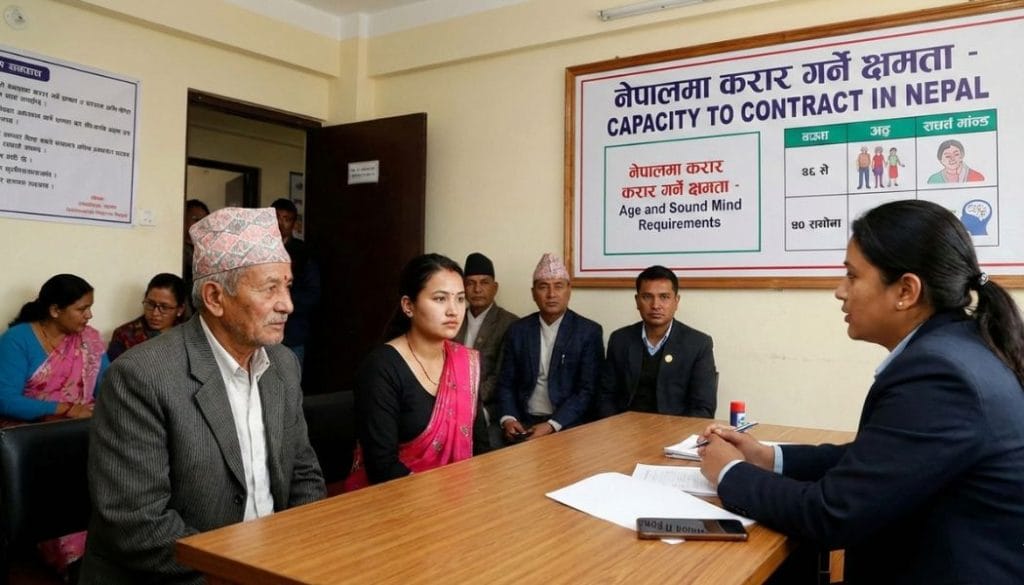
The principles governing capacity to contract Nepal have been established to balance commercial freedom with societal protection. Every person is presumed competent unless proven otherwise. However, three distinct categories of individuals are explicitly deemed incompetent to safeguard vulnerable parties and maintain transactional integrity.
Legal Framework: Muluki Civil Code 2074 Section 506
The primary legislation governing capacity to contract Nepal is found in Section 506 of the Muluki Civil Code 2074 (National Civil Code 2017). This provision states that every person shall be competent to conclude contracts except:
- One who is a minor
- One who is of unsound mind
- One who is disqualified by law
This section revolutionized Nepal’s contract law by replacing the previous Contract Act 2056 and aligning with international best practices. The Kathmandu legal community has widely adopted these standards in commercial and civil transactions.
| Category | Legal Status | Contract Validity |
|---|---|---|
| Major (18+ years) | Competent | Valid & enforceable |
| Minor (under 18) | Incompetent | Generally void |
| Person of unsound mind | Conditionally incompetent | Void when unsound |
| Person disqualified by law | Incompetent | Void or voidable |
| Guardian representation | Authorized | Valid for benefit |
Who is Competent to Contract in Nepal?
Capacity to contract Nepal is automatically granted to individuals meeting three essential requirements. These requirements must coexist at the time of contract formation for the agreement to be legally binding.
Legal Age Requirement in Nepal
The age of majority in Nepal is 18 years, established on August 17, 2018 (2075-05-01 B.S.). Any person who has completed 18 years is considered a major and possesses full contractual competence. This threshold was reduced from 21 years under previous legislation, reflecting modern societal needs and aligning with global standards.
Contracts entered into by majors in Kathmandu, Lalitpur, Pokhara, and other municipalities are presumed valid provided other contractual elements exist. However, age verification is recommended for significant transactions, particularly in property dealings and commercial agreements.
Sound Mind Requirement
Capacity to contract Nepal requires mental competence at the time of signing. A person is considered of sound mind when they can:
- Understand the purpose and nature of the contract
- Form rational judgment regarding its effects on their interests
- Comprehend the consequences of their actions
The test for soundness is factual and determined by courts based on evidence. Notably, a person usually of unsound mind but occasionally sound may contract during lucid intervals. Conversely, a normally sound person experiencing temporary unsoundness cannot contract during that period.
Not Disqualified by Law
Individuals must not be legally prohibited from contracting. Capacity to contract Nepal is denied to persons convicted of crimes involving moral turpitude, insolvents under the Insolvency Act 2063, and those restricted by specific statutes. Section 10 of the Amount and Governmental Contract Arrangement Act 2020 further restricts government contractors with criminal convictions.
Who Lacks Capacity to Contract in Nepal?
Understanding incompetence is crucial for risk mitigation in Nepalese business transactions. Three primary categories lack capacity to contract Nepal.
Minors Under 18 Years
Persons below 18 are minors and generally lack capacity to contract Nepal. Their agreements are void ab initio and cannot be enforced against them. Key implications include:
- Minors cannot be bound by contracts, even if beneficial
- Guardian consent does not validate minor’s direct contract
- Estoppel does not apply against minors
- Exceptions exist for contracts of necessity and beneficial nature executed by guardians
The Supreme Court of Nepal has consistently upheld this protection, referencing precedents that prioritize minor welfare over commercial interests.
Persons of Unsound Mind
Capacity to contract Nepal is denied to individuals unable to understand transaction consequences. Categories include:
- Personal insanity (idiocy)
- Lunacy or temporary insanity
- Drunkenness (while intoxicated)
- Hypnotism (under influence)
- Mental decay (old age complications)
Contracts made during unsoundness are void. However, guardians may contract on behalf of such persons for their benefit. The burden of proving unsoundness rests on the claimant, requiring medical evidence and witness testimony.
Persons Disqualified by Law
Capacity to contract Nepal is restricted for:
- Alien enemies (citizens of countries at war with Nepal)
- Convicted felons serving sentences
- Insolvents declared by courts
- Persons convicted of corruption, theft, fraud, or homicide
- Trustees who embezzled property
These disqualifications protect public interest and maintain contractual integrity. Restrictions may be temporary (until sentence completion) or permanent (for certain offenses).
Exceptions and Special Cases
Contracts with Minors
While minors lack capacity to contract Nepal, exceptions exist:
- Contracts for necessaries (food, shelter, education) are enforceable against minor’s property
- Beneficial contracts of employment may be validated
- Guardian-executed contracts for minor’s benefit are valid
Guardian Representation
Guardians and curators can exercise capacity to contract Nepal on behalf of incompetent persons. Under Section 506(3), they may conclude contracts benefiting the incapacitated individual. For immovable property transactions, court permission is mandatory.
Legal Persons
Companies, NGOs, and partnerships possess capacity to contract Nepal through authorized representatives. Directors or persons authorized by directors can bind legal entities, with authority granted through board resolutions or operational documents.
Practical Implications for Business in Kathmandu and Nepal
Capacity to contract Nepal verification is essential for:
- Real estate transactions: Age and mental competence must be verified
- Employment agreements: Minors require guardian consent for valid contracts
- Commercial partnerships: Director authority should be confirmed through company documents
- International contracts: Foreign party capacity must align with Nepali law
Businesses in Kathmandu Valley, Pokhara Metropolitan, and Biratnagar should implement verification procedures including citizenship certificate review, mental competence assessment for elderly parties, and legal person authorization confirmation.
Frequently Asked Questions
1. What is the legal age for capacity to contract Nepal?
The legal age is 18 years as per Muluki Civil Code 2074. Persons below this age are minors and lack contractual competence.
2. Can a 17-year-old sign a contract in Nepal?
No. A 17-year-old lacks capacity to contract Nepal. Their agreements are void unless made through a guardian for their benefit.
3. What makes a person of unsound mind in Nepal?
Inability to understand contract purpose, form rational judgments, or comprehend consequences. Medical evidence is required for legal determination.
4. Are contracts with minors ever valid?
Only when executed by guardians for the minor’s benefit or for necessaries. Direct minor contracts are void.
5. Can a drunk person enter into a contract?
No. Drunkenness constitutes temporary unsound mind, voiding capacity to contract Nepal during intoxication.
6. What happens if someone lacks capacity to contract Nepal?
The contract is void or voidable and cannot be enforced against the incompetent party.
7. Who can represent incompetent persons in contracts?
Guardians, curators, or legally authorized representatives can contract on behalf of incompetent individuals.
8. Is citizenship required for capacity to contract Nepal?
Not necessarily. Foreign nationals can contract in Nepal, but certain restrictions apply to foreign investment and property ownership.
9. Can companies have capacity to contract Nepal?
Yes. Legal persons contract through authorized directors or representatives as per company documents.
10. How is sound mind determined for contracts?
Through medical evaluation, witness testimony, and court assessment of understanding and judgment capacity at contract time.
11. Does insolvency affect capacity to contract Nepal?
Yes. Insolvent individuals are disqualified from contracting until rehabilitation is completed.
12. Can contracts be ratified after reaching majority?
No. Contracts made as minors cannot be ratified. Fresh contracts must be executed after turning 18.
13. What documents prove capacity to contract Nepal?
Citizenship certificate, passport, company registration documents, board resolutions, and court-appointed guardian letters.
14. Are online contracts subject to capacity rules?
Yes. Electronic contracts under the Electronic Transactions Act 2063 follow the same capacity to contract Nepal requirements.
15. How can Kathmandu businesses verify capacity?
By requesting citizenship certificates, conducting age verification, and obtaining legal person authorization documents before contracting.
16. What is the statute of limitations for capacity disputes?
Two years from discovery of incompetence under Muluki Civil Code provisions.
17. Can persons with mental illness contract during lucid intervals?
Yes. Capacity to contract Nepal exists during periods of soundness for those occasionally unsound.
18. Are foreign nationals restricted from contracting?
Generally no, except for property ownership and government contracts requiring special permissions.
19. What is quasi-competence in Nepal law?
Persons aged 10-18 have limited capacity requiring guardian consent for significant transactions.
20. How do courts in Patan handle capacity disputes?
Patan courts follow Kathmandu High Court precedents, requiring medical evidence and guardian documentation.
21. Can a guardian sell minor’s property?
Only with court permission for immovable property, but movable property can be sold for minor’s benefit.
22. What constitutes disqualified by law?
Conviction for corruption, theft, fraud, homicide, insolvency declaration, and alien enemy status.
23. Are verbal contracts affected by capacity rules?
Yes. All contracts, whether written or verbal, require capacity to contract Nepal for enforceability.
24. How does bankruptcy affect capacity?
Bankruptcy proceedings disqualify individuals from contracting until discharge is granted.
25. Can elderly persons with dementia contract?
Only during lucid intervals with medical evidence; otherwise, guardians must represent them.
Practical Steps for Kathmandu Residents
Step 1: Verify age through citizenship certificate before significant transactions
Step 2: Assess mental competence for elderly parties or those with known conditions
Step 3: Obtain guardian authorization for minor or incompetent party contracts
Step 4: Document authorization for legal person representatives
Step 5: Consult qualified lawyers in Kathmandu for complex transactions
Legal Disclaimer =
This guide is provided for general information only and does not constitute legal advice. Capacity to contract Nepal issues require case-specific analysis by qualified legal professionals. For personalized consultation regarding contract drafting, capacity verification, or dispute resolution in Kathmandu, Pokhara, or Biratnagar, contact experienced Nepal law firms.
Contact reputable legal service providers for contract review, capacity assessment, and documentation services. Professional legal guidance ensures compliance with Muluki Civil Code 2074 and protects your interests in all contractual matters.
References
Primary Legal Sources:
- Muluki Civil Code 2074 Section 506 – Nepal Law Commission
- Supreme Court of Nepal Precedents – Supreme Court Nepal
- Contract Act 2056 Historical Context – Ministry of Finance Nepal
Academic Authority:
- KSL Review: Contract Law Analysis – Kathmandu School of Law
- Nepal Law Journal: Contract Capacity – Nepal Law Review
Professional Legal Firms:
- Onesphere Law Associates Kathmandu – Kathmandu Legal Experts
- Law Imperial Nepal – Contract Enforcement Specialists
Government Resources:
- Office of Company Registrar Nepal – OCR Nepal
- Department of Industry Nepal – DOI Nepal
Note: All legal information was verified against current Nepal law as of January 2026. However, legal frameworks evolve. Consult practicing attorneys for updated advice specific to your situation in Kathmandu, Pokhara, Lalitpur, or other Nepal jurisdictions.