

Table of Contents
How Can a Foreign Investor Invest in Nepal? Understanding foreign investment in Nepal is essential for international investors seeking legal recognition and protection. This guide explains registration procedures, legal requirements, documentation, costs, and benefits under Nepal’s Foreign Investment and Technology Transfer Act for legitimate foreign investment recognition.
Steps to Invest in Nepal as a Foreign Investor
- Step 1: Determine the eligible sector and investment type
- Step 2: Register the company with the Office of Company Registrar
- Step 3: Obtain approval from the Department of Industry
- Step 4: Register foreign investment with the Department of Industry
- Step 5: Open a foreign currency account with Nepal Rastra Bank approval
- Step 6: Complete post-registration compliance and reporting requirements
What Is Foreign Investment in Nepal
Foreign investment in Nepal refers to capital, technology, or expertise brought into the country by foreign nationals, foreign companies, or non-resident Nepali citizens for commercial purposes. The investment must be registered with the Department of Industry under the Foreign Investment and Technology Transfer Act, 2019 to receive legal recognition and protection. Foreign investment can take various forms including equity participation, reinvestment of earnings, loans, or technology transfer agreements.
The Government of Nepal recognizes foreign investment as a crucial driver for economic development, job creation, and technology transfer. Foreign investors can establish wholly foreign-owned enterprises or joint ventures with Nepali partners depending on the sector. The legal framework provides specific rights, protections, and facilities to recognized foreign investors including repatriation of profits, capital, and access to various incentives.
Recognition as foreign investment is important because it grants investors legal protection under bilateral investment treaties, access to dispute resolution mechanisms, and eligibility for various government incentives. Without proper registration and recognition, foreign capital may not receive these protections and benefits. The Department of Industry serves as the primary regulatory authority for approving, monitoring, and facilitating foreign investment in Nepal.
Where to Register Foreign Investment in Nepal
Foreign investment registration in Nepal is conducted at the Department of Industry, which operates under the Ministry of Industry, Commerce and Supplies. The Department of Industry is located in Kathmandu and serves as the single-window facility for foreign investment approval and registration. The office handles all applications for foreign investment approval, technology transfer agreements, and provides necessary certifications for recognized foreign investments.
The Department of Industry maintains an online portal where investors can submit applications, track their application status, and access relevant information about investment procedures. Physical submission of documents is also accepted at the Department’s office in Tripureshwor, Kathmandu. Regional offices may assist with preliminary information, but final approval and registration occur at the central office in Kathmandu.
Before approaching the Department of Industry, foreign investors must first register their company with the Office of Company Registrar if establishing a new entity. For investment in existing companies, the company must be registered under the Companies Act, 2006. The Department of Industry website provides detailed guidelines, application forms, and sector-specific requirements for foreign investors.
Official Portal: Department of Industry, Nepal
What Laws Govern Foreign Investment in Nepal
Foreign investment in Nepal is regulated by a comprehensive legal framework designed to facilitate, protect, and monitor foreign capital inflows. The primary legislation governing foreign investment provides clear guidelines on eligible sectors, approval procedures, investor rights, and obligations.
Key laws and regulations include:
- Foreign Investment and Technology Transfer Act, 2019 (FITTA)
- Foreign Investment and Technology Transfer Rules, 2020
- Industrial Enterprises Act, 2020
- Companies Act, 2006
- Nepal Rastra Bank Act, 2002
- Foreign Exchange (Regulation) Act, 1962
- Income Tax Act, 2002
- Labor Act, 2017
- Special Economic Zone Act, 2016
- Public Private Partnership and Investment Act, 2019
- Bilateral Investment Promotion and Protection Agreements (BIPPAs)
- Double Taxation Avoidance Agreements (DTAAs)
How to Register Foreign Investment company in Nepal
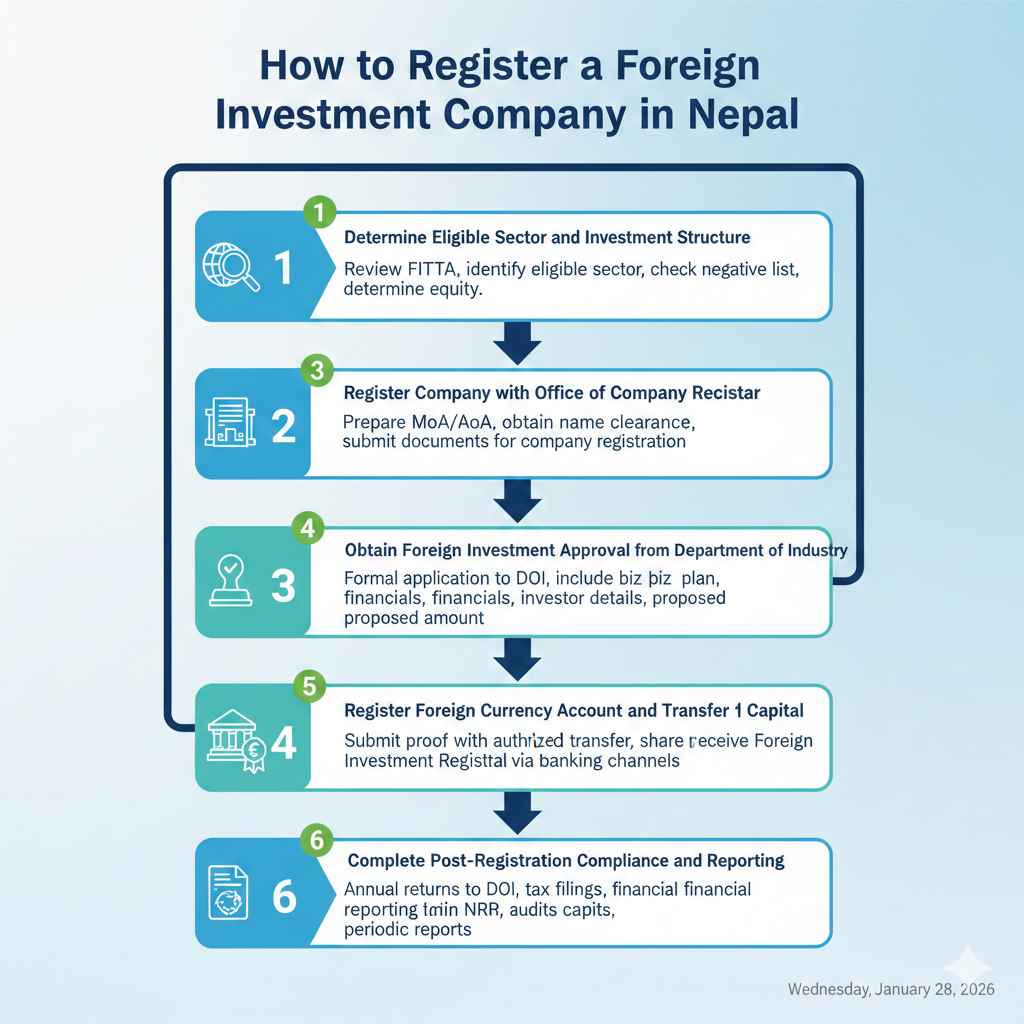
Step 1: Determine Eligible Sector and Investment Structure
Foreign investors must first identify the sector for investment and verify eligibility under Nepal’s foreign investment policy. Certain sectors are restricted or require special approval. Investors should review the Foreign Investment and Technology Transfer Act and consult the negative list to ensure their proposed business activity permits foreign participation and determine the maximum foreign equity allowed.
Step 2: Register Company with Office of Company Registrar
The investor must register a company under the Companies Act, 2006 with the Office of Company Registrar. This involves preparing the memorandum and articles of association, obtaining name clearance, and submitting registration documents. The company can be a private limited company, public limited company, or other permitted structure depending on the business nature and investment size.
Step 3: Obtain Foreign Investment Approval from Department of Industry
Submit a formal application to the Department of Industry for foreign investment approval. The application must include the company registration certificate, business plan, financial projections, details of foreign investors, proposed investment amount, and sector-specific documents. The Department reviews the application for completeness, sectoral compliance, and alignment with national policies before granting approval.
Step 4: Register Foreign Investment with Department of Industry
After receiving approval, the foreign investor must formally register the foreign investment by submitting proof of capital transfer, share certificates, and other required documents. The Department of Industry issues a Foreign Investment Registration Certificate upon successful verification. This certificate serves as official recognition of the investment and entitles the investor to legal protections and facilities under FITTA.
Step 5: Open Foreign Currency Account and Transfer Capital
The investor must open a foreign currency account with a commercial bank authorized by Nepal Rastra Bank. Foreign investment capital must be brought into Nepal through banking channels and converted at the prevailing exchange rate. Nepal Rastra Bank approval is required for opening foreign currency accounts. Proper documentation of capital transfer is essential for investment registration and future repatriation.
Step 6: Complete Post-Registration Compliance and Reporting
After registration, foreign investors must comply with ongoing reporting requirements including annual returns to the Department of Industry, tax filings with the Inland Revenue Department, and financial reporting to Nepal Rastra Bank. Investors must maintain proper books of accounts, conduct annual audits, and submit periodic reports on investment utilization, employment generation, and business operations as required by law.
What Documents Are Required for Foreign Investment Registration
The documentation requirements for foreign investment registration in Nepal are comprehensive to ensure transparency and legal compliance. The following documents must be submitted:
- Company registration certificate from the Office of Company Registrar
- Memorandum and articles of association of the company
- Board resolution approving foreign investment and authorizing signatories
- Passport copies and photographs of all foreign investors
- Citizenship certificates or incorporation documents of Nepali partners (if joint venture)
- Detailed business plan including project description and financial projections
- Proof of technical and financial capacity of foreign investors
- Bank guarantee or evidence of capital availability
- Technology transfer agreement (if applicable)
- Environmental impact assessment (for specified sectors)
- Sector-specific licenses or approvals from relevant authorities
- Tax clearance certificate from home country (if required)
- Power of attorney for authorized representatives in Nepal
- Share distribution details and shareholding pattern
- Bank certificate confirming foreign currency transfer
- Audited financial statements of foreign investing company
What Are the Sectoral Restrictions for Foreign Investment
Foreign investment in Nepal is permitted in most sectors with varying degrees of foreign equity participation. The government maintains a negative list specifying sectors where foreign investment is prohibited or restricted to protect national interests, security, and domestic industries.
Here is the organized table based on the data provided:
| Sector | Category | Foreign Equity Allowed | Special Conditions | Approval Authority |
|---|---|---|---|---|
| Manufacturing Industries | – | Up to 100% | No restrictions in most sub-sectors | Department of Industry |
| Tourism and Hospitality | – | Up to 100% | Permitted in hotels, restaurants, travel agencies | Department of Industry |
| Information Technology | – | Up to 100% | Encouraged sector with various incentives | Department of Industry |
| Agriculture and Livestock | – | Up to 100% | Restricted in certain traditional farming activities | Department of Industry + Ministry of Agriculture |
| Energy and Infrastructure | – | Up to 100% | Hydropower, solar, wind energy permitted | Department of Industry + Energy Ministry |
| Education Services | – | Up to 70% | Requires approval from Ministry of Education | Department of Industry + Education Ministry |
| Health Services | – | Up to 70% | Hospital and diagnostic centers permitted | Department of Industry + Health Ministry |
| Financial Services | – | Up to 51% | Banking and insurance have specific regulations | Nepal Rastra Bank + Insurance Board |
| Retail and Wholesale | Restricted | Foreign investment generally not permitted | – | Not Applicable |
| Cottage Industries | Restricted | Reserved for Nepali citizens | – | Not Applicable |
| Arms and Ammunition | Prohibited | – | National security concern | Not Applicable |
| Real Estate Business | Restricted | Foreign investment not permitted in land trading | – | Not Applicable |
How Long Does the Foreign Investment Registration Process Take
The timeline for foreign investment registration in Nepal varies depending on the complexity of the project and completeness of documentation.
Typical timeframes include:
- Company registration with Office of Company Registrar: 5-7 working days
- Foreign investment approval from Department of Industry: 7-15 working days
- Foreign investment registration certificate issuance: 3-5 working days after capital transfer
- Nepal Rastra Bank approval for foreign currency account: 7-10 working days
- Overall process completion: 4-8 weeks from initial application
- Sector-specific approvals may add 2-4 additional weeks
- Environmental clearance (if required): 30-60 days
- Special Economic Zone applications: 15-30 days
- Expedited processing available for priority sectors with complete documentation
What Are the Costs for Foreign Investment Registration
The costs associated with foreign investment registration in Nepal include government fees, professional service charges, and compliance expenses. The fee structure is designed to be reasonable and transparent.
Here is the table organized by Fee Type, Amount, and Remarks:
| Fee Type | Amount (NPR) | Remarks |
|---|---|---|
| Company Registration Fee | 5,000 – 50,000 | Based on authorized capital |
| Foreign Investment Approval Fee | 5,000 | One-time fee to Department of Industry |
| Foreign Investment Registration Fee | 10,000 | Upon capital transfer verification |
| Name Reservation Fee | 500 | For company name clearance |
| PAN Registration | 500 | Permanent Account Number |
| Tax Registration | 1,000 | VAT and other tax registrations |
| Nepal Rastra Bank Processing | 2,000 – 5,000 | For foreign currency account approval |
| Legal Documentation | 50,000 – 200,000 | Lawyer fees for document preparation |
| Translation and Notarization | 10,000 – 30,000 | For foreign documents |
| Sector-Specific Licenses | Varies | Depending on business type |
What Are Post-Registration Requirements for Foreign Investors
After obtaining foreign investment registration, investors must fulfill ongoing compliance obligations to maintain their legal status and operational permissions.
Post-registration requirements include:
- Submit annual returns to the Department of Industry by Shrawan end (mid-July)
- File annual tax returns with the Inland Revenue Department
- Conduct mandatory annual audit by registered chartered accountants
- Submit audited financial statements to Department of Industry
- Report any changes in shareholding structure within 35 days
- Obtain approval for additional foreign investment or capital increase
- Maintain proper books of accounts as per Nepal Accounting Standards
- Comply with labor laws including minimum wage and social security contributions
- Renew business licenses and sector-specific permits annually
- Submit foreign exchange reports to Nepal Rastra Bank quarterly
- Obtain approval for profit and capital repatriation
- Maintain valid work permits and visas for foreign employees
- Comply with environmental regulations and submit periodic reports
- Participate in Department of Industry surveys and data collection
- Notify authorities of any change in registered office address
What Types of Foreign Investment Are Recognized in Nepal
Foreign investment in Nepal can take various forms depending on the investor’s objectives, sector requirements, and partnership arrangements. The Foreign Investment and Technology Transfer Act recognizes multiple investment modalities.
Here is the table organized based on the Investment Type details provided:
| Investment Type | Description | Minimum Investment | Key Features |
|---|---|---|---|
| Equity Investment | Direct purchase of shares in Nepali company | NPR 50 million (general) / NPR 20 million (certain sectors) | Most common form; provides ownership rights |
| Reinvestment of Earnings | Profits reinvested in the same or different business | No minimum | Treated as fresh foreign investment |
| Loan Investment | Foreign loan to Nepali enterprise | As per agreement | Subject to Nepal Rastra Bank approval |
| Technology Transfer | Transfer of technical know-how, patents, trademarks | No minimum | Requires separate technology transfer agreement |
| Joint Venture | Partnership between foreign and Nepali investors | NPR 50 million | Combines local knowledge with foreign capital |
| Wholly Foreign-Owned | 100% foreign equity in permitted sectors | NPR 50 million | Full control but limited to open sectors |
| Portfolio Investment | Investment in securities through stock market | As per SEBON regulations | Subject to Securities Board regulations |
| Foreign Direct Investment (FDI) | Long-term investment with management control | NPR 50 million | Preferred for economic development |
What Benefits Does Foreign Investment Recognition Provide
Recognition as foreign investment in Nepal provides numerous legal protections, rights, and facilities that unregistered foreign capital does not enjoy. These benefits are designed to attract and protect genuine foreign investors.
Key benefits include:
- Legal protection under bilateral investment treaties and international agreements
- Right to repatriate profits, dividends, and capital after tax payment
- Access to foreign currency accounts for international transactions
- Eligibility for various tax holidays and exemptions under Industrial Enterprises Act
- Protection against nationalization except for public interest with compensation
- Right to sell shares and exit investment with proper procedures
- Access to one-stop service at Department of Industry for various approvals
- Eligibility for special economic zone benefits and facilities
- Priority in infrastructure development and utility connections
- Simplified visa and work permit procedures for foreign employees and dependents
- Access to dispute resolution mechanisms including international arbitration
- Exemption from certain local content requirements in specified sectors
- Eligibility for government incentives in priority and export-oriented industries
- Protection of intellectual property rights and technology
- Access to industrial land and facilities in industrial estates
- Reduced customs duties on machinery and raw materials in certain sectors
FAQs
-
1. What is the minimum investment required for foreign investment in Nepal?
The minimum foreign investment is NPR 50 million for most sectors. However, certain sectors like energy-based industries, tourism in remote areas, and export-oriented industries require only NPR 20 million. Technology transfer agreements have no minimum investment requirement.
-
2. Can foreign investors own 100% equity in Nepal?
Yes, foreign investors can own 100% equity in most sectors including manufacturing, tourism, IT, and energy. However, sectors like education, health, and financial services have restrictions. Retail trading and cottage industries are generally prohibited for foreign investment.
-
3. How can foreign investors repatriate profits from Nepal?
Step 1: Pay all applicable taxes on profits
Step 2: Obtain tax clearance certificate from Inland Revenue Department
Step 3: Submit repatriation application to Nepal Rastra Bank
Step 4: Provide audited financial statements and board resolution
Step 5: Receive approval and transfer funds through banking channels -
4. Is foreign investment approval required for all sectors?
Yes, all foreign investment must be approved and registered with the Department of Industry regardless of sector. Even 100% permitted sectors require formal registration to receive legal recognition and protection under the Foreign Investment and Technology Transfer Act.
-
5. What documents do foreign investors need from their home country?
Valid passport copies
Company incorporation certificate (if corporate investor)
Audited financial statements
Tax clearance certificate
Bank solvency certificate -
6. Can non-resident Nepalis invest as foreign investors?
Yes, non-resident Nepalis can invest as foreign investors if they bring capital from abroad in convertible foreign currency. They receive the same treatment as other foreign investors including repatriation rights. However, they may also choose to invest as Nepali citizens in restricted sectors.
-
7. What happens if foreign investment is not registered?
Unregistered foreign investment does not receive legal protection, cannot repatriate profits or capital, is ineligible for tax incentives, may face penalties and legal action, and cannot access dispute resolution mechanisms. Registration is mandatory for all foreign investment in Nepal.
-
8. How long is the foreign investment registration certificate valid?
The foreign investment registration certificate remains valid as long as the company operates legally and complies with reporting requirements. There is no expiry date, but investors must submit annual returns and maintain compliance with all applicable laws and regulations.
Our firm stands as Nepal’s leading legal service provider for foreign investment matters, offering comprehensive assistance from initial consultation through post-registration compliance. With extensive experience in investment law, company registration, and regulatory approvals, we provide end-to-end solutions for foreign investors seeking to establish and operate businesses in Nepal. Our expert team ensures smooth navigation of legal requirements, timely approvals, and full compliance with Nepal’s foreign investment regulations, making us the No.1 choice for international investors entering the Nepali market.