
Table of Contents
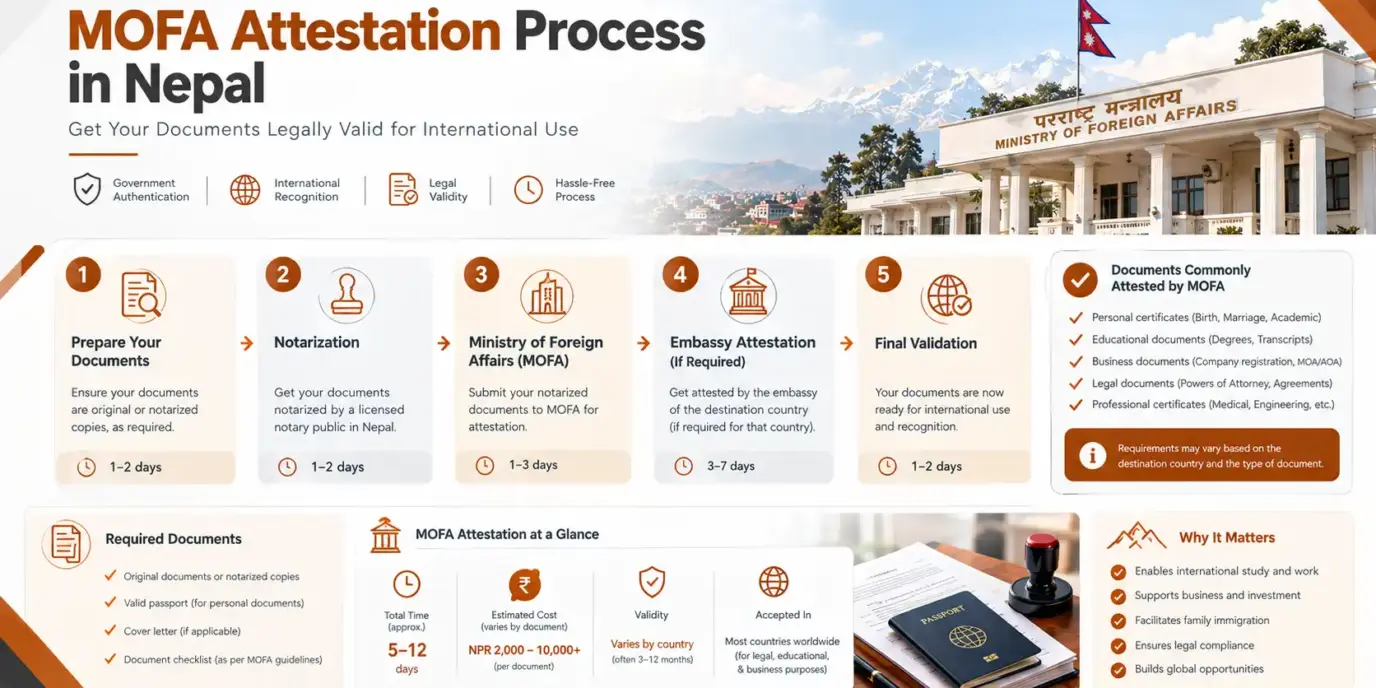
The MOFA attestation process in Nepal is the official procedure through which documents issued in Nepal are authenticated for international use. When a document is required to be presented to foreign authorities, educational institutions, or employers, its authenticity must be verified by the Ministry of Foreign Affairs. Consequently, this process is regarded as essential for anyone seeking to use Nepali documents outside the country.
Furthermore, Nepal is not a signatory to the 1961 Hague Apostille Convention. Therefore, the apostille system is not available. Instead, the MOFA attestation process in Nepal serves as the recognized alternative. Under this system, documents are verified through a chain of authentication that includes notarization, line-ministry verification, and final attestation by the Department of Consular Services.
In this guide, the entire procedure is explained in a step-by-step manner. Moreover, the documents required, the applicable fees, and the expected timeline are outlined in detail.
What Is the MOFA Attestation Process in Nepal?
The MOFA attestation process in Nepal is defined as the multi-stage verification procedure administered by the Department of Consular Services, Ministry of Foreign Affairs. When documents are attested by MOFA, the signatures and seals of the issuing authorities are verified. However, it is important to note that MOFA does not certify the factual accuracy of the document’s content. Instead, the authenticity of the signatory’s authority is confirmed.
Additionally, the attestation is carried out at the Department of Consular Services, located at Tripureshwor, Kathmandu. An online appointment system has been introduced, and applications can be pre-booked through the portal at demand.nepalconsular.gov.np. A toll-free enquiry line, 1152, is also maintained for applicant assistance.
Notably, the MOFA attestation process in Nepal is often followed by embassy legalization. Many destination countries require their own embassy or consulate in Kathmandu to affix a final attestation stamp before the document is accepted.
Why the MOFA Attestation Process in Nepal Is Required
The importance of completing the MOFA attestation process in Nepal cannot be overstated. When Nepali documents are presented abroad without proper attestation, they are frequently rejected by foreign authorities. This rejection can result in visa denials, delayed employment offers, and failed academic admissions.
Moreover, the attestation serves as a safeguard against document fraud. By verifying the chain of custody from the original issuer to the foreign recipient, the integrity of the document is preserved. Hence, the MOFA attestation process in Nepal is regarded as a critical component of international document authentication.
In addition, countries such as the United Arab Emirates, Qatar, Saudi Arabia, Kuwait, Oman, Malaysia, South Korea, Japan, and China are known to require MOFA attestation as a prerequisite for visa and residency applications.
Legal Framework Governing MOFA Attestation in Nepal
The MOFA attestation process in Nepal is supported by the following legal instruments:
| Legal Instrument | Relevance to MOFA Attestation |
|---|---|
| Notary Public Act, 2063 (2006) | Governs the licensing and acts of notary publics who perform initial document certification |
| Notary Public Rules, 2063 | Regulates notary seals, registers, and fee ceilings under Rule 23 |
| Civil Registration Act, 2033 | Governs birth, marriage, and death certificates issued by local authorities |
| Education Regulation | Provides the framework for academic document verification |
| Companies Act, 2063 (2006) | Governs corporate documents such as MOA, AOA, and board resolutions |
| Ministerial Practice at MOFA | Internal directives of the Department of Consular Services administering the attestation procedure |
Moreover, the general executive power of the Ministry of Foreign Affairs is exercised through the Department of Consular Services. The legal basis for this practice is derived from Nepal’s diplomatic and consular traditions, supported by internal departmental directives.
Types of Documents Requiring MOFA Attestation
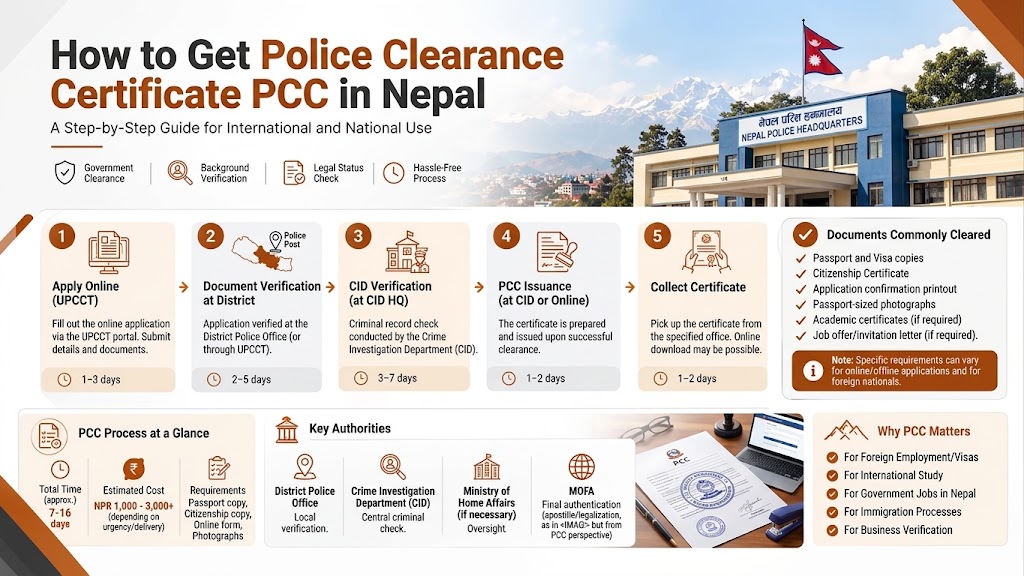
The MOFA attestation process in Nepal applies to a broad range of document categories. These are generally classified as follows:
| Document Category | Examples | Issuing Authority |
|---|---|---|
| Educational Documents | Degrees, diplomas, transcripts, mark sheets, provisional certificates, SLC/SEE certificates | Universities, Office of the Controller of Examinations, Tribhuvan University, Kathmandu University |
| Personal Documents | Birth certificates, marriage certificates, death certificates, migration certificates, citizenship certificates | Ward Office, Municipality, District Administration Office |
| Legal Documents | Power of attorney, affidavits, court orders, contracts, police clearance certificates | District Court, Nepal Police, licensed notary public |
| Commercial Documents | Certificate of incorporation, MOA, AOA, audit reports, business licenses, invoices, certificates of origin | Office of the Company Registrar, Inland Revenue Department |
| Medical Documents | Medical certificates, test results, fitness certificates | Registered medical institutions, Ministry of Health |
Furthermore, it is important to note that documents not written in English or Nepali are required to be translated by a licensed notary public before the MOFA stage is initiated.
Step-by-Step MOFA Attestation Process in Nepal
The following steps are required to be followed in sequential order to ensure a valid and internationally recognized attestation.
Step 1: Document Collection and Initial Verification
The original document is required to be collected from the issuing authority. For educational documents, this involves obtaining the original degree and transcript from the university registrar. For personal documents, the original certificate must be obtained from the Ward Office or Municipality.
Moreover, it is strongly advised that the document be examined for completeness. Any damage, alteration, or missing information may result in rejection at subsequent stages.
Step 2: Notarization by a Licensed Notary Public
Under the Notary Public Act, 2063, documents are required to be notarized by a notary public licensed by the Nepal Notary Public Council. The notary performs one or more of the following acts:
- Certification of true copies against originals
- Attestation of signatures
- Certification of translations
- Execution of affidavits and sworn statements
Additionally, Rule 16 of the Notary Public Rules governs the notary seal and signature. Rule 17 mandates that a register of notarial acts be maintained for 15 years. Rule 23 caps the notary fee at NPR 200 per act.
Consequently, the notarization stage is regarded as the foundation of the attestation chain. Without proper notarization, line-ministry verification may be denied.
Step 3: Certified Translation (If Required)
When the original document is not in English or Nepali, a certified translation is required. The translation must be performed by a person holding a notary license under Section 4 of the Notary Public Act, 2063.
Furthermore, the translator is required to certify that the English version is a true and faithful rendering of the original. The notary then attests the translator’s certification. It is important to note that the notary does not certify the factual accuracy of the underlying document, only that the translation matches the original.
Step 4: Line-Ministry Verification
Before submission to MOFA, the document is required to be verified by the relevant line ministry or department. The specific authority depends on the document type:
| Document Type | Verifying Authority | Procedure |
|---|---|---|
| SLC/SEE, Plus Two | Office of the Controller of Examinations, then Ministry of Education, Science & Technology | Verification letter signed and stamped by the registrar, followed by MoEST counter-stamp |
| Bachelor’s, Master’s, PhD | Awarding university registrar, then Ministry of Education, Science & Technology | University verification letter, followed by MoEST verification |
| Birth, Marriage, Death, Migration | Ward Office, Municipality, then Local Registration Section under Ministry of Home Affairs | Counter-verification by municipality, followed by Ministry of Home Affairs stamp |
| Police Clearance | Nepal Police headquarters | Official police report with seal and signature |
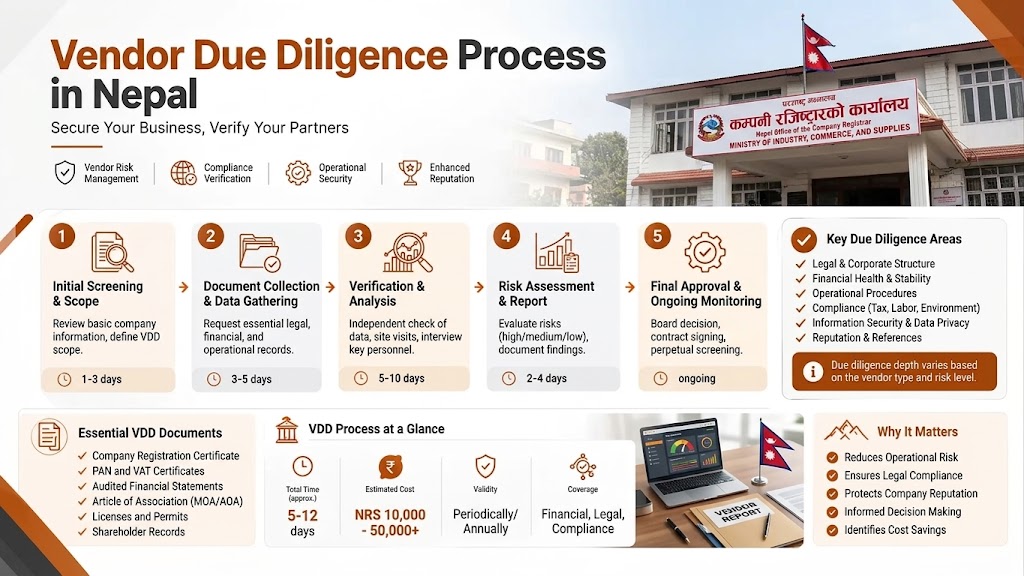
| Corporate Documents | Office of the Company Registrar, Inland Revenue Department | Verification of company records and tax status |
Moreover, the line ministry verifies the signature and seal of the original issuing authority. This verification is a prerequisite for MOFA acceptance.
Step 5: MOFA Consular Attestation
Once the line-ministry stamp is in place, the document is submitted to the Department of Consular Services, Ministry of Foreign Affairs, Tripureshwor, Kathmandu. An online appointment is required to be booked in advance through demand.nepalconsular.gov.np.
The following documents are required to be submitted at the MOFA counter:
- Completed attestation application form
- Original document and one clear photocopy
- Copy of the applicant’s Nepali citizenship certificate
- Copy of the applicant’s valid passport
- Recent passport-sized photograph (if required)
- Proof of government fee payment
Subsequently, MOFA officials verify the signature and seal of the line-ministry officer. Upon satisfactory verification, the MOFA attestation stamp and signature are affixed. The processing time at this stage is typically 1 to 3 working days.
Step 6: Destination Embassy Legalization (If Required)
For many countries, additional legalization by the destination country’s embassy or consulate in Kathmandu is required. This requirement is particularly common for:
- Gulf states: UAE, Qatar, Saudi Arabia, Kuwait, Oman, Bahrain
- East Asian countries: Malaysia, South Korea, Japan, China
- Certain African and European destinations
Furthermore, some Hague Convention member states may accept MOFA-attested documents with a certified translation without requiring an embassy stamp. However, confirmation from the specific embassy is strongly advised before submission.
If the destination country does not maintain an embassy in Kathmandu, documents are often routed through New Delhi or accepted with MOFA attestation plus sworn translation.
Documents Required for MOFA Attestation in Nepal
The following documents are required to be prepared and submitted during the MOFA attestation process in Nepal:
| Document | Purpose | Quantity |
|---|---|---|
| Completed Application Form | Formal request for attestation | 1 original |
| Original Document Requiring Attestation | Primary document for authentication | 1 original |
| Photocopy of the Original Document | Counterpart for MOFA records | 1 copy |
| Citizenship Certificate Copy | Identity verification of the applicant | 1 copy |
| Valid Passport Copy | Proof of nationality and travel status | 1 copy |
| Passport-Sized Photograph | Applicant identification (if required) | 2 copies |
| Payment Receipt | Evidence of government fee settlement | 1 copy |
| Line-Ministry Verification Stamp | Pre-requisite authentication | Affixed on original |
| Certified Translation (if applicable) | English or Nepali version of foreign-language documents | 1 original + 1 copy |
Moreover, for commercial documents, additional items such as board resolutions, power of attorney, and company registration certificates may be required by the destination embassy.
Fees and Timeline for MOFA Attestation
The MOFA attestation process in Nepal is generally completed within a predictable timeframe when all documents are in order.
| Phase | Estimated Duration |
|---|---|
| Document Collection and Notarization | 1–2 days |
| Certified Translation (if required) | 1–2 days |
| Line-Ministry Verification | 2–5 days |
| MOFA Consular Attestation | 1–3 working days |
| Destination Embassy Legalization | 3–7 working days (if applicable) |
Total Estimated Time: 7 to 15 working days
The costs associated with the process are outlined below:
| Cost Component | Approximate Amount (NPR) |
|---|---|
| Notary Fee (per act, capped by Rule 23) | Up to NPR 200 |
| Translation Fee (if required) | Varies by document length and complexity |
| Line-Ministry Verification Fee | Varies by department |
| MOFA Attestation Fee (personal documents) | Approximately NPR 500 per document |
| MOFA Attestation Fee (commercial documents) | Higher rates apply |
| Destination Embassy Legalization Fee | Varies by embassy (USD 50–100 typical) |
| Courier and Miscellaneous Charges | As applicable |
Furthermore, it is important to note that government fees are subject to revision by executive notification. Therefore, applicants are advised to confirm current rates at demand.nepalconsular.gov.np or by calling the toll-free line 1152.
Online Appointment System for MOFA Attestation
The Department of Consular Services has introduced an online booking system to streamline the MOFA attestation process in Nepal. Applicants are required to visit demand.nepalconsular.gov.np to book a time slot.
Moreover, while online booking reduces counter waiting time, the final submission of original documents is still required to be made in person. The portal allows applicants to pre-submit details, select preferred appointment dates, and receive confirmation via email or SMS.
In addition, the toll-free enquiry line 1152 is operated by the Department of Consular Services to assist applicants with procedural queries.
Common Mistakes to Avoid During MOFA Attestation
Several errors are frequently observed during the MOFA attestation process in Nepal. These mistakes are required to be avoided to prevent delays and rejection:
- Submitting documents that are damaged, altered, or incomplete
- Failing to obtain line-ministry verification before approaching MOFA
- Using an unlicensed notary public for initial certification
- Neglecting to translate documents not written in English or Nepali
- Booking an online appointment without preparing all required documents
- Assuming MOFA attestation alone is sufficient without checking embassy requirements
- Submitting photocopies instead of original documents at the MOFA counter
- Overlooking fee payment requirements before the appointment date
- Failing to verify the current fee structure before submission
- Delaying the process during peak migration season (May–August)
Moreover, it is strongly advised that applicants begin the process well in advance of their international deadlines. Peak seasons are known to cause extended processing times at both line ministries and MOFA.
MOFA Attestation vs. Apostille: Key Differences
Since Nepal is not a contracting state to the Hague Apostille Convention, the following distinctions are important:
| Aspect | MOFA Attestation (Nepal) | Apostille (Hague Countries) |
|---|---|---|
| Legal Basis | Consular legalisation chain | 1961 Hague Convention |
| Number of Steps | Multiple: notary, line ministry, MOFA, embassy | Single-step by designated Competent Authority |
| MOFA Role | Verifies line-ministry signatures and seals | Would issue apostille sticker if Nepal were a member |
| Embassy Requirement | Often required for final acceptance | Not required between Hague member states |
| Timeline | 7–15 working days | Typically 1–3 working days |
| Cost | Multiple fees across stages | Single government fee |
Furthermore, if Nepal accedes to the Hague Apostille Convention in the future, the multi-step chain may be replaced by a simplified apostille process for use in member states. Until that occurs, the MOFA attestation process in Nepal remains the only lawful route.
Post-Attestation Considerations
After the MOFA attestation process in Nepal is completed, several considerations are required to be kept in mind:
- Attested documents should be photocopied and stored securely before submission to foreign authorities
- The validity of attestation is generally tied to the validity of the underlying document
- Some countries require attested documents to be submitted within a specific timeframe
- Multiple copies should be attested simultaneously if several submissions are anticipated
- The destination embassy’s specific requirements must be verified before final submission
Moreover, it is recommended that applicants maintain a record of all fee receipts and appointment confirmations for future references.
Why Choose Corporatebizlegal Pvt Ltd for MOFA Attestation Services?
At Corporatebizlegal Pvt Ltd, the MOFA attestation process in Nepal is managed with meticulous attention to procedural accuracy. Our team possesses extensive experience in document authentication, notarization, and liaison with government authorities.
Moreover, our services include:
- Document screening and eligibility verification
- Licensed notary public certification and certified translation
- Coordination with line ministries for pre-MOFA verification
- Online appointment booking at demand.nepalconsular.gov.np
- Submission and follow-up at the Department of Consular Services
- Destination embassy legalization coordination
- End-to-end tracking and secure document delivery
Call to Action: If you require MOFA attestation for documents intended for international use, contact Corporatebizlegal Pvt Ltd today. Our experienced professionals will guide you through every step of the process with precision and care. Schedule your confidential consultation now.
Disclaimer
The information provided in this guide is intended for general informational and educational purposes only. It does not constitute legal advice, nor does it create an attorney-client relationship. Government fees, procedures, and timelines referenced herein are subject to amendment, and individual circumstances may vary. Readers are strongly advised to verify current requirements with the Department of Consular Services, Ministry of Foreign Affairs, before submitting documents. Corporatebizlegal Pvt Ltd disclaims all liability for any actions taken based on the contents of this publication.
References
For further reading and verification of the legal framework discussed in this guide, the following authoritative sources are referenced:
- Ministry of Foreign Affairs, Nepal – Official government portal for foreign policy and consular services.
- Department of Consular Services, MOFA – Online appointment and application portal for MOFA attestation services.
- Ministry of Education, Science & Technology, Nepal – Authority responsible for verification of academic and educational documents.
- Ministry of Home Affairs, Nepal – Governing body for civil registration, citizenship, and local administration verification.
- Office of the Company Registrar, Nepal – Official source for corporate document verification and company registration records.
- Nepal Police – Authority issuing police clearance certificates and criminal record verification.
- Nepal Notary Public Council – Regulatory body governing licensed notary publics and notarial acts in Nepal.
- Hague Conference on Private International Law – International authority on the Apostille Convention and cross-border document legalization standards.
- Embassy of Nepal, Washington DC – Diplomatic mission providing attestation guidelines for Nepali documents used in the United States.
- World Bank Doing Business Report – Nepal – International benchmark for business regulations and administrative procedures in Nepal.
End of Guide
This content has been prepared by Corporatebizlegal Pvt Ltd and is protected under applicable copyright laws. Unauthorized reproduction is prohibited.
Frequently Asked Questions
What is the MOFA attestation process in Nepal?
The MOFA attestation process in Nepal is the official multi-stage procedure through which documents issued in Nepal are authenticated by the Ministry of Foreign Affairs for international use. It involves notarization, line-ministry verification, and final attestation by the Department of Consular Services at Tripureshwor, Kathmandu
How long does the MOFA attestation process take in Nepal?
The standard MOFA attestation process in Nepal takes approximately 7 to 15 working days from start to finish. MOFA itself typically completes its attestation within 1 to 3 working days of submission. Academic documents and police clearance certificates may take longer during peak travel seasons.
What documents are required for MOFA attestation?
The required documents include the original document and a photocopy, a completed application form, copies of citizenship and passport, a payment receipt, and the line-ministry verification stamp. Certified translation is required for documents not in English or Nepali.
Is MOFA attestation valid worldwide?
MOFA-attested documents are generally accepted worldwide. However, many destination countries require additional legalization by their own embassy or consulate. It is advised to confirm specific requirements with the destination embassy before submission.
What is the difference between MOFA attestation and apostille?
MOFA attestation is Nepal's alternative to apostille, as Nepal is not a signatory to the Hague Apostille Convention. The MOFA attestation process in Nepal involves multiple verification steps, whereas apostille is a single-step process used by Hague member countries.
How much does MOFA attestation cost in Nepal?
Indicative fees are approximately NPR 500 per personal document at the MOFA counter. Commercial documents are charged at higher rates. Notary fees are capped at NPR 200 per act under Rule 23 of the Notary Public Rules, 2063. Translation and embassy fees are charged separately.
Which line ministry verifies educational documents?
Educational documents are verified by the Ministry of Education, Science & Technology (MoEST). For SLC/SEE and Plus Two certificates, verification is first done by the Office of the Controller of Examinations. For university degrees, the awarding university registrar's verification is required first.
Which line ministry verifies birth and marriage certificates?
Birth, marriage, migration, and death certificates are verified by the Ward Office and Municipality, followed by counter-verification by the Local Registration Section under the Ministry of Home Affairs before MOFA attestation.
Do I need embassy legalization after MOFA attestation?
Yes, for many countries. Gulf states, Malaysia, South Korea, Japan, and China typically require their embassy's legalization after MOFA attestation. Some European countries may accept MOFA attestation with certified translation alone. Always confirm with the specific destination embassy.
Was this article helpful?
Let us know what you think!