
Table of Contents
Nepal FDI Approval Timeline: Comprehensive Process Guide for Foreign Investors 2026
Introduction
Understanding the Nepal FDI approval timeline is crucial for foreign investors planning to establish a business presence in this emerging South Asian market. With regulatory frameworks governed by the Foreign Investment and Technology Transfer Act 2019 (FITTA) and the Industrial Enterprises Act 2020 (IEA), navigating the approval process requires strategic planning and realistic timeline expectations. This comprehensive guide provides detailed insights into the actual timeframes for each step of the foreign investment approval process in Nepal, addressing common challenges and offering practical solutions to streamline your investment journey. Whether you’re considering a 100% foreign-owned enterprise or a joint venture, this resource will help you plan your investment timeline with precision and avoid common pitfalls that delay approvals.
Understanding Nepal’s FDI Regulatory Framework
Before diving into the specific Nepal FDI approval timeline, it’s essential to understand the regulatory landscape that governs foreign investments. The process is primarily regulated under:
- Foreign Investment and Technology Transfer Act 2019 (FITTA): The principal legislation governing foreign investments
- Foreign Investment and Technology Transfer Rule 2020: Implementing regulations of FITTA
- Industrial Enterprises Act 2020 (IEA): Governs industrial enterprises including those with foreign investment
- Foreign Exchange Regulation Act 1962 (FERA): Regulates foreign exchange transactions
- Public Private Partnership and Investment Act 2019: Relevant for larger investment projects
The approval process varies depending on the investment amount, with the Department of Industry (DOI) handling investments up to NPR 6 billion and the Investment Board of Nepal (IBN) managing larger projects exceeding NPR 6 billion or hydropower projects above 200 MW.
Detailed Nepal FDI Approval Timeline Breakdown
Unlike the generic “3 to 5 months” estimate commonly cited, our research and experience reveal a more nuanced Nepal FDI approval timeline with specific timeframes for each step. The following table provides a realistic breakdown of processing times at each stage:
| Step | Process | Minimum Time | Maximum Time | Average Time | Common Delay Factors |
|---|---|---|---|---|---|
| 1 | Document Preparation & Notarization | 5-7 days | 2-3 weeks | 10 days | Document authentication, translation needs |
| 2 | Initial Application Submission to DOI/IBN | 1-2 days | 1 week | 3 days | Application completeness, appointment availability |
| 3 | Initial Review by DOI/IBN | 1 week | 3 weeks | 2 weeks | Application backlog, additional information requests |
| 4 | Inter-agency Consultations (if required) | 2 weeks | 6 weeks | 4 weeks | Sector-specific approvals, security clearances |
| 5 | Foreign Investment Approval Issuance | 3-5 days | 2 weeks | 1 week | Administrative processing, approval hierarchy |
| 6 | Company Registration at OCR | 3-5 days | 2 weeks | 1 week | Name availability, document verification |
| 7 | Tax Registration (PAN/VAT) | 2-3 days | 1 week | 4 days | System issues, additional documentation |
| 8 | Local Business Registration | 2-5 days | 2 weeks | 1 week | Local office procedures, political events |
| 9 | Industry Registration at DOI | 1-2 weeks | 4 weeks | 3 weeks | Inspection requirements, documentation issues |
| 10 | Bank Account Opening & NRB Recording | 1-2 weeks | 3 weeks | 2 weeks | Due diligence procedures, compliance checks |
Total Timeline Range: 8 weeks to 20 weeks (2-5 months)
This detailed breakdown reveals that the actual Nepal FDI approval timeline can vary significantly based on multiple factors, with sector-specific requirements and document preparation often creating the most substantial delays.
Step-by-Step FDI Approval Process with Timeline Insights
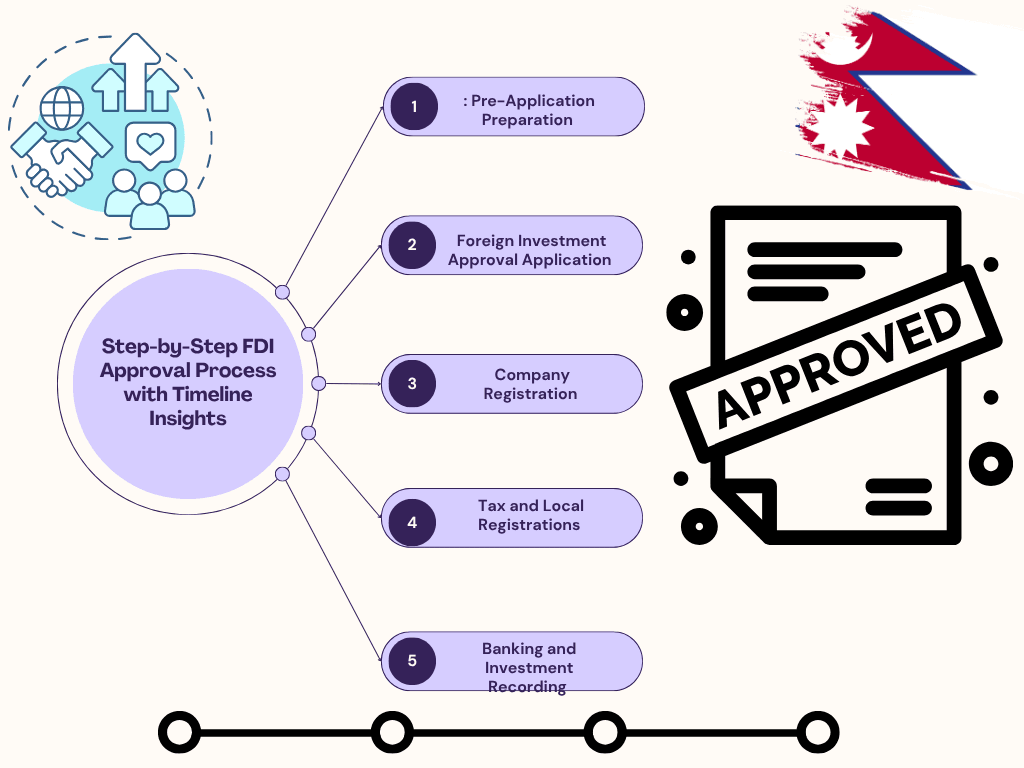
Step 1: Pre-Application Preparation (1-3 weeks)
Before submitting your FDI application, thorough preparation is essential for minimizing delays in the Nepal FDI approval timeline. This phase includes:
- Business Structure Decision: Determining whether to establish a private limited company, public company, or branch office
- Sector Verification: Confirming your business sector is open to foreign investment under Nepal’s negative list
- Document Collection: Gathering all required documents including incorporation certificates, passports, financial statements, and project reports
- Local Partner Engagement: If applicable, identifying and finalizing agreements with Nepali partners
Pro Tip: Begin document authentication and notarization processes immediately, as obtaining apostilles or consular legalization from your home country can take 2-3 weeks.
Step 2: Foreign Investment Approval Application (2-4 weeks)
The core of the Nepal FDI approval timeline begins with submitting your application to the appropriate authority:
- For investments ≤ NPR 6 billion: Department of Industry (DOI)
- For investments > NPR 6 billion: Investment Board of Nepal (IBN)
The application must include:
- Completed application form
- Project report with detailed business plan
- Investment schedule and financial projections
- Documents of the investing company/individual
- Joint venture agreement (if applicable)
Timeline Insight: The initial review typically takes 1-2 weeks, followed by a detailed examination period of 1-2 additional weeks. Applications requiring inter-agency consultations (for regulated sectors) may extend this phase by 2-4 weeks.
Step 3: Company Registration (1-2 weeks)
After receiving foreign investment approval, you must register your company with the Office of the Company Registrar (OCR):
- Name reservation and approval
- Submission of incorporation documents
- Memorandum and Articles of Association filing
- Certificate of incorporation issuance
Timeline Accelerator: Using the OCR’s online registration system can reduce this step to 5-7 days compared to the manual process which typically takes 10-14 days.
Step 4: Tax and Local Registrations (1-2 weeks)
Concurrent with company registration, you must complete:
- PAN (Permanent Account Number) registration with the Inland Revenue Department
- VAT registration (if applicable)
- Local business registration at the respective ward office
- Industry registration with the Department of Industry
Common Delay: Ward office registrations can be unpredictable, with processing times varying from 2 days to 2 weeks depending on local administrative efficiency and political factors.
Step 5: Banking and Investment Recording (1-3 weeks)
The final phase of the Nepal FDI approval timeline involves:
- Opening a corporate bank account in Nepal
- Recording the foreign investment with Nepal Rastra Bank (NRB)
- Depositing the initial investment amount as per the approved schedule
Recent Update: As of 2024, the NRB has streamlined the investment recording process through their online portal, reducing this step from 2-3 weeks to 1-2 weeks in most cases.
Factors Influencing the Nepal FDI Approval Timeline
Several critical factors can significantly impact your Nepal FDI approval timeline:
1. Sector-Specific Requirements
Regulated industries require additional approvals from sector-specific regulators:
| Sector | Additional Approval Required | Average Additional Time |
|---|---|---|
| Banking & Finance | Nepal Rastra Bank | 4-6 weeks |
| Insurance | Nepal Insurance Authority | 3-5 weeks |
| Telecommunications | Nepal Telecommunication Authority | 4-8 weeks |
| Hydropower | Department of Electricity Development | 6-10 weeks |
| Tourism & Trekking | Ministry of Tourism | 2-4 weeks |
| Education | Affiliated University/Concerned Authority | 3-6 weeks |
2. Investment Scale and Complexity
- Investments below NPR 50 million: Typically processed within 8-10 weeks
- Investments between NPR 50-500 million: Usually require 10-14 weeks
- Investments above NPR 500 million: May take 14-20 weeks due to additional scrutiny
3. Documentation Quality
Incomplete or improperly notarized documents are the primary cause of delays, potentially extending the Nepal FDI approval timeline by 2-6 weeks.
4. Political and Administrative Factors
- Government transitions and policy changes
- Staff shortages at regulatory agencies
- Holiday seasons (especially Dashain and Tihar festivals)
- Local elections or administrative disruptions
Recent Updates Affecting the Nepal FDI Approval Timeline
Several regulatory changes in 2023-2024 have impacted the Nepal FDI approval timeline:
Digital Transformation Initiatives
The Department of Industry has implemented several digital initiatives that have reduced processing times:
- Online Application Portal: Reduces initial submission time by 40%
- Digital Document Verification: Cuts document processing time by 30%
- Electronic Payment System: Streamlines fee payment processes
Regulatory Amendments
- NRB Foreign Investment Bylaws 2023: Simplified investment recording procedures
- Industrial Enterprises Act Amendments 2023: Introduced expedited processing for priority sectors
- One-Stop Service Policy: Implemented at DOI to reduce inter-agency coordination delays
Practical Challenges and Solutions in the FDI Approval Process
Based on our experience assisting foreign investors, here are common challenges affecting the Nepal FDI approval timeline and practical solutions:
Challenge 1: Document Authentication Delays
Problem: Obtaining proper notarization and authentication of foreign documents can take 3-4 weeks.
Solution: Begin document preparation immediately after deciding to invest in Nepal. Use embassy legalization services in your home country to streamline the process.
Challenge 2: Inter-Agency Coordination Issues
Problem: Communication gaps between DOI, NRB, and other regulatory bodies can create delays.
Solution: Engage a local legal representative who maintains relationships with key officials across agencies. Consider using the DOI’s liaison service for regulated sectors.
Challenge 3: Unpredictable Local Office Procedures
Problem: Ward office registrations vary significantly in efficiency and requirements.
Solution: Research the specific requirements of your target ward office in advance. If possible, establish a local presence or partner before initiating the registration process.
Challenge 4: Banking Due Delays
Problem: Banks’ enhanced due diligence procedures can delay account opening by 2-3 weeks.
Solution: Prepare comprehensive KYC documentation in advance. Consider banking with institutions that have established foreign investment departments.
Expedited Processing Options for Priority Investments
While the standard Nepal FDI approval timeline ranges from 2-5 months, certain investments may qualify for expedited processing:
Priority Sectors
The following sectors may qualify for priority processing:
- Export-oriented industries
- Information technology and software development
- Renewable energy projects (excluding large hydropower)
- Tourism infrastructure in designated areas
- Agriculture processing and value addition
Fast-Track Application Process
For investments in priority sectors, the following options may reduce the Nepal FDI approval timeline:
- Pre-Application Consultation: Schedule a consultation with DOI officials to identify potential issues before submission
- Premium Processing Service: Available for investments above NPR 100 million with an additional fee
- Investment Board Facilitation: For projects above NPR 500 million, IBN provides dedicated case management
These options can potentially reduce the total approval timeline by 25-40%, bringing it down to 6-12 weeks in optimal conditions.
Comparative Analysis: Nepal FDI Timeline vs. Regional Standards
Understanding how Nepal’s FDI approval timeline compares to regional competitors provides important context:
| Country | Average FDI Approval Timeline | Minimum Investment Requirement | Digital Processing Options |
|---|---|---|---|
| Nepal | 8-20 weeks | NPR 20 million (IT exempted) | Partially digital |
| India | 4-12 weeks | Varies by sector | Fully digital |
| Bangladesh | 6-16 weeks | No minimum (varies by sector) | Partially digital |
| Sri Lanka | 4-10 weeks | No minimum | Fully digital |
| Pakistan | 8-24 weeks | Varies by sector | Limited digital |
Key Insight: Nepal’s FDI approval timeline is competitive within the region, particularly for investments in priority sectors. The ongoing digital transformation initiatives are expected to further improve Nepal’s position in the coming years.
Post-Approval Investment Injection Timeline
After approval, the Nepal FDI approval timeline continues with investment injection requirements as per FERA regulations:
Investment Injection Schedule
| Stage | Timeline | Percentage of Investment | Requirements |
|---|---|---|---|
| Stage I | Within 1 year of approval | 25% (NPR 20M) <br> 15% (NPR 20-250M) <br> 10% (NPR 250M-1B) | Bank verification, NRB recording |
| Stage II | At commercial production/operation commencement | Up to 70% | Progress report, utilization plan |
| Stage III | Within 2 years of commercial operations | Remaining 30% | Completion report, final verification |
Recent Update: The 2023 NRB guidelines now allow for flexible scheduling of Stage II and III injections based on business requirements, with prior approval from the Department of Industry.
Post-Approval Compliance Timeline
Maintaining compliance after approval is crucial for foreign investors. Key compliance requirements include:
Ongoing Compliance Timeline
| Compliance Activity | Frequency | Timeline for Completion |
|---|---|---|
| Initial Compliance Report | One-time | Within 3 months of company registration |
| Annual Return Filing | Annually | Within 3 months of fiscal year-end |
| Financial Statement Audit | Annually | Within 6 months of fiscal year-end |
| Tax Filing | Quarterly/Annually | As per tax calendar |
| Investment Status Report | Annually | Within 3 months of each anniversary |
| Renewal of Registrations | Annually | Before expiration dates |
Pro Tip: Implement a compliance calendar system to track all deadlines well in advance, as late filings can result in penalties and complications for future investments or repatriation.
Timeline for Repatriation of Investment
The final phase of the investment lifecycle involves repatriation, which follows this timeline:
| Repatriation Type | Processing Time | Key Requirements |
|---|---|---|
| Dividend Repatriation | 2-4 weeks | Tax clearance certificate, DOI approval |
| Share Sale Proceeds | 3-6 weeks | Share transfer approval, valuation report |
| Capital Repatriation | 4-8 weeks | Liquidation process, tax clearance |
| Royalty/Fees | 2-3 weeks | Technology transfer agreement, tax clearance |
Critical Note: Begin the repatriation process at least 2-3 months before you need the funds, as tax clearance certificates alone can take 4-6 weeks to obtain.
Timeline Breakdown Table
| Phase | Process | Minimum Time | Maximum Time | Average Time | Critical Success Factors |
|---|---|---|---|---|---|
| Pre-Application | Document Preparation | 1 week | 3 weeks | 2 weeks | Early start, proper notarization |
| Application | FDI Approval | 2 weeks | 6 weeks | 4 weeks | Complete application, sector clarity |
| Registration | Company & Tax | 1 week | 3 weeks | 2 weeks | Online processes, proper documentation |
| Local Compliance | Business & Industry | 1 week | 4 weeks | 2.5 weeks | Local relationships, ward office preparation |
| Banking | Account & NRB Recording | 1 week | 3 weeks | 2 weeks | KYC preparation, bank selection |
| Total Timeline | Complete Process | 6 weeks | 19 weeks | 12.5 weeks | Professional guidance, advance planning |
FAQ Section
How long does the FDI approval process take in Nepal?
The Nepal FDI approval timeline typically ranges from 8 to 20 weeks (2-5 months), depending on investment size, sector, and documentation quality. Standard investments under NPR 50 million usually complete in 8-12 weeks, while larger investments or regulated sectors may require 14-20 weeks.
What is the fastest way to get FDI approval in Nepal?
The fastest route to FDI approval involves: (1) investing in priority sectors, (2) utilizing the DOI’s pre-application consultation service, (3) preparing flawless documentation in advance, (4) using online application systems, and (5) engaging experienced local legal counsel. With these approaches, the process can be completed in as little as 6-8 weeks.
Can I start business operations before completing all FDI approval steps?
No, foreign investors must complete all approval steps before commencing business operations in Nepal. Operating without proper approvals can result in fines, penalties, and potential blacklisting from future investments. However, preliminary market research and planning activities can be conducted before initiating the formal approval process.
What are the most common reasons for FDI approval delays in Nepal?
The most common causes of delays in the Nepal FDI approval timeline include: (1) incomplete or improperly notarized documents, (2) applications in restricted sectors, (3) insufficient minimum investment, (4) missing information in project reports, (5) inter-agency coordination issues for regulated sectors, and (6) administrative backlogs during government transitions or holiday seasons.
How has the Nepal FDI approval timeline changed in recent years?
Official timeline estimates often represent ideal scenarios without accounting for common delays. Our experience shows that actual processing times typically exceed official estimates by 30-50%. The detailed timeline breakdown provided in this guide reflects more realistic expectations based on recent case studies and current processing patterns.
Is there a way to track my FDI application status in Nepal?
Yes, the Department of Industry has implemented an online tracking system for FDI applications. Applicants receive a reference number upon submission which can be used to check status updates online. For investments handled by the Investment Board of Nepal, a dedicated case manager provides regular status updates
What happens if my FDI application is rejected in Nepal?
If your FDI application is rejected, you will receive a written explanation citing the specific reasons for rejection. Most rejections occur due to: (1) proposed business in a restricted sector, (2) insufficient documentation, (3) failure to meet minimum investment requirements, or (4) incomplete project reports. You may address the identified issues and reapply, though this will extend the overall Nepal FDI approval timeline.
How accurate are the official timeline estimates for FDI approval in Nepal?
Official timeline estimates often represent ideal scenarios without accounting for common delays. Our experience shows that actual processing times typically exceed official estimates by 30-50%. The detailed timeline breakdown provided in this guide reflects more realistic expectations based on recent case studies and current processing patterns.
Can I expedite the Nepal FDI approval process with additional fees?
While Nepal doesn’t officially offer premium processing for all FDI applications, certain options exist to accelerate the process: (1) investments above NPR 100 million may qualify for priority processing with an additional fee, (2) the Investment Board of Nepal provides expedited services for large-scale projects, and (3) engaging specialized legal counsel can significantly reduce administrative delays.
How does the Nepal FDI approval timeline compare to other South Asian countries?
Nepal’s FDI approval timeline is competitive within South Asia, typically faster than Pakistan (8-24 weeks) and comparable to Bangladesh (6-16 weeks), though generally longer than India (4-12 weeks) and Sri Lanka (4-10 weeks). Nepal’s ongoing digital transformation initiatives are expected to further improve its regional position in the coming years.
Conclusion
Understanding the detailed Nepal FDI approval timeline is essential for successful investment planning in this emerging market. While the process typically requires 2-5 months from start to finish, strategic preparation, proper documentation, and professional guidance can significantly reduce processing time. The ongoing digital transformation of Nepal’s investment approval system promises further efficiency improvements in the coming years.
For foreign investors considering Nepal as an investment destination, we recommend engaging experienced legal counsel familiar with the current regulatory landscape and administrative procedures. This expertise can prove invaluable in navigating the complexities of the approval process and avoiding common pitfalls that extend timelines.
Ready to invest in Nepal? Contact our team of FDI specialists for a personalized assessment of your investment timeline and requirements. We provide end-to-end assistance throughout the approval process, ensuring your investment journey is as efficient and compliant as possible.
Disclaimer: This article provides general information about Nepal’s FDI approval process and timelines as of 2025. Regulations and procedures may change, and specific cases may vary based on individual circumstances. This content does not constitute legal advice. Consult with qualified legal professionals for guidance on your specific investment situation.
Corporate Biz legal and Company Darta Nepal is the best and most credible company registration in Nepal and expert Law firm in Nepal