
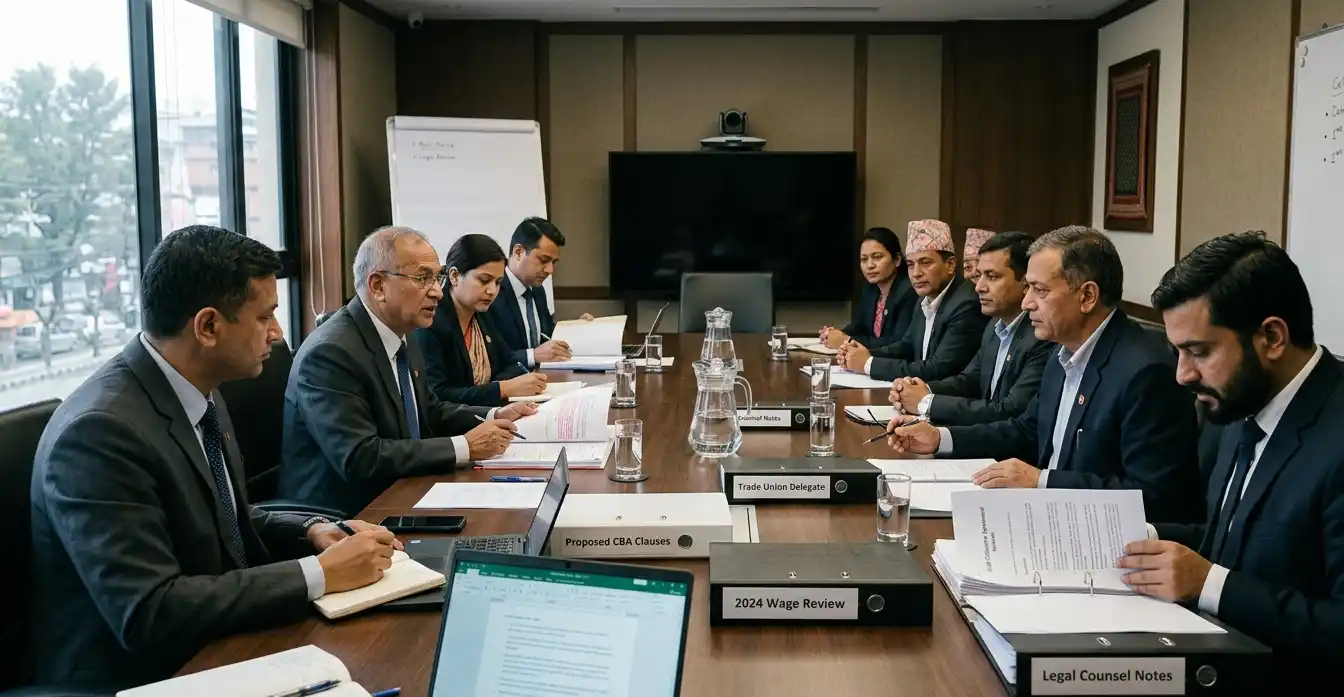
Resolving issues from collective bargaining and trade union negotiations in Nepal requires a practical understanding of local labour laws and industrial relations. Non-compliance with the Labour Act, 2074 (2017) and its rules can lead to significant legal trouble, operational disruptions, and financial penalties. Our firm represents both businesses and workers through these complex discussions, prioritising compliance and practical, legally sound solutions.
TL;DR: Collective bargaining in Nepal is a legal process where registered trade unions negotiate employment terms with employers under the Labour Act, 2074. Our legal team assists clients in navigating these negotiations, dispute resolution, and ensuring compliance with Nepali labour regulations.
Understanding Collective Bargaining & Trade Union Negotiations in Nepal
In Nepal, collective bargaining is the formal process where a registered trade union negotiates employment terms and conditions on behalf of its members with an employer. This fundamental right is enshrined in Nepali legislation, primarily the Labour Act, 2074. Trade union negotiations typically cover critical areas such as wages, working hours, employee benefits, and grievance resolution mechanisms. The ultimate aim is to establish a legally binding collective agreement that clearly defines the employer-employee relationship and operational rules.
This process is crucial for maintaining industrial harmony and ensuring fair treatment of workers.
When to Seek a Labour Dispute Lawyer in Nepal for Union Matters
- When a recognised trade union formally initiates collective bargaining or proposes amendments to an existing collective agreement.
- If an employer faces allegations of unfair labour practices or has failed to meet statutory collective bargaining obligations as stipulated by the Labour Act, 2074.
- During disputes concerning the interpretation or application of an existing collective agreement, necessitating mediation or conciliation services.
- When contemplating significant workforce changes or organisational restructuring that will impact unionised employees and require consultation.
- In response to legal claims for wrongful termination, discrimination, or other employment-related grievances filed by unionised workers.
Navigating the Collective Bargaining & Trade Union Negotiations Process in Nepal
The typical pathway begins with the establishment and formal recognition of a trade union within a company. Once a union is registered and meets the criteria outlined in the Labour Act, 2074, it gains the right to engage the employer in collective bargaining. Employers have a legal duty to participate in these negotiations in good faith.
The Labour Act mandates that disputes arising from these negotiations must first undergo mediation or conciliation facilitated by the Department of Labour and Occupational Safety (DoLOS) or relevant local labour offices. Should conciliation fail to achieve a resolution, the matter can then be escalated to the Labour Court for adjudication. The outcome of a successful negotiation is a collective agreement, which, upon registration with the relevant authorities, becomes legally enforceable.
employment law compliance Nepal
How Our Nepal Labour Lawyers Support Your Negotiations
Our experienced legal team provides practical guidance to effectively manage industrial relations. We offer strategic advice on how to approach or respond to collective bargaining demands, ensuring alignment with current labour legislation. We represent both employers and trade unions in negotiation sessions, striving to achieve mutually beneficial agreements that comply with Nepal’s labour laws.
Furthermore, we provide robust representation in conciliation proceedings and Labour Court litigation. Our focus is on safeguarding your interests throughout the dispute resolution process, minimising risk and ensuring favourable outcomes.
Fee Structures and Timelines for Labour Negotiations in Nepal
The costs and duration associated with collective bargaining and trade union negotiations in Nepal are inherently variable. Legal fees are contingent upon the complexity of the issues at hand, the number of parties involved, and the length of negotiations or potential litigation. Timelines are significantly influenced by the parties’ willingness to compromise, the efficiency of the mediation and conciliation processes, and the current caseload of the Labour Court.
Delays can also arise from incomplete documentation or misunderstandings of procedural requirements, underscoring the need for expert legal guidance.
Common Pitfalls and Compliance Risks in Union Negotiations
A prevalent error involves failing to recognise or adequately engage with a legitimately registered trade union, often resulting in protracted disputes and legal challenges. Employers may also err by implementing changes affecting unionised staff without prior consultation, breaching their statutory duties. Insufficient record-keeping of employment details can complicate negotiation processes.
A critical compliance risk is the failure to exhaust the mandatory conciliation process before initiating Labour Court proceedings, potentially leading to the dismissal of a case on procedural grounds.
What Clients Can Expect from Our Services
Clients engaging our firm for collective bargaining and trade union negotiations receive comprehensive legal counsel, dedicated support during negotiations, and skilled representation in dispute resolution forums. This includes expert assistance in drafting, reviewing, and negotiating collective agreements, preparing detailed submissions for conciliation and court proceedings, and providing clear, actionable advice on compliance with the Labour Act, 2074. Our objective is to secure optimal outcomes while fostering stable and productive labour-management relations.
labour court procedures Nepal