

Table of Contents
Secure Your Project Office in Nepal With Tax Benfits In Nepal
Introduction: Project Office In Nepal
Foreign companies executing specific projects in Nepal can establish a foreign project office registration Nepal through simplified procedures. This comprehensive guide covers essential requirements, documentation, and legal processes for successful project office establishment. Moreover, understanding project-specific regulations ensures compliant operations within defined timelines and objectives.
Understanding Foreign Project Office in Nepal
A foreign project office registration Nepal allows international companies to operate temporarily for specific project execution. Project offices are temporary branch offices established to execute specific projects in Nepal, typically set up by foreign contractors or consultants engaged in development projects. Additionally, project offices serve as legal entities conducting contract-based activities with predetermined duration.
Key Characteristics of Project Offices
Temporary Nature
Project offices operate for specific project durations with defined start and end dates. They automatically cease operations upon project completion.
Contract-Based Operations
Project offices must be established based on contracts or agreements with Nepalese entities or government authorities. Operations are limited to activities directly related to contracted projects.
Limited Business Scope
Project offices cannot engage in general commercial activities beyond their specific project mandates. They focus exclusively on project execution and related services.
Types of Foreign Project Offices
1. Development Project Offices
Established for executing development projects funded by international donors or multilateral agencies.
2. Construction Project Offices
Set up for infrastructure construction projects, including roads, bridges, buildings, and utilities.
3. Consulting Project Offices
Focused on providing technical assistance, advisory services, and capacity building programs.
4. Research Project Offices
Dedicated to research activities, studies, and knowledge transfer initiatives.
Legal Framework and Requirements
Governing Laws
The Companies Act of Nepal 2006 provides the scope of registration of branch and liaison office in Nepal. Additionally, Section 154 (2) of the Companies Act requires approval from the competent government authority to set up a branch office in Nepal.
Regulatory Approvals
Branch offices are registered based on license, selection or agreement with the competent authority in Nepal. Project offices require specific approvals from relevant government ministries based on project sectors.
Capital Requirements
Project offices typically have reduced capital requirements compared to commercial branch offices. Minimum capital depends on project value and duration.
Required Documents for Registration
Essential Documentation Checklist
| Document Type | Requirements | Specifications |
|---|---|---|
| Project Contract/Agreement | Original copy | With Nepalese entity |
| Certificate of Incorporation | Notarized & translated | Parent company |
| Memorandum of Association | Notarized & translated | In Nepali language |
| Articles of Association | Notarized & translated | In Nepali language |
| Board Resolution | Original | For project office establishment |
| Power of Attorney | Notarized | For authorized representative |
| Project Proposal | Detailed document | Technical and financial details |
| Director’s Passports | Certified copies | All directors |
| Representative’s Citizenship | Original copy | Nepalese authorized representative |
| Financial Statements | Latest 3 years | Parent company records |
Project-Specific Documents
- Technical specifications and project plans
- Environmental impact assessment (if required)
- Social safeguards documents
- Implementation timeline and milestones
- Budget and financial projections
Step-by-Step Registration Process
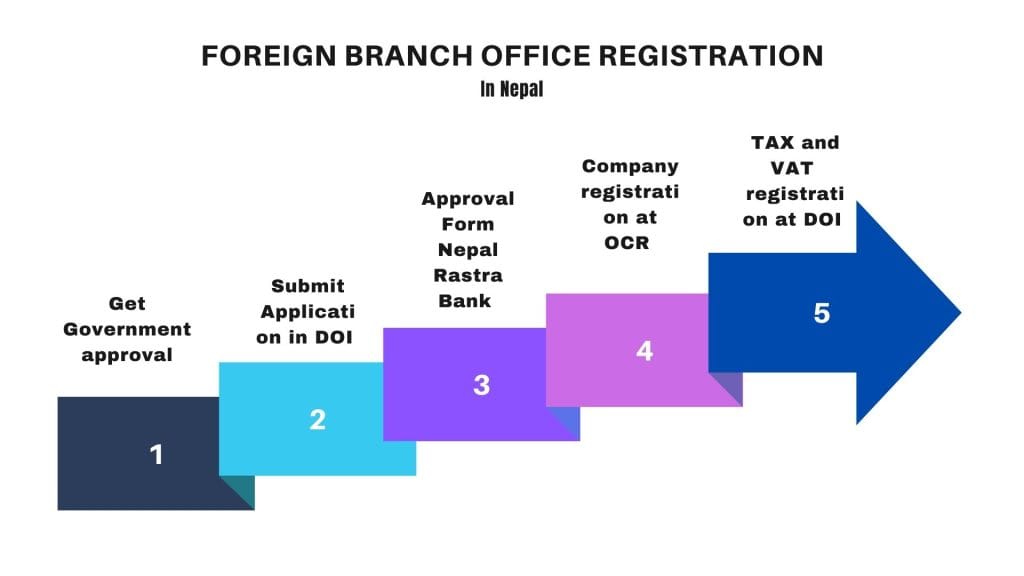
Step 1: Secure Project Contract
Obtain a valid contract or agreement with a Nepalese entity for project execution. The contract must clearly define project scope, timeline, and deliverables.
Step 2: Government Authority Approval
Submit a detailed project proposal to the Department of Industry (DOI) or Investment Board Nepal (IBN), depending on the investment amount. The proposal should include project description, investment plan, and financial projections.
Step 3: Document Preparation
Prepare required documents including the permission/approval issued by the competent authority to the foreign company to operate business in Nepal, photocopies of certificate of incorporation, memorandum of association, and articles of association.
Step 4: Company Registrar Application
Submit application to the Office of Company Registrar with complete documentation and required fees.
Step 5: Tax Registration
Obtain PAN (Permanent Account Number) and VAT registration for tax compliance during project duration.
Step 6: Municipal License
Register with local municipal authorities for business operation permits in project locations.
Step 7: Sector-Specific Approvals
Obtain additional permits from relevant ministries based on project sector requirements.
Cost Analysis for Project Office Registration
| Service Type | Cost Range (NPR) | Government Fees |
|---|---|---|
| Authority Approval | 25,000-75,000 | 15,000-25,000 |
| Company Registration | 10,000-20,000 | 5,000-10,000 |
| PAN Registration | Free | Free |
| VAT Registration | Free | Free |
| Municipal License | 3,000-10,000 | 1,500-5,000 |
| Professional Fees | 100,000-300,000 | Variable |
| Total Estimated Cost | 138,000-405,000 | 21,500-40,000 |
Operational Framework
Project Duration Limits
Project offices typically operate for 1-5 years depending on project complexity and requirements. Extensions require additional approvals and justification.
Staffing Requirements
Project offices must appoint Nepalese authorized representatives and comply with local employment laws for hiring.
Reporting Obligations
Regular progress reports to sponsoring authorities and quarterly financial reports to tax authorities are mandatory.
Tax Implications and Compliance
Income Tax
Project offices pay income tax on Nepal-sourced income at applicable rates. Tax treaties may provide relief from double taxation.
Withholding Tax
Payments to parent company may attract withholding tax based on nature of transactions and applicable tax treaties.
VAT Registration
Project offices with taxable supplies exceeding thresholds must register for VAT and maintain compliance.
Social Security
Employee social security contributions are mandatory for all local staff employed by project offices.
Sector-Specific Considerations
Infrastructure Projects
Construction and infrastructure project offices require additional permits from Ministry of Physical Infrastructure and Transport.
Health Projects
Health sector project offices need approvals from Ministry of Health and Population and Nepal Medical Council.
Education Projects
Educational project offices require permissions from Ministry of Education, Science and Technology.
Environmental Projects
Environmental projects need clearances from Ministry of Forests and Environment and impact assessments.
Benefits and Limitations
Advantages:
- Simplified Procedures: Streamlined registration for specific projects
- Reduced Capital Requirements: Lower investment thresholds
- Tax Benefits: Potential treaty benefits and project-specific exemptions
- Focused Operations: Clear mandate and objectives
- Temporary Nature: No long-term commitments
Limitations:
- Limited Business Scope: Restricted to project activities only
- Temporary Authorization: Operations cease with project completion
- Compliance Requirements: Regular reporting and monitoring
- Renewal Challenges: Extensions require strong justification
- Operational Restrictions: Cannot diversify business activities
Common Challenges and Solutions
Challenge 1: Contract Clarity
Solution: Ensure comprehensive project contracts with clear deliverables, timelines, and payment terms.
Challenge 2: Regulatory Compliance
Solution: Engage local legal experts familiar with sector-specific requirements and regulations.
Challenge 3: Tax Obligations
Solution: Establish proper accounting systems and engage qualified tax advisors for compliance.
Challenge 4: Staff Management
Solution: Implement HR policies compliant with Nepal Labor Act and social security regulations.
Best Practices for Project Office Operations
Pre-Registration Planning
- Conduct thorough feasibility studies
- Secure comprehensive project contracts
- Identify all regulatory requirements
- Plan resource allocation and staffing
During Operations
- Maintain regular communication with authorities
- Submit timely reports and compliance documents
- Monitor project progress against milestones
- Ensure proper financial management
Project Closure
- Complete all deliverables as per contract
- Submit final reports to authorities
- Clear all tax obligations
- Formally close the project office
Future Trends and Developments
Digital Integration
Government agencies are implementing digital platforms for project approvals and monitoring systems.
Streamlined Procedures
Continued efforts to simplify project office registration and reduce bureaucratic delays.
Sector-Specific Frameworks
Development of specialized procedures for different project sectors and funding sources.
Frequently Asked Questions (FAQs)
Q1: What is the difference between a project office and a branch office?
A: Project offices are temporary establishments for specific project execution with defined timelines, while branch offices are permanent commercial entities for ongoing business operations.
Q2: How long can a project office operate in Nepal?
A: Project offices typically operate for 1-5 years depending on project duration. Extensions are possible with proper justification and approval.
Q3: What are the minimum capital requirements for project offices?
A: Capital requirements vary based on project value and sector. Generally, project offices have lower capital requirements than commercial branch offices.
Q4: Can project offices engage in activities beyond their project mandate?
A: No, project offices can only engage in activities directly related to their specific project contracts and cannot diversify into other business areas.
Q5: What happens when the project is completed?
A: Project offices must be formally closed upon project completion, with all obligations cleared and final reports submitted to authorities.
Q6: Are there tax benefits for project offices?
A: Project offices may benefit from tax treaties and project-specific exemptions, depending on funding sources and bilateral agreements.
Q7: Can project offices hire local staff?
A: Yes, project offices can hire local staff and must comply with Nepal Labor Act and social security regulations for all employees.
Q8: What approvals are required for development project offices?
A: Development project offices require approvals from relevant ministries, Department of Industry, and sector-specific authorities based on project nature.
Q9: Can project office registration be expedited?
A: Yes, with complete documentation and proper preparation, project office registration can be processed within 15-30 working days.
Q10: What are the reporting requirements for project offices?
A: Project offices must submit regular progress reports to project sponsors, quarterly financial reports to tax authorities, and annual returns to Company Registrar.
Conclusion
Foreign project office registration Nepal provides international companies with efficient mechanisms for executing specific projects in Nepal’s developing economy. Success depends on thorough preparation, comprehensive documentation, and strict compliance with project-specific regulations. Moreover, understanding sectoral requirements and maintaining proper reporting ensures smooth project implementation.
The streamlined procedures for project offices make Nepal an attractive destination for international development projects and technical assistance programs. Furthermore, proper planning and professional guidance significantly reduce registration time and operational challenges.
Remember that project offices offer focused solutions for specific objectives while maintaining regulatory compliance and operational efficiency. Therefore, follow this comprehensive guide to establish your foreign project office successfully in Nepal.
This guide provides general information and should not replace professional legal advice. Always consult qualified legal professionals for specific project requirements and regulatory compliance.
Company Darta Nepal & Corporate Biz Legal is a trusted law firm in Nepal, providing expert company registration services in Nepal with full legal compliance and professional support.