
Solukhumbu District Court is located in Salleri, the headquarters of Solukhumbu District in Koshi Province. Established in 2021 B.S. (1964 A.D.), this judicial body serves the entire Khumbu region, from lowland villages at 600 meters to Mount Everest at 8,848 meters. The court operates under Nepal’s Constitution 2015 and Muluki Civil Code 2074.
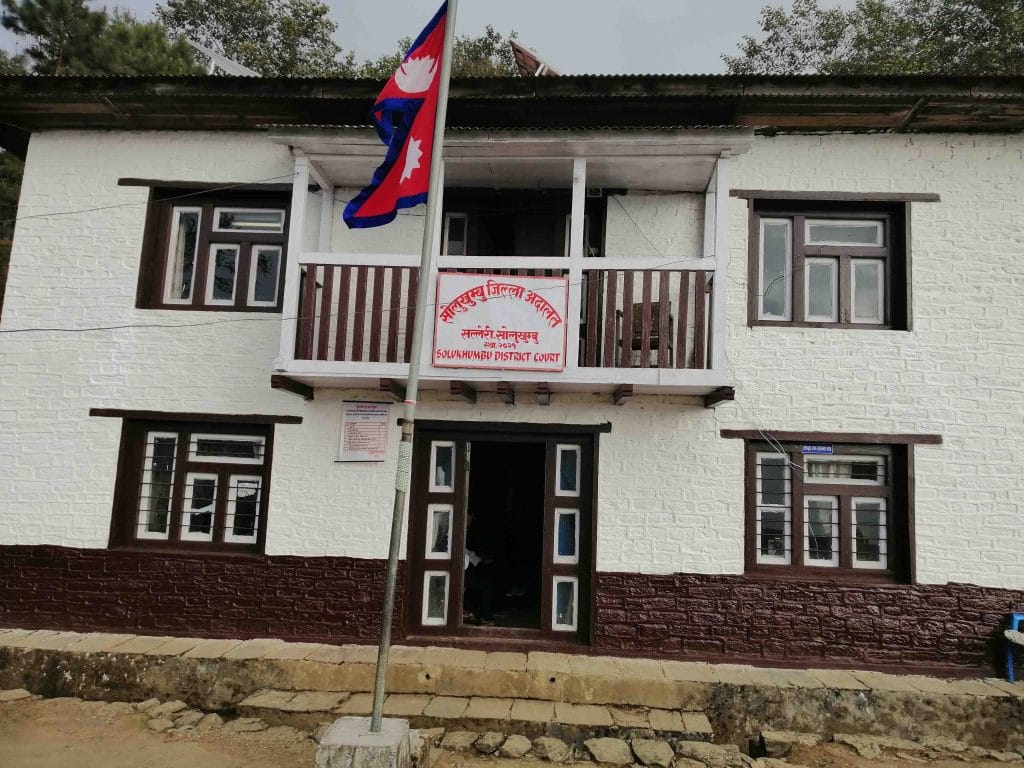
Access to justice in this Himalayan region presents unique challenges. However, the judicial system has been adapted to serve remote communities. This guide provides step-by-step procedures for legal matters in the Everest region.
Key Facts About Solukhumbu District Court (Salleri)
| Detail | Information |
|---|---|
| Full Address | Solududhakunda Municipality, Ward No. 5, Salleri 56000, Koshi Province |
| Primary Phone | 038-520195 |
| Official Email | info.dcsolukhumbu@supremecourt.gov.np |
| Current Judge | Honorable Justice Santosh Prasad Parajuli |
| Court Altitude | 2,400 meters above sea level |
| Common Civil Cases | Divorce, property disputes, partition suits |
| Common Criminal Cases | Sexual violence, assault, theft |
| Staff Strength | 26 positions sanctioned (operating with available personnel) |
| Year Established | 1964 A.D. (2021 B.S.) |
The court building is situated in one of Nepal’s highest-altitude judicial locations. Because of this, special consideration is given to mountain weather conditions and remote accessibility.
How to Reach Solukhumbu District Court from Kathmandu
Travel options to Solukhumbu District Court Salleri include several routes. Each method has different time requirements and costs.
| Transport Mode | Duration | Cost Range (NPR) | Notes |
|---|---|---|---|
| Jeep via BP Highway | 8-10 hours | 1,500-2,500 | Daily departures from Chabhil Chowk, passes Okhaldhunga |
| Bus via BP Highway | 10-12 hours | 800-1,200 | Less comfortable, longer duration |
| Flight to Phaplu | 30 minutes | 4,000-6,000 | Morning flights only (Tara Air, Summit Air) |
| Flight to Lukla + Trek | 2-3 days trek | 8,000+ flight + trek costs | For Khumbu region residents |
The Sunkoshi Bridge at Ghurmi (completed in 2014) reduced travel time significantly. Previously, passengers had to cross on footbridge and change vehicles.
Filing Civil Cases at Solukhumbu District Court
Step 1: Determining Jurisdiction
Before any case is filed, jurisdiction must be established. Solukhumbu District Court has territorial jurisdiction over all matters arising within Solukhumbu District boundaries. For property disputes, jurisdiction is determined by property location. For personal matters, defendant’s residence is considered.
Step 2: Plaint Drafting
A written plaint (Mudda) must be prepared. The following information is required:
- Names and addresses of plaintiff and defendant
- Chronological facts of dispute
- Legal grounds for claim
- Specific relief sought
- Signature and verification by plaintiff or advocate
Professional legal drafting is recommended. Mistakes in the plaint often result in case rejection.
Step 3: Required Documents Checklist
Solukhumbu court filing requires these documents:
- Citizenship certificate copies (plaintiff and defendant)
- Marriage certificate (for family cases)
- Property ownership documents (for land disputes)
- Evidence supporting claims (contracts, receipts, photos)
- Power of attorney (if represented by lawyer)
- Recent passport-sized photographs
Step 4: Court Fee Payment
Court fees Solukhumbu are calculated as follows:
| Claim Amount (NPR) | Court Fee | Example Cases |
|---|---|---|
| Up to 25,000 | Rs. 500 | Small rent disputes |
| 25,001-50,000 | 5% of amount | Minor contract breaches |
| 50,001-1,00,000 | 3.5% of amount | Medium property claims |
| 1,00,001-5,00,000 | 2% of amount | Divorce cases, partition |
| 5,00,001-25,00,000 | 1.5% of amount | Large property disputes |
| Above 25,00,000 | 1% of amount | Major land transactions |
Fees are paid in cash at the court counter. Poor litigants may request fee deferment through municipal authority recommendation.
Step 5: Submission Process
- Visit the Bhishi Heralne (filing section) at Solukhumbu District Court
- Present all documents for initial verification
- Submit plaint with court fee receipt
- Receive diary number
- Return after 2-3 days for case registration number
- Collect summons for defendant service
Filing Criminal Cases Through Solukhumbu Court
First Information Report (FIR)
Criminal proceedings begin with police. Victims must:
- Visit nearest police station in Solukhumbu district
- Lodge written or oral complaint
- Provide evidence and witness information
- Obtain FIR copy
Police Investigation
Solukhumbu District Police conduct inquiry. Evidence is collected, statements recorded. For serious crimes, suspects may be arrested with court warrant.
Charge Sheet Filing
After investigation, government attorney files charge sheet in Solukhumbu District Court. The court then schedules bail hearings and trial dates.
Trial Process
Trial stages include:
- Accused statement recording
- Evidence submission by both sides
- Witness examination and cross-examination
- Final arguments by government attorney and defense lawyer
- Judgment delivery
Mediation Process at Solukhumbu District Court
Mediation is encouraged for civil disputes. Solukhumbu district court mediation follows national guidelines but includes local customs.
Traditional Sherpa mediation (Khada Yangza system) exists alongside formal court mediation. The court may refer cases to:
- Court-appointed mediators
- Local government mediation committees
- Community-based mediation for petty disputes
However, concerns exist about power imbalances affecting marginalized groups (women, Dalits, persons with disabilities).
Special Considerations for Khumbu Region Residents
Remote Village Access
Litigants from remote villages (Pangboche, Thame, Khumjung) face significant barriers:
- 3-5 days trek to reach Salleri
- Limited transportation during monsoon (June-September)
- Snow blockage in high passes (December-February)
Language Services
Solukhumbu court provides basic interpretation for Sherpa, Rai, and Magar languages. However, formal proceedings are conducted in Nepali.
Document Authentication
Village-level documents (birth certificates, marriage registration) must be authenticated by Ward Chairman before court acceptance.
Common Legal Issues in Khumbu Region
Tourism-Related Disputes
With Everest tourism, cases include:
- Porter wage disputes
- Trekking agency contract breaches
- Helicopter rescue payment conflicts
- Lodge ownership inheritance
Property Division in Mountain Communities
High-altitude land ownership is complex. Traditional communal grazing rights often conflict with formal land registration. Court decisions consider both legal documents and customary practices.
Family Law Matters
Divorce rates are increasing in Solukhumbu district, partly due to migration. Child custody cases consider school accessibility in mountainous terrain.
Appealing Solukhumbu District Court Decisions
Dissatisfied parties may appeal to Biratnagar High Court within 70 days of judgment. Grounds for appeal include:
- Legal error in judgment
- Procedural irregularity
- New evidence discovery
Appeal process requires:
- Certified copy of judgment (Rs. 50 per page)
- Appeal petition with grounds
- Security deposit (if challenging monetary order)
Accessibility for Persons with Disabilities
The International Commission of Jurists notes significant barriers:
- Steep roads to court building
- No ramp access in older sections
- No sign language interpreters
- No Braille documents
Persons with disabilities are advised to:
- Contact court in advance (038-520195)
- Request assistance from District Administration Office
- Bring personal support person
- Apply for legal aid through Nepal Bar Association
Frequently Asked Questions
What is the fastest way to file an urgent case from Lukla?
Flight to Phaplu (30 minutes) followed by jeep to Salleri (1 hour) is quickest. Alternatively, trekking takes 2-3 days. For genuine emergencies, contact the judge’s chamber directly.
How long does a typical divorce case take in Solukhumbu District Court?
Mutual consent divorce: 2-3 months. Contested divorce: 8-18 months. Delays occur due to defendant summons delivery in remote villages.
Are court fees waived for poor litigants?
Fee deferment is possible. Application must be submitted with recommendation from municipal or village authority. Final judgment may order losing party to pay court fees.
Can cases be filed online in Solukhumbu?
Online filing is not available. Physical presence is required for document verification and oath taking. However, case status can be checked via Supreme Court portal.
What language should court documents be written in?
All documents must be in Nepali. English documents require certified translation. Traditional documents in Sherpa script need official translation.
Is lawyer representation mandatory?
No, but highly recommended. Complex procedures and legal technicalities often result in case rejection without professional assistance.
How are summons delivered to remote villages?
Court staff or police travel to villages. Delivery time: 5-15 days depending on location. Helicopter service is used only for exceptional circumstances.
What are typical lawyer fees in Solukhumbu?
Junior advocates: Rs. 10,000-25,000. Senior lawyers: Rs. 30,000-75,000. Fees depend on case complexity and travel requirements to remote areas.
Can foreigners file cases in Solukhumbu District Court?
Yes, if the cause of action occurred in Solukhumbu district. Foreign trekkers and climbers may file cases for accidents, theft, or contract disputes. Presence in court may be required unless power of attorney is granted to Nepali lawyer.
How is evidence collected from high-altitude locations?
Court commissions are appointed. They travel to location, inspect evidence, and submit written reports. Costs are borne by requesting party.
Case Study: Property Dispute Resolution in Khumbu
In 2024, a land boundary dispute between two families in Khumjung village was resolved through court-commissioned local inspection. The judge appointed a surveyor who trekked for three days to reach the disputed plot at 3,800 meters. Traditional boundary markers (stone cairns) were examined alongside official maps. Final judgment incorporated both modern land records and customary Sherpa land use practices, demonstrating how Solukhumbu District Court balances formal law with mountain community traditions.
Legal Aid Services in Solukhumbu
Free legal aid is available for:
- Persons below poverty line
- Women and children
- Persons with disabilities
- Senior citizens
- Indigenous peoples
Applications are submitted to Nepal Bar Association or court registry. Processing takes 7-14 days.
Conclusion
Solukhumbu District Court serves one of Nepal’s most geographically challenging districts. While mountain remoteness creates access barriers, the judicial system has adapted through mobile courts, local mediation, and consideration of customary practices. Success in legal matters requires proper documentation, patience with extended timelines, and often, professional legal representation.
For residents of the Khumbu region, understanding court procedures is essential. This guide provides the foundation needed to navigate the legal system effectively. Always verify current judge assignments and fee structures by contacting the court directly before filing.
Call to Action
Need assistance with Solukhumbu District Court matters? Contact experienced legal professionals familiar with mountain region procedures. For immediate help, call the court at 038-520195 or email info.dcsolukhumbu@supremecourt.gov.np. Document preparation services are available in Salleri market area, 200 meters from court premises.
Disclaimer: This guide is for informational purposes only and does not constitute legal advice. Court procedures and fees are subject to change. Verify all information with official sources before taking legal action.