

Table of Contents
Understanding Trademark Protection in Nepal
A trademark represents one of the most valuable intangible assets a business can own. In Nepal’s rapidly evolving commercial landscape, securing exclusive rights to your brand identity—encompassing logos, names, slogans, and distinctive marks—provides essential legal protection against unauthorized use, counterfeiting, and market confusion.
Trademark registration in Nepal operates under a first-to-file system, meaning priority rights are granted to the first applicant filing a valid application, regardless of prior use in the market. This principle makes early registration strategically critical for both domestic enterprises and foreign investors seeking to enter Nepal’s emerging market.
Legal Framework and Governing Authorities
The trademark registration system in Nepal is governed by established statutory instruments administered by designated government authorities:
Primary Legislation:
- Patent, Design and Trademark Act, 1965 (2022 BS) – The foundational statute establishing registration procedures, rights, and enforcement mechanisms
- Patent, Design and Trademark Rules, 1965 – Procedural guidelines implementing the Act’s provisions
Regulatory Authority:
- Department of Industry (DOI) – Operating under the Ministry of Industry, Commerce and Supplies, the DOI serves as the primary registry for trademark applications, examinations, oppositions, and maintenance
- Intellectual Property Section – The specific division within DOI handling trademark administration
International Framework:
Nepal is a member of the World Trade Organization (WTO) and complies with TRIPS Agreement (Trade-Related Aspects of Intellectual Property Rights) standards. While Nepal has not acceded to the Madrid Protocol for international registration, it recognizes priority claims under the Paris Convention for applicants filing within six months of a first filing in a convention country.
The Strategic Importance of Trademark Registration
Legal and Commercial Significance
Registering a trademark in Nepal transforms an unprotected brand element into enforceable intellectual property rights. Registration establishes:
- Exclusive Ownership Rights: Legal presumption of ownership and exclusive nationwide usage rights
- Enforcement Mechanisms: Standing to pursue civil remedies, criminal penalties, and customs border enforcement
- Asset Valuation: Registered trademarks appear on balance sheets, facilitating investment, franchising, and licensing opportunities
- Brand Integrity: Prevention of market dilution and consumer confusion regarding product origins
Risk Assessment: Consequences of Non-Registration
Businesses operating without registered trademarks face substantial vulnerabilities:
- Inability to Prevent Infringement: Unregistered marks receive limited protection under passing-off common law principles, requiring expensive evidentiary burdens to prove goodwill
- Priority Loss: Competitors may register identical or confusingly similar marks, forcing original users to rebrand or engage in costly litigation
- Counterfeiting Exposure: Without registration, border customs cannot detain counterfeit goods, eliminating crucial enforcement tools
- Investment Barriers: Due diligence processes for investors and acquirers flag unregistered intellectual property as high-risk assets
Step-by-Step Trademark Registration Process in Nepal
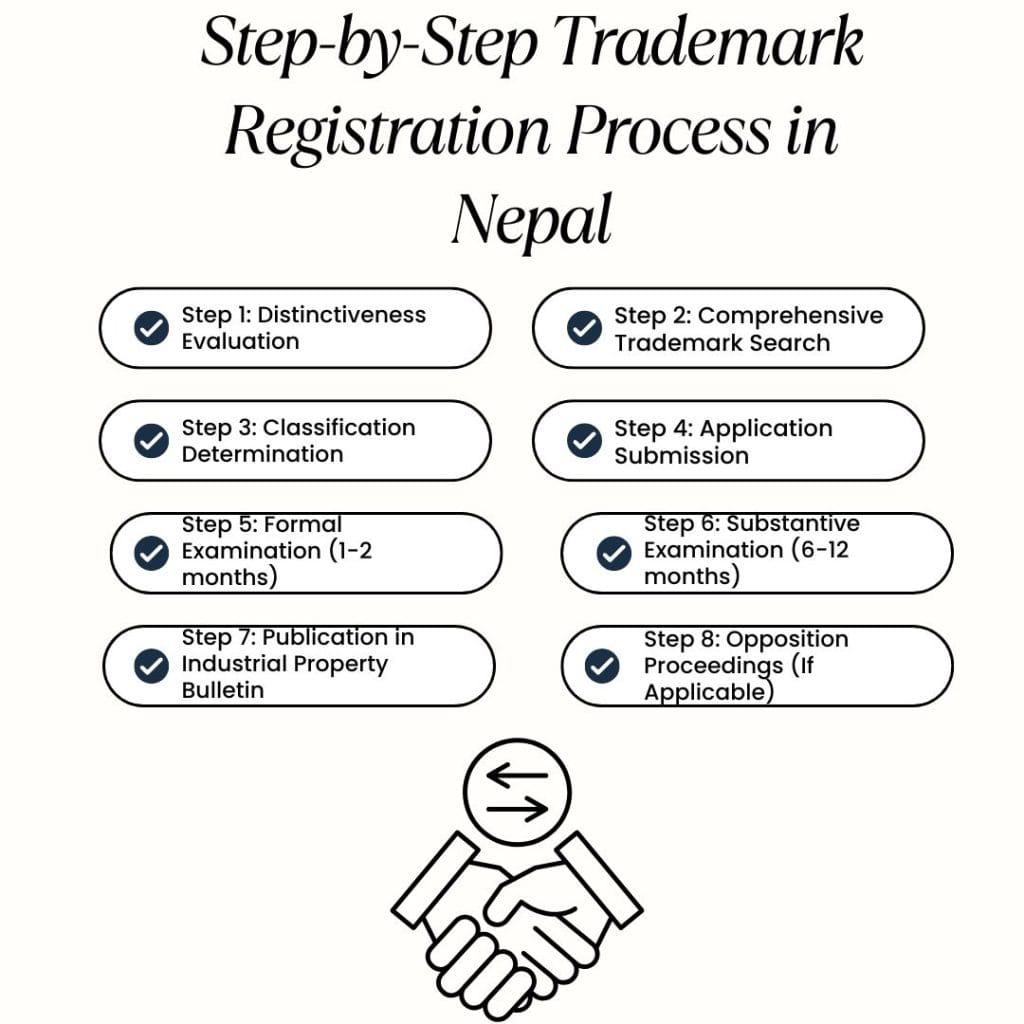
Phase 1: Pre-Filing Strategy and Availability Assessment
Step 1: Distinctiveness Evaluation
Before application, evaluate whether your mark meets statutory requirements:
- Inherent Distinctiveness: Marks must distinguish goods/services; generic terms (e.g., “Milk” for dairy products) face rejection
- Non-Deceptiveness: Marks must not mislead consumers regarding product nature, quality, or geographic origin
- Public Morality: Marks contrary to public order or morality are prohibited
Step 2: Comprehensive Trademark Search
Conduct exhaustive clearance searches to identify conflicting prior registrations:
- Search the DOI’s trademark database for identical or phonetically/similarly similar marks in relevant classes
- Review pending applications that may mature into conflicting registrations
- Analyze unregistered common law uses that might support opposition claims
Best Practice: Professional search reports reduce rejection risk by 60-70% and inform registration strategies, including potential modifications or coexistence agreements.
Phase 2: Application Preparation and Filing
Step 3: Classification Determination
Identify appropriate Nice Classification classes covering your goods/services. Nepal follows the 11th Edition of the Nice Classification system, encompassing 45 classes (Classes 1-34 for goods, 35-45 for services).
Step 4: Application Submission
Submit the prescribed Form-1 (Application for Registration of Trademark) to the DOI’s Intellectual Property Section, accompanied by:
- Eight specimen copies of the trademark (5cm × 5cm for word marks; appropriate dimensions for device marks)
- Completed application form with applicant details and class specifications
- Priority documents (if claiming Paris Convention priority, with certified Nepali translations)
- Power of Attorney (for applications filed through representatives)
Filing Modalities:
- Physical Filing: Direct submission to DOI headquarters in Kathmandu
- Online Filing: Electronic submission through the DOI’s IP Management Information System (limited availability; verification recommended)
Phase 3: Formal and Substantive Examination
Step 5: Formal Examination (1-2 months)
The DOI conducts administrative review verifying:
- Completeness of application and required documents
- Payment of prescribed fees
- Proper classification and specification drafting
Applications with formal defects receive correction notices with 30-day response deadlines.
Step 6: Substantive Examination (6-12 months)
Examining attorneys assess:
- Absolute Grounds: Distinctiveness, descriptiveness, and public morality compliance
- Relative Grounds: Conflicts with prior registered or pending marks
- Prohibited Marks: Government emblems, international organization insignia, or protected geographical indications
Common Objections: Marks deemed descriptive of goods/services (e.g., “Cold” for beverages) or confusingly similar to well-known marks face provisional refusal requiring substantive responses.
Phase 4: Publication and Opposition Period
Step 7: Publication in Industrial Property Bulletin
Approved applications proceed to publication in the official bulletin, triggering a 90-day opposition window during which third parties may file opposition based on prior rights or statutory non-compliance.
Strategic Note: Monitor the bulletin weekly if operating in competitive sectors to identify conflicting applications requiring opposition.
Step 8: Opposition Proceedings (If Applicable)
Oppositions involve:
- Notice of Opposition filing by aggrieved parties
- Counter-statement submission by applicants (60 days)
- Evidence submission phases
- Hearing and written decisions
Unopposed applications or successful defense against opposition advance to registration.
Phase 5: Registration and Certificate Issuance
Step 9: Registration and Certification
Following clearance of opposition periods or successful opposition defense:
- Entry of mark in Trademark Register
- Issuance of Registration Certificate containing registration number, mark representation, owner details, class specifications, and validity dates
- Publication of registration in the Industrial Property Bulletin
Required Documentation and Classification Systems
Document Checklist by Applicant Type
The documentation requirements vary based on applicant category and filing basis:
| Document | Individual Applicant | Company Applicant | Foreign Applicant |
|---|---|---|---|
| Completed Application Form (Form-1) | Required | Required (company seal) | Required |
| Power of Attorney | If represented | If represented | Required (legalized/apostilled) |
| Citizenship/Registration Certificate | Citizenship copy | Company registration certificate | Certificate of incorporation (legalized) |
| Passport-sized Photographs | 2 copies | Representative’s 2 copies | Representative’s 2 copies |
| Specimen Marks (5cm × 5cm) | 8 copies | 8 copies | 8 copies |
| Priority Documents | If applicable | If applicable | If claiming priority (legalized translation) |
| Fee Payment Receipt | Required | Required | Required |
| Board Resolution | N/A | Authorizing trademark filing | Authorizing Nepal representative |
Note: Foreign applicants must designate local agents or attorneys through properly executed Powers of Attorney, preferably legalized through Nepali embassies or apostilled under the Hague Convention.
The Nice Classification System in Nepal
Nepal adopts the international Nice Classification system for trademark categorization. Strategic class selection ensures comprehensive protection:
Classes 1-34 (Goods):
- Class 1: Chemicals for industrial use
- Class 5: Pharmaceutical and veterinary products
- Class 9: Scientific, electronic, and software apparatus
- Class 16: Paper goods and printed materials
- Class 25: Clothing, footwear, headgear
- Class 30: Foodstuffs including coffee, tea, spices
Classes 35-45 (Services):
- Class 35: Advertising, business management, retail services
- Class 36: Insurance, financial services, real estate
- Class 41: Education, training, entertainment
- Class 42: Scientific and technological services, software development
Multi-Class Applications: Nepal permits single applications covering multiple classes, with separate fees required for each class.
Timeframes, Official Fees, and Validity Periods
Processing Timelines
| Stage | Estimated Duration | Variables |
|---|---|---|
| Formal Examination | 1-2 months | Application backlog, completeness |
| Substantive Examination | 6-12 months | Complexity, objections raised |
| Publication Period | 3 months (mandatory) | Opposition filings |
| Opposition Resolution | 6-24 months | Evidence complexity, hearings |
| Registration Certificate | 1-2 months post-clearance | Administrative processing |
Total Estimated Timeline: 12-24 months for uncontested applications; 24-48 months for opposed applications.
Expedited Consideration: While Nepal lacks formal expedited examination, substantial portfolio applicants or urgent commercial necessity may warrant direct engagement with examiners through professional representatives.
Official Fee Structure
As per the Patent, Design and Trademark Rules, 1965 (as amended):
| Service | Official Fee (NPR) | USD Equivalent (approx.) |
|---|---|---|
| Application Filing (per class) | 2,000 | $15 |
| Renewal Application (per class) | 4,000 | $30 |
| Certified Copy of Certificate | 1,000 | $7.5 |
| Assignment Recordal | 2,000 | $15 |
| Name/Address Change Recordal | 1,000 | $7.5 |
| License Recordal | 2,000 | $15 |
| Opposition Filing | 2,000 | $15 |
| Appeal Filing | 3,000 | $22 |
Professional Service Fees:
- Trademark Search: NPR 5,000-15,000 ($40-$115)
- Application Preparation/Filing: NPR 10,000-25,000 ($75-$190)
- Opposition/A appeals: NPR 50,000-150,000 ($380-$1,150)
Validity and Renewal Terms
Initial Validity: 7 years from filing date for marks registered under the 1965 Act; 10 years for applications filed after implementation of substantive amendments aligning with TRIPS (effective 2006).
Renewal Terms:
- Renewal Window: 6 months before expiry
- Grace Period: 6-month late renewal with penalty fees (50% surcharge)
- Restoration: No provision for lapsed mark restoration; vigilance required
Strategic Compliance: Calendar monitoring systems should track renewal deadlines, as lapsed registrations require complete reapplication with fresh examination and vulnerability to third-party interception.
Post-Registration Compliance and Enforcement Obligations
Mandatory Maintenance Requirements
Renewal Filings:
Submit Form-3 (Application for Renewal) with existing certificates and renewal fees within prescribed windows. Late renewals require surcharge payments and risk registration cancellation.
Recordal of Changes:
Within 6 months of any material change, record:
- Assignments: Deeds of assignment require registration to be effective against third parties
- License Agreements: Exclusive and non-exclusive licenses should be recorded to establish licensee rights
- Name/Address Changes: Corporate restructuring or relocations must be updated
Declaration of Use:
While Nepal does not currently require periodic proof-of-use declarations (as in the United States), maintaining use records strengthens enforcement positions against non-use cancellation actions or opposition defenses.
Enforcement Mechanisms and Remedies
Civil Remedies:
Registered trademark holders may file infringement suits in District Courts seeking:
- Permanent and temporary injunctions
- Damages or account of profits
- Destruction of infringing goods and manufacturing implements
- Costs and attorney fees (limited recovery)
Criminal Enforcement:
Knowing infringement of registered trademarks constitutes criminal offenses under the National Criminal Code, 2017, punishable by imprisonment up to 1 year and fines up to NPR 100,000. Police complaints may be filed with the District Police Office or through the Department of Commerce, Supply and Consumer Protection for market raids.
Customs Protection:
Record registered trademarks with Nepal Customs Department to enable border detention of counterfeit imports/exports. Customs officials may seize suspected counterfeit goods ex officio or upon rights-holder notification.
Alternative Dispute Resolution:
Mediation and arbitration clauses in license agreements provide efficient resolution frameworks for commercial disputes, though court intervention remains necessary for injunctive relief.
Refusals, Objections, and Appeals Procedures
Common Grounds for Application Refusal
Absolute Grounds (Statutory Prohibitions):
- Lack of inherent distinctiveness (generic or descriptive terms)
- Deceptive marks misrepresenting product nature or origin
- Marks contrary to public morality or national symbols
- Geographical indications protected under separate regimes (e.g., “Darjeeling” for tea)
Relative Grounds (Prior Rights Conflicts):
- Identical or confusingly similar marks in identical/similar classes
- Well-known mark protections extending beyond registered classes
- Bad faith filings targeting established unregistered marks
Administrative Appeals Structure
First Appeal – Department of Industry:
Applicants receiving provisional refusals may file written responses within 60 days, submitting:
- Arguments distinguishing the applied-for mark from cited references
- Evidence of acquired distinctiveness through extensive use
- Consent agreements from prior rights holders (where available)
Second Appeal – High Court:
Adverse decisions from the DOI may be appealed to the respective High Court (Kathmandu High Court for central region cases) within 35 days of decision notification, invoking writ jurisdiction for procedural irregularities or substantive legal errors.
Supreme Court Jurisdiction:
Final appeals on questions of law or significant public interest proceed to the Supreme Court through special leave petitions or regular appeals, depending on jurisdictional thresholds.
Opposition Defense Strategies
When facing third-party opposition:
- Priority Evidence: Establish first-to-file priority or earlier commercial use documentation
- Distinction Arguments: Demonstrate differences in channels of trade, consumer sophistication, or mark dissimilarity
- Coexistence Agreements: Negotiate consent agreements delineating territorial or usage limitations
- Non-Use Cancellation: Counter-attack opponent marks based on non-use grounds (where applicable)
Strategic Benefits and Commercial Value of Trademark Registration
Legal Protection Advantages
Exclusive Territorial Rights:
Registration confers exclusive rights throughout Nepal’s federal democratic republic territory, preventing others from using identical or confusingly similar marks in connection with similar goods/services.
Presumption of Validity:
Registered marks enjoy legal presumption of validity and ownership, shifting evidentiary burdens to challengers in enforcement actions.
In rem Jurisdiction:
Registration creates property rights enforceable against the world (erga omnes), unlike contractual rights limited to specific parties.
Commercial and Financial Benefits
Asset Appreciation:
Trademarks appreciate with brand value, often becoming the most valuable corporate assets (exemplified by multinational valuations where trademarks exceed tangible asset values).
Financing and Security Interests:
Registered trademarks serve as collateral for secured lending under the Secured Transaction (First Amendment) Act, 2064, enabling intellectual property-based financing.
Licensing Revenue Streams:
Registration facilitates franchising, merchandising, and brand extension strategies through recorded license agreements generating royalty income.
Market Entry Leverage:
Strong trademark portfolios signal commercial seriousness to distributors, retailers, and joint venture partners, facilitating market penetration.
Long-Term Strategic Considerations
Brand Portfolio Management: Systematic registration of house marks, product lines, and defensive marks in adjacent classes prevents brand dilution and cybersquatting.
International Expansion Foundation: Nepal registrations support Madrid Protocol international applications (upon future accession) or serve as base applications for regional protection strategies.
Due Diligence Premium: Registered IP assets command 20-40% valuation premiums in M&A transactions compared to unregistered marks.
Frequently Asked Questions (FAQ)
General Eligibility and Application Process
Q: Who is eligible to apply for trademark registration in Nepal?
Any individual, company, partnership, or legal entity engaged in commercial activities may apply. Foreign applicants must designate local representatives through Powers of Attorney. No prior use in Nepal is required—intent-to-use applications are permissible.
Q: Can I register a trademark personally, or must I use an attorney?
While personal filing is permitted, professional representation is strongly recommended for specification drafting, classification strategy, and examination responses. Foreign applicants must use local agents.
Q: How long does trademark registration take in Nepal?
Uncontested applications typically require 12-24 months. Opposed applications or those receiving office actions may extend to 36-48 months. Early filing is advised given the first-to-file system.
Costs and Renewal
Q: What is the total cost for trademark registration in Nepal?
Official fees total NPR 2,000 per class for filing, plus NPR 4,000 per class for 7-year renewals. Professional fees add NPR 10,000-25,000 for search and application services. Budget $200-500 total for single-class registrations through professional firms.
Q: What happens if I miss the renewal deadline?
A 6-month grace period permits late renewal with 50% surcharge penalties. Failure to renew within the grace period results in registration cancellation, leaving the mark available for third-party registration.
Q: Are government fees refundable if my application is rejected?
Official fees are non-refundable. Investment in comprehensive trademark searches before filing minimizes rejection risks and wasted fees.
Foreign Applicants and International Considerations
Q: Does my international trademark registration protect me in Nepal?
No. Nepal is not a Madrid Protocol member. Independent national applications are required. However, Paris Convention priority claims are recognized within 6 months of first filing in member countries.
Q: What legalization requirements apply to foreign documents?
Powers of Attorney and corporate certificates require legalization through Nepali embassies/consulates or Apostille certification (for Hague Convention countries), followed by certified Nepali translation.
Q: Can I register trademarks in English or other languages?
Yes. Word marks in Roman script, Devanagari, or other scripts are registrable. Foreign language marks should include translations/transliterations to avoid confusion or misrepresentation objections.
Enforcement and Protection Scope
Q: What protection does registration provide against domain name cybersquatting?
While Nepal lacks specific cybersquatting legislation, registered trademarks support complaints under UDRP proceedings for .com domains or civil actions under unfair competition principles for .np domains.
Q: Can I stop imports of counterfeit goods at the border?
Yes. Record your registration with Nepal Customs to enable detention of suspected counterfeit shipments. customs officials have ex officio authority to inspect and detain suspicious goods.
Q: What constitutes trademark infringement in Nepal?
Unauthorized use of identical marks on identical goods, or similar marks on similar goods where confusion is likely, constitutes infringement. Willful infringement triggers criminal penalties including imprisonment.
Practical Compliance
Q: Must I use the ® symbol in Nepal?
While not mandatory, the ® symbol provides constructive notice of registration. Unregistered marks may use ™ symbols. False use of ® for unregistered marks constitutes misrepresentation.
Q: Can I modify my trademark after registration?
Material alterations affecting mark identity require new applications. Minor non-distinctive modifications may be recorded as amendments. Use mark variations as initially registered to avoid non-use vulnerabilities.
Q: How do I monitor for conflicting applications?
Professional watch services monitor the Industrial Property Bulletin weekly. Alternatively, quarterly manual searches of the DOI database identify potentially conflicting applications requiring opposition during the 90-day window.
Conclusion
Trademark registration in Nepal represents a critical legal investment for businesses operating in or entering this dynamic South Asian market. The first-to-file nature of Nepal’s intellectual property system creates urgency—delay exposes brands to priority losses and cybersquatting risks. By navigating the examination process strategically, maintaining rigorous renewal schedules, and implementing proactive enforcement mechanisms, rights holders secure valuable commercial assets that appreciate with brand equity.
For complex matters involving multi-class applications, opposition proceedings, or cross-border portfolio management, engagement with specialized intellectual property counsel ensures compliance with evolving DOI practices while maximizing protection scope. Early professional intervention typically reduces total registration timelines and strengthens long-term enforceability of trademark rights in Nepal’s growing marketplace. Contact Corporatebizlegal PVT LTD for Trademark related work.