
Table of Contents
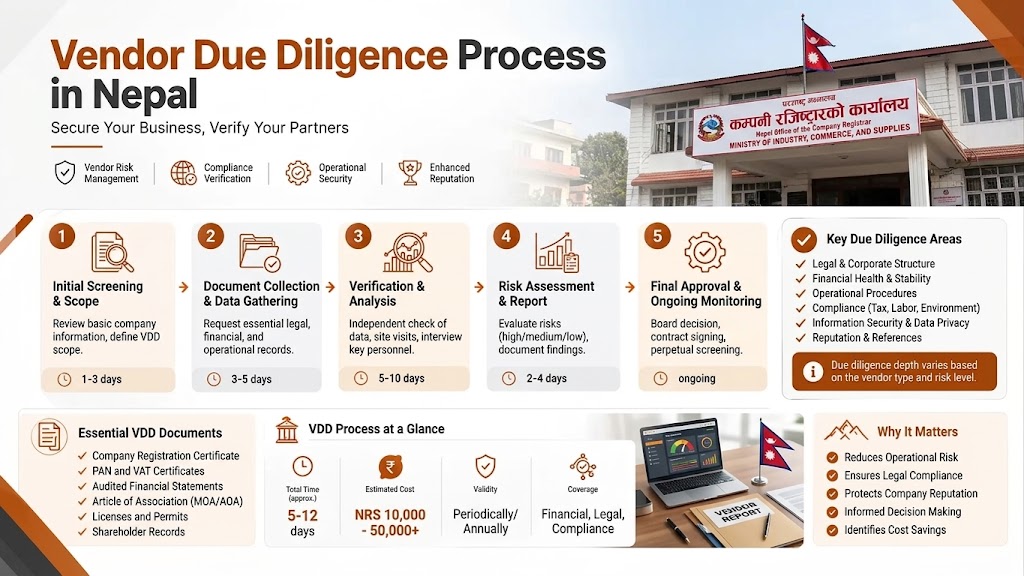
The vendor due diligence process in Nepal is the systematic investigation through which businesses evaluate potential suppliers before contractual relationships are established. When a company intends to engage with a new vendor, the legal status, financial health, and operational capacity of that supplier must be verified. Consequently, this process is regarded as essential for risk mitigation and regulatory compliance.
Furthermore, Nepal was placed on the FATF grey list in February 2025 due to weaknesses in anti-money laundering enforcement and beneficial ownership transparency. Therefore, the vendor due diligence process in Nepal has been placed under heightened scrutiny. Businesses are now required to demonstrate robust Know Your Customer and Know Your Business procedures to avoid regulatory penalties and reputational damage.
In this guide, the entire procedure is explained in a step-by-step manner. Moreover, the documents required, the regulatory framework, verification sources, and post-due diligence obligations are outlined in detail.
What Is the Vendor Due Diligence Process in Nepal?
The vendor due diligence process in Nepal is defined as the comprehensive assessment of a potential supplier’s legal standing, financial stability, tax compliance, and operational reliability. When this process is conducted properly, fraudulent entities, shell companies, and non-compliant vendors are identified before any commercial commitment is made.
Additionally, the investigation encompasses verification of company registration with the Office of the Company Registrar, tax status with the Inland Revenue Department, and industry registration with the Department of Industry. For higher-risk engagements, site visits, credit bureau checks, and beneficial ownership screening are also incorporated.
Notably, the vendor due diligence process in Nepal is not governed by a single statute. Instead, multiple laws create compliance obligations that businesses must verify during supplier assessments. These include the Companies Act, 2063, the Asset (Money) Laundering Prevention Act, 2064, and the Public Procurement Act, 2063.
Why the Vendor Due Diligence Process in Nepal Is Essential
The importance of conducting thorough vendor due diligence in Nepal cannot be overstated. When businesses fail to verify their suppliers, the following risks are encountered:
- Engagement with unregistered or dissolved companies
- Payment to vendors with outstanding tax liabilities
- Association with entities involved in money laundering
- Contractual disputes with financially insolvent suppliers
- Reputational damage from partnerships with non-compliant vendors
- Regulatory sanctions for inadequate AML and KYC procedures
Moreover, the Financial Intelligence Unit of Nepal and the Department of Money Laundering Investigation have intensified oversight of business transactions. Consequently, companies that neglect proper due diligence may be subject to penalties under the Asset (Money) Laundering Prevention Act, 2064.
In addition, the vendor due diligence process in Nepal is mandated for public procurement under the Public Procurement Act, 2063. Bidders are required to be disqualified if their qualification statements are found to be factually false or substantially incomplete.
Legal Framework Governing Vendor Due Diligence in Nepal
The vendor due diligence process in Nepal is supported by the following legal instruments:
| Legal Instrument | Relevance to Vendor Due Diligence |
|---|---|
| Companies Act, 2063 (2006) | Governs company registration, management, reporting obligations, and dissolution procedures |
| Asset (Money) Laundering Prevention Act, 2064 (2008) | Mandates KYC, KYB, and five-year record retention for financial and commercial relationships |
| Public Procurement Act, 2063 (2007) | Establishes qualification criteria and disqualification grounds for government contractors |
| Income Tax Act, 2058 (2002) | Regulates tax registration, filing, and compliance verification |
| Value Added Tax Act, 2052 (1996) | Mandates VAT registration and compliance for qualifying businesses |
| Labour Act, 2074 (2017) | Sets employment standards and worker protection requirements for vendor operations |
| Contract Act, 2056 (2000) | Establishes the legal framework for contractual relationships with vendors |
| Insolvency Act, 2063 (2006) | Governs bankruptcy proceedings affecting vendor financial stability |
| Foreign Investment and Technology Transfer Act, 2075 (2019) | Regulates foreign-owned vendors operating in Nepal |
| Individual Privacy Act, 2018 | Governs the collection, storage, and processing of personal data during due diligence |
Furthermore, the Nepal Rastra Bank has issued directives requiring financial institutions to maintain enhanced due diligence for high-risk customers. These standards are increasingly being adopted by the private sector as best practice for vendor screening.
Types of Vendor Due Diligence in Nepal
The vendor due diligence process in Nepal may be categorized into several types based on scope and complexity:
| Due Diligence Type | Scope | Typical Duration | Use Cases |
|---|---|---|---|
| Basic Due Diligence | Company registration verification, tax status check, basic financial review | 1–2 weeks | Low-value transactions, non-critical suppliers, routine purchases |
| Standard Due Diligence | Comprehensive legal, financial, and operational assessment | 3–4 weeks | Medium-value contracts, regular suppliers, standard procurement |
| Enhanced Due Diligence | Detailed investigation including site visits, third-party reports, extensive verification | 6–8 weeks | High-value contracts, strategic suppliers, critical services |
| Financial Due Diligence | In-depth financial analysis, credit assessment, payment capacity evaluation | 2–3 weeks | Large financial commitments, credit extension, long-term contracts |
| Legal Due Diligence | Detailed legal compliance review, litigation search, regulatory verification | 2–4 weeks | Complex contracts, regulated industries, high legal risk |
| Operational Due Diligence | Facility inspection, capacity assessment, quality system evaluation | 2–3 weeks | Manufacturing suppliers, technical services, production contracts |
| Reputational Due Diligence | Background checks, reference verification, market inquiry | 1–2 weeks | Brand-sensitive relationships, public-facing services |
Moreover, the appropriate type of due diligence is determined by the transaction value, risk exposure, and the criticality of the vendor to business operations.
Step-by-Step Vendor Due Diligence Process in Nepal
The following steps are required to be followed in sequential order to conduct a comprehensive and legally defensible vendor assessment.
Step 1: Define the Scope and Objectives
Before any investigation is initiated, the scope of the vendor due diligence process in Nepal must be clearly defined. The transaction value, risk exposure, and business requirements are required to be assessed. Consequently, the specific information sources, verification methods, and evaluation criteria are identified.
Furthermore, the internal approval workflow is required to be established. Procurement, finance, legal, and compliance departments are typically involved in the review process.
Step 2: Collect Vendor Documentation
Comprehensive documentation is required to be requested from the potential vendor. The following items are typically collected:
- Company registration certificate
- Memorandum and Articles of Association
- Permanent Account Number certificate
- Value Added Tax registration certificate
- Industry registration certificate (if applicable)
- Audited financial statements for the past three years
- Tax clearance certificates
- Bank reference letters
- Operational licenses and permits
- Ownership structure and beneficial ownership disclosure
- List of directors and key management personnel
- Client references and past performance records
- Insurance certificates
- Compliance declarations
Moreover, for foreign vendors, additional documents such as certificate of incorporation, embassy attestation, and foreign investment approval may be required.
Step 3: Verify Legal Registration and Compliance Status
The vendor’s legal status is required to be confirmed through independent verification. The Office of the Company Registrar is the primary source for checking company registration details, shareholding patterns, directorship information, and annual compliance status.
Additionally, the following verifications are required to be conducted:
| Verification Area | Authority | Method |
|---|---|---|
| Company Registration | Office of the Company Registrar | Online portal at ocr.gov.np or physical inspection |
| Tax Compliance | Inland Revenue Department | PAN verification and tax clearance status |
| Industry Registration | Department of Industry | Industry registration certificate verification |
| VAT Status | Inland Revenue Department | VAT registration number validation |
| Labour Compliance | Department of Labour | SSF registration and labour law adherence |
| Sector-Specific Licenses | Relevant regulatory bodies | License validity and renewal status |
Furthermore, pending litigation, regulatory violations, and compliance issues are required to be identified. These factors may significantly affect the vendor’s ability to fulfill contractual obligations.
Step 4: Assess Financial Stability and Creditworthiness
The vendor’s financial health is required to be analyzed through examination of audited financial statements. Balance sheets, profit and loss accounts, and cash flow statements for the past three years are reviewed.
The following financial indicators are evaluated:
- Liquidity position and working capital adequacy
- Debt-to-equity ratio
- Profitability trends
- Payment history and credit bureau records
- Outstanding tax liabilities
- Bank references and credit ratings
Moreover, for high-value contracts, a full financial due diligence may be commissioned. This involves detailed ratio analysis, cash flow stress testing, and assessment of contingent liabilities.
Step 5: Evaluate Operational Capacity and Reputation
The vendor’s ability to deliver goods or services is required to be assessed through operational due diligence. Site visits are conducted to verify physical infrastructure, production capacity, workforce strength, and quality management systems.
Additionally, the vendor’s market reputation is evaluated through:
- Client reference checks
- Market inquiries and industry feedback
- Media screening for negative coverage
- Review of past performance records
- Assessment of after-sales service capability
Consequently, a comprehensive picture of the vendor’s reliability and service quality is established.
Step 6: Conduct AML and Beneficial Ownership Screening
Under the Asset (Money) Laundering Prevention Act, 2064, businesses are required to identify the beneficial owners of their vendors. A beneficial owner is defined as the natural person who ultimately owns or controls the company, typically holding 15 percent or more of the capital.
Furthermore, the following screening measures are required to be implemented:
- Verification of shareholders holding 15 percent or more
- Screening against sanctions lists and regulatory blacklists
- Assessment of politically exposed person status
- Review of source of funds and wealth
- Evaluation of transaction patterns for suspicious activity
Moreover, the goAML system maintained by the Financial Intelligence Unit of Nepal is required to be used for reporting suspicious transactions. Since August 2023, all reporting entities must submit reports exclusively through this platform.
Step 7: Prepare the Due Diligence Report
All findings are required to be compiled into a comprehensive due diligence report. This document must include:
- Executive summary of findings
- Legal status and compliance verification results
- Financial stability assessment
- Operational capacity evaluation
- AML and reputational screening outcomes
- Risk grading and identified red flags
- Recommendations for vendor engagement, conditional approval, or rejection
- Suggested contractual safeguards and risk mitigation measures
Furthermore, the report is required to be presented to decision-makers with supporting documentation and clear next steps.
Documents Required for Vendor Due Diligence in Nepal
The following documents are required to be collected and verified during the vendor due diligence process in Nepal:
| Document | Purpose | Verified With |
|---|---|---|
| Company Registration Certificate | Confirms legal existence and good standing | Office of the Company Registrar |
| Memorandum and Articles of Association | Defines company objectives and governance | Office of the Company Registrar |
| PAN Certificate | Verifies tax registration status | Inland Revenue Department |
| VAT Registration Certificate | Confirms VAT compliance | Inland Revenue Department |
| Industry Registration Certificate | Validates industrial enterprise status | Department of Industry |
| Audited Financial Statements | Assesses financial health and stability | Independent auditor review |
| Tax Clearance Certificate | Confirms no outstanding tax liabilities | Inland Revenue Department |
| Bank Reference Letter | Verifies banking relationship and creditworthiness | Vendor’s bank |
| Operational Licenses and Permits | Confirms sector-specific authorization | Relevant regulatory authority |
| Ownership and Beneficial Ownership Disclosure | Identifies ultimate controllers | Company records and declarations |
| Director and Management Details | Assesses governance quality | Office of the Company Registrar |
| Insurance Certificates | Confirms risk coverage | Insurance provider verification |
| Client References | Validates market reputation | Direct reference checks |
| Compliance Declarations | Evidence of anti-bribery and AML policies | Vendor submission |
Moreover, for vendors engaged in public procurement, additional documents such as construction entrepreneur licenses, quality control certificates, and authorization from manufacturers may be required.
Timeline and Costs for Vendor Due Diligence
The vendor due diligence process in Nepal is generally completed within the following timeframe:
| Phase | Estimated Duration |
|---|---|
| Scope Definition and Internal Approval | 2–3 days |
| Document Collection from Vendor | 3–7 days |
| Legal and Compliance Verification | 3–5 days |
| Financial Analysis and Credit Check | 3–5 days |
| Operational Assessment and Site Visit | 3–7 days |
| AML Screening and Background Checks | 2–4 days |
| Report Compilation and Review | 2–3 days |
Total Estimated Time: 2 to 8 weeks, depending on complexity
The costs associated with the process are outlined below:
| Due Diligence Level | Estimated Cost (NPR) | Scope |
|---|---|---|
| Basic Due Diligence | NPR 35,000 – 50,000 | Registration verification, tax status, basic financial review |
| Standard Due Diligence | NPR 75,000 – 100,000 | Comprehensive legal, financial, and operational assessment |
| Enhanced Due Diligence | NPR 125,000+ | Detailed investigation with site visits, third-party reports, and full financial analysis |
Furthermore, additional costs may be incurred for translation services, specialized sectoral verification, and expedited processing.
Post-Due Diligence Compliance Obligations
After the vendor due diligence process in Nepal is completed, several ongoing obligations are required to be fulfilled:
- Formal contracts must be executed incorporating due diligence findings and risk mitigation provisions
- Periodic compliance verification must be conducted annually or biannually
- Updated financial statements are required to be reviewed to track vendor financial health
- Performance evaluations must be assessed against contractual commitments
- Risk profiles are required to be updated based on changing business conditions
- Documentation is required to be maintained for a minimum of seven years
- Audit rights under vendor agreements must be exercised periodically
- Clear termination procedures must be established for non-compliant vendors
Moreover, the Asset (Money) Laundering Prevention Act, 2064 mandates five-year minimum retention of customer transaction data and KYC documentation. Consequently, proper record-keeping is regarded as a legal obligation, not merely a best practice.
Common Mistakes to Avoid During Vendor Due Diligence
Several errors are frequently observed during the vendor due diligence process in Nepal. These mistakes are required to be avoided:
- Relying solely on vendor-provided documents without independent verification
- Failing to verify beneficial ownership and ultimate controllers
- Neglecting to check the vendor’s standing with the Office of the Company Registrar
- Overlooking tax compliance status and outstanding liabilities
- Skipping site visits for medium and high-risk vendors
- Inadequate screening against sanctions and regulatory blacklists
- Poor documentation of the due diligence process and findings
- Delaying periodic re-verification after initial onboarding
- Ignoring sector-specific licensing requirements
- Failing to incorporate due diligence findings into contractual terms
Moreover, it is strongly advised that professional legal and financial consultants be engaged for complex or high-value vendor relationships. Self-conducted due diligence is known to miss critical red flags, particularly in beneficial ownership identification.
Why Choose Corporatebizlegal Pvt Ltd for Vendor Due Diligence?
At Corporatebizlegal Pvt Ltd, the vendor due diligence process in Nepal is conducted with comprehensive legal expertise and regulatory insight. Our team possesses extensive experience in corporate law, anti-money laundering compliance, and financial analysis.
Moreover, our services include:
- Legal registration and compliance verification with OCR, IRD, and DOI
- Financial stability assessment and credit bureau analysis
- Beneficial ownership identification and AML screening
- Operational site visits and capacity evaluation
- Reputational background checks and reference verification
- Comprehensive due diligence report preparation
- Ongoing vendor monitoring and compliance advisory
Call to Action: If you require professional vendor due diligence services in Nepal, contact Corporatebizlegal Pvt Ltd today. Our experienced team will safeguard your business from supplier risks and ensure full regulatory compliance. Schedule your confidential consultation now.
Disclaimer
The information provided in this guide is intended for general informational and educational purposes only. It does not constitute legal advice, nor does it create an attorney-client relationship. The laws and regulations referenced herein are subject to amendment, and individual circumstances may vary. Readers are strongly advised to consult with a qualified legal professional before undertaking any vendor due diligence or commercial engagement. Corporatebizlegal Pvt Ltd disclaims all liability for any actions taken based on the contents of this publication.
References
For further reading and verification of the legal framework discussed in this guide, the following authoritative sources are referenced:
- Office of the Company Registrar, Nepal – Official portal for company registration verification and corporate records.
- Inland Revenue Department, Nepal – Government authority for tax registration, PAN verification, and tax clearance status.
- Department of Industry, Nepal – Regulatory body for industrial enterprise registration and verification.
- Nepal Rastra Bank – Central bank issuing AML directives and overseeing financial sector compliance.
- Financial Intelligence Unit, Nepal – Authority receiving suspicious transaction reports through the goAML system.
- Public Procurement Monitoring Office – Government body overseeing public procurement processes and bidder qualification.
- Ministry of Labour and Employment, Nepal – Authority for labour law compliance and social security verification.
- Department of Money Laundering Investigation – Investigative body for money laundering offences in Nepal.
- FATF – Financial Action Task Force – International standard-setting body for AML and counter-terrorist financing.
- World Bank Doing Business Report – Nepal – International benchmark for business regulations and procurement practices.
- International Finance Corporation (IFC) Nepal – Global authority on corporate governance and supply chain integrity standards.
- Asian Development Bank – Nepal – Regional development bank providing insights on Nepal’s regulatory and business environment.
- UNCITRAL Legislative Guide on Public Procurement – International reference for procurement best practices and vendor qualification standards.
End of Guide
This content has been prepared by Corporatebizlegal Pvt Ltd and is protected under applicable copyright laws. Unauthorized reproduction is prohibited.
Frequently Asked Questions
What is the vendor due diligence process in Nepal?
The vendor due diligence process in Nepal is the systematic investigation of a potential supplier's legal status, financial health, tax compliance, operational capacity, and reputation before a commercial relationship is established. It involves verification with government authorities, financial analysis, and risk assessment.
Why is vendor due diligence important in Nepal?
Vendor due diligence is essential to mitigate risks of fraud, money laundering, tax non-compliance, and financial instability. Furthermore, Nepal's placement on the FATF grey list in February 2025 has intensified the need for robust Know Your Business procedures.
How long does vendor due diligence take in Nepal?
Basic due diligence is completed in 1 to 2 weeks. Standard comprehensive due diligence requires 3 to 4 weeks. Enhanced investigations for high-risk or complex vendors may take 6 to 8 weeks.
What documents are required for vendor due diligence in Nepal?
Core documents include the company registration certificate, PAN and VAT certificates, audited financial statements, tax clearance certificates, operational licenses, ownership disclosure, bank references, and insurance certificates.
Where can company registration be verified in Nepal?
Company registration is verified with the Office of the Company Registrar, located in Tripureshwor, Kathmandu, or through their online portal at ocr.gov.np.
Is beneficial ownership verification mandatory in Nepal?
Yes. Under the Asset (Money) Laundering Prevention Act, 2064, beneficial ownership disclosure is required for entities holding 15 percent or more of a company's capital. Enhanced due diligence is mandated for high-risk relationships.
What laws govern vendor due diligence in Nepal?
The process is governed by the Companies Act, 2063, Asset (Money) Laundering Prevention Act, 2064, Public Procurement Act, 2063, Income Tax Act, 2058, VAT Act, 2052, Labour Act, 2074, Contract Act, 2056, and Insolvency Act, 2063.
How much does vendor due diligence cost in Nepal?
Costs range from NPR 35,000 for basic verification to NPR 125,000 or more for enhanced due diligence. The exact cost depends on the scope, vendor complexity, and required verification depth.
Can vendor due diligence be conducted without the vendor's knowledge?
No. Ethical and legal due diligence requires vendor cooperation for document submission, reference checks, and site access. Covert investigations may violate privacy laws and contractual good faith principles.
What happens if a vendor fails due diligence?
If significant red flags are identified, the vendor may be rejected, conditionally approved with enhanced monitoring, or engaged with specific contractual safeguards. The due diligence report provides recommendations based on risk tolerance.
Was this article helpful?
Let us know what you think!