
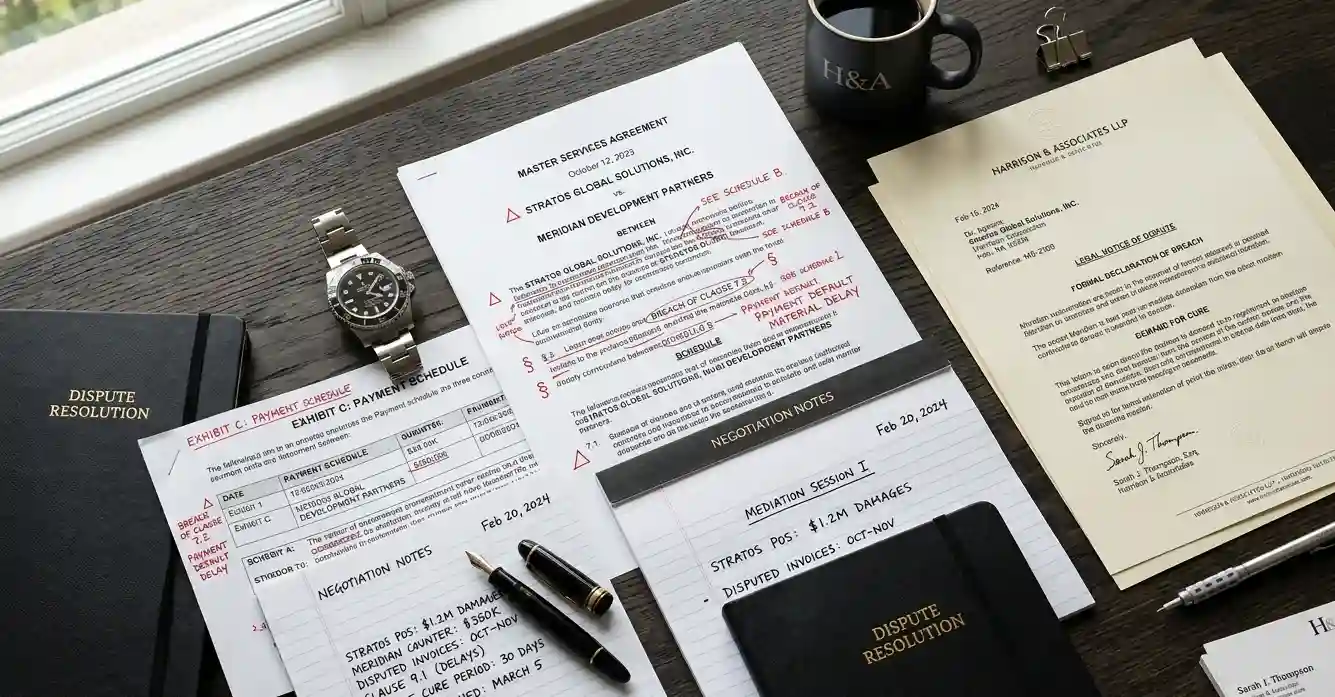
Contract dispute resolution in Nepal is the set of legal mechanisms—negotiation, mediation, arbitration, and civil litigation—used to enforce or terminate contractual rights under the Contract Act, 2074 and the National Civil Procedure Code, 2074. It ensures breaches are remedied through courts or approved tribunals.
TL;DR:
A contract dispute lawyer in Nepal helps you enforce or terminate contractual rights when the other party breaches an agreement. Our firm drafts demand letters, files arbitration or court suits, and secures judgment enforcement so you can recover losses efficiently.
When should you hire a contract dispute lawyer in Nepal?
- The counter‑party refuses to deliver goods or services despite a valid contract under the Contract Act, 2074.
- Payment defaults trigger statutory interest and penalties that require precise calculation.
- Ambiguous clauses lead to conflicting interpretations affecting liability.
- An arbitration clause exists but the opposing side disputes the award or tribunal jurisdiction.
- A regulator such as Nepal Rastra Bank issues a compliance notice that hinges on contract performance.
Key Nepali statutes and courts involved
- Contract Act, 2074 – defines rights, obligations, and remedies for breaches.
- National Civil Procedure Code, 2074 – governs filing and conduct of civil suits.
- Arbitration Act, 2055 – provides the framework for institutional arbitration.
- Mediation Act, 2068 – allows court‑connected mediation ordered by the District Court.
- Limitation Act – sets the three‑year limitation period for breach claims.
How to navigate a contract dispute in Nepal
Initial assessment & document collection:
Gather the original contract, amendments, correspondence, invoices, and any regulatory notices.
Ensure foreign‑language documents are translated and certified; the District Court rejects filings lacking proper Nepali translation.
Pre‑litigation negotiation
Draft a formal demand letter citing the specific breach and statutory remedies under the Contract Act. A successful negotiation can settle the matter without incurring court fees or arbitration costs.
Mediation or arbitration (if contract‑specified)
File a request with the designated arbitral institution under the Arbitration Act, 2055. Institutional backlogs may add months; the Mediation Act, 2068 permits the District Court to order mediation even without an arbitration clause.
Filing a civil suit
Submit a plaint in the appropriate District Court, attaching verified copies of the contract and proof of breach. The Court Fees Act determines filing fees based on the claim amount.
Court hearings & evidence presentation
Present documentary and oral evidence; the court may issue interim orders such as injunctions to halt further breaches.
Judgment & enforcement
Obtain damages, interest, and costs; enforce the judgment through the execution process under the Civil Procedure Code. For arbitral awards, the Supreme Court can confirm enforcement under the New York Convention, provided public policy is respected.
Our practical support in contract disputes
- Conduct a contract audit to spot missing signatures, vague clauses, and translation gaps.
- Prepare and file demand letters, arbitration requests, or mediation applications.
- Represent you in District Court, manage evidentiary objections, and coordinate enforcement with the Supreme Court when necessary.
Typical fees and timelines
- Negotiated settlement: often resolved within weeks, saving litigation costs.
- Arbitration: usually 3–6 months, depending on the institution’s schedule.
- District Court suit: typically 9–18 months due to docket congestion.
Fee structure is transparent: an initial retainer plus hourly rates for negotiation, arbitration filing, and court representation. Periodic cost estimates are provided to keep budgeting predictable.
Common pitfalls and compliance risks
- Missing arbitration clause – forces costly court litigation.
- Untranslated contracts – leads to filing rejections and delays.
- Overlooking limitation periods – may bar a claim under the Limitation Act.
- Incorrect interest calculations – reduces recoverable amounts.
- Incomplete regulatory filings – trigger additional compliance notices from bodies such as the Department of Industry.
What clients receive
- A detailed legal memorandum outlining rights, liabilities, and recommended actions.
- Drafted demand letters, settlement proposals, or arbitration submissions.
- Court‑filed plaints, evidence bundles, and procedural motions.
- Final judgment or arbitral award with clear enforcement instructions.
- Ongoing advisory updates on related compliance obligations.