

Table of Contents

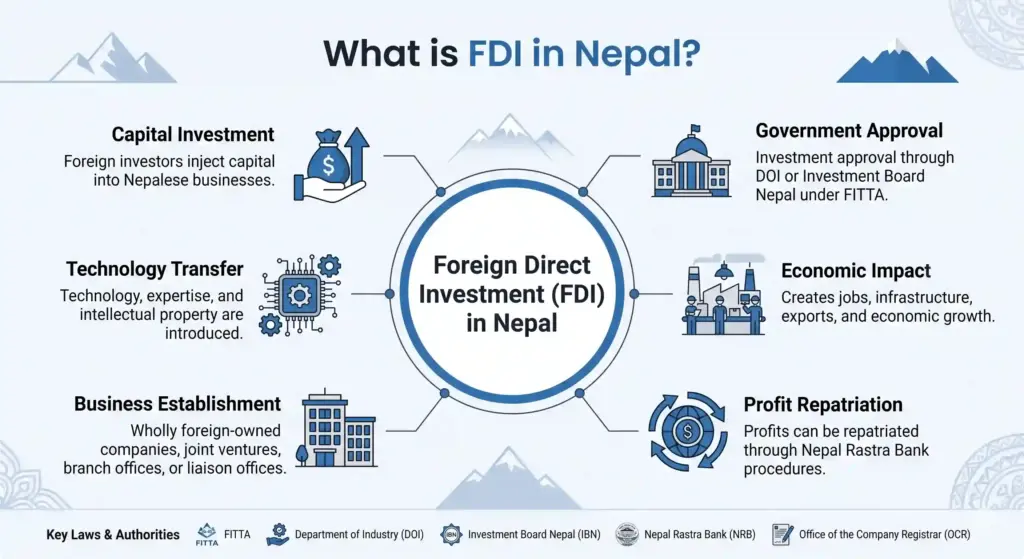
Foreign Direct Investment (FDI) in Nepal allows foreign individuals, companies, and institutions to invest in Nepal through equity investment, technology transfer, joint ventures, share acquisitions, and other forms permitted under the Foreign Investment and Technology Transfer Act, 2019 (FITTA). Most foreign investments require prior approval from the Department of Industry (DOI) or the Investment Board Nepal (IBN), followed by company registration, Nepal Rastra Bank (NRB) compliance, and industry-specific licensing where applicable.
Nepal has become an increasingly attractive investment destination due to its strategic location between India and China, growing infrastructure, competitive workforce, expanding IT sector, and investor-friendly legal reforms. With foreign ownership permitted in most industries and simplified approval procedures, Nepal offers significant opportunities for international investors.
This guide explains everything you need to know about FDI in Nepal, including eligibility, approval procedures, required documents, restricted sectors, company registration, taxation, profit repatriation, compliance requirements, and practical legal considerations for investing successfully in Nepal.
FDI in Nepal at a Glance: Key Facts
| Attribute | Details |
|---|---|
| Governing Legislation | Foreign Investment and Technology Transfer Act, 2019 (FITTA); Industrial Enterprises Act, 2020; Companies Act, 2006; Foreign Exchange (Regulation) Act, 1962; Income Tax Act, 2002; Labor Act, 2017 |
| Primary Approval Authority (≤ NPR 6 billion) | Department of Industry (DOI) |
| Primary Approval Authority (> NPR 6 billion) | Investment Board Nepal (IBN) |
| Company Registration | Office of Company Registrar (OCR) |
| Tax Authority | Inland Revenue Department (IRD) |
| Central Bank | Nepal Rastra Bank (NRB) |
| Minimum Investment | NPR 20 million (~USD 150,000); no minimum for IT sector under automatic route |
| Foreign Ownership | 100% permitted in most sectors; caps apply to aviation, telecom, banking, insurance, media |
| Capital Repatriation | Permitted after tax clearance; NRB recording required; decentralized to commercial banks as of December 2025 |
| Business Visa | Non-tourist/business visa issued by Department of Immigration on DOI recommendation; fees vary by investment size |
| Corporate Tax Rate | 25% standard; 30% for banks, insurance, telecom, petroleum, tobacco, alcohol |
| Dividend Withholding Tax | 5% |
| Royalty/Interest WHT | 15% |
| Standard Approval Timeline | Statutory: 15 working days; Practical: 30–60 days |
What is Foreign Direct Investment (FDI) in Nepal?
In short, FDI in Nepal requires formal foreign investment approval from the Department of Industry or Investment Board Nepal before incorporation — unlike domestic investment, which needs no such pre-clearance.
The Legal Definition of Foreign Investment Under FITTA
Under Section 2(j) of FITTA 2019, foreign investment encompasses: (a) investment in shares of a Nepalese company in foreign currency; (b) reinvestment of earnings derived from foreign investment; (c) lease financing of airlines, ships, plants, and machinery above prescribed thresholds; (d) investment in venture capital funds approved by the Securities Board of Nepal (SEBON); (e) investment in listed securities through secondary markets; (f) investment through acquisition of shares or assets of an existing Nepalese company; (g) investment through technology transfer agreements; and (h) investment made by establishing or expanding an industry in Nepal.
Critically, FITTA excludes foreign loans from the definition of foreign investment, treating them as a separate instrument regulated under Section 12 and subject to distinct Nepal Rastra Bank guidelines. Foreign loans may only be obtained from financial institutions, not from parent companies or private enterprises, unless specifically structured through approved channels.
Economic Significance
FDI constitutes one of Nepal’s principal sources of external finance, particularly in sectors where domestic capital formation is insufficient. Hydropower, tourism infrastructure, information technology, and manufacturing have historically attracted the largest foreign capital inflows. The government’s policy orientation reflected in the Industrial Enterprises Act, 2020 and periodic gazette notifications favors export-oriented, import-substituting, and employment-generating industries.
Domestic Investment vs. Foreign Investment in Nepal
The fundamental legal distinction lies in the approval requirement. Domestic investors may register a company at the Office of Company Registrar without sectoral pre-approval (subject to general licensing requirements). Foreign investors, conversely, must obtain foreign investment approval from DOI or IBN before company incorporation.
This two-tier system means that foreign investors cannot simply purchase shares in an existing private company or complete a foreign company registration in Nepal without first clearing the foreign investment gateway.
Common Forms of FDI in Nepal
In our experience assisting foreign investors, the most common structures for FDI in Nepal are:
- Greenfield Equity Investment: Establishing a wholly foreign-owned company or Joint Venture private limited company.
- Brownfield Share Acquisition: Purchasing shares in an existing Nepalese company, now simplified under the December 2025 NRB reforms.
- Technology Transfer: Licensing patents, trademarks, or technical know-how to a Nepalese entity, often combined with minority equity.
- Foreign Loan: Debt financing from international lenders, subject to NRB debt-equity and interest rate regulations.
- Branch Operations: Establishing a branch office of a foreign-owned company in Nepal, permitted only in specific sectors.
Why Invest in Nepal? Key Advantages of Doing Business in Nepal
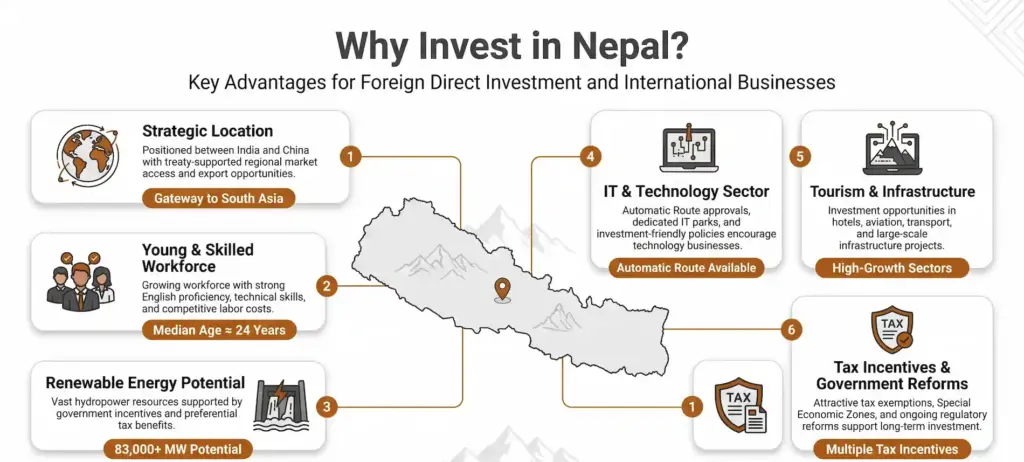
Strategic Location and Market Access
Nepal sits between two of the world’s largest economies. While the country is landlocked, it enjoys duty-free access to the Indian market under the India-Nepal Treaty of Trade, and preferential access to China’s Tibet Autonomous Region through established border points. For manufacturers seeking to serve South Asian markets, Nepal offers a cost-competitive base with treaty-backed export privileges.
Young Workforce
With a median age of approximately 24 years, Nepal possesses a demographic dividend that few regional competitors can match. The workforce is increasingly literate, English-proficient, and technologically adaptable particularly in the IT and business process outsourcing sectors.
Renewable Energy
Nepal’s theoretical hydropower potential exceeds 83,000 megawatts, of which less than 2% has been developed. The government has prioritized hydropower as a strategic sector, offering concessional tax rates of 20% (down from the standard 25%) and 100% tax exemption for the first ten years of commercial operation for projects meeting certain timelines.
IT and Technology Investment in Nepal
The information technology sector enjoys unique regulatory advantages. There is no minimum investment threshold for IT industries approved through the Automatic Route, and the government has established dedicated IT parks with substantial tax rebates. The Automatic Route in Nepal itself introduced in October 2023 allows investments up to NPR 500 million (approximately USD 3.75 million) in IT, energy, tourism, and infrastructure without case-by-case DOI approval.
Tourism and Infrastructure
Nepal’s tourism sector, while cyclical, remains a cornerstone of the economy. Foreign investment is permitted in hotels, resorts, adventure tourism infrastructure, and aviation services (subject to equity caps). Infrastructure development including roads, bridges, tunnels, and airports falls under the Public-Private Partnership and Investment Act, 2019, which provides a structured framework for large-scale projects.
Government Reforms and Tax Incentives
Beyond sector-specific concessions, the Special Economic Zone Act, 2016 offers 100% income tax exemption for the first five to ten years (depending on location), followed by 50% rebates. Manufacturing industries, tourism services, and hydropower companies listed on the Nepal Stock Exchange enjoy a reduced 15% corporate tax rate.
Legal Framework Governing Foreign Direct Investment in Nepal
Nepal’s FDI regime is not contained in a single statute. Rather, it operates as an interlocking system of laws where compliance with one triggers obligations under several others. Understanding how these laws interact throughout the investment lifecycle is essential for avoiding regulatory deadlock.
FITTA Nepal: Foreign Investment and Technology Transfer Act, 2019
FITTA is the cornerstone legislation. It establishes the definitions, approval procedures, sectoral restrictions, minimum investment thresholds, technology transfer rules, and repatriation guarantees. The 2025 amendments to FITTA expanded the scope of technology transfer to include IT, management, outsourcing, and engineering services, and strengthened the legal basis for cross-border service-based investments.
Industrial Enterprises Act, 2020
This Act classifies industries by capital size and scope, governs industry registration, and prescribes incentives. A foreign investment can only be made in an activity classified as an “industry” under this Act. If the proposed activity does not meet the statutory definition of an industry, DOI will reject the FDI application regardless of its economic merit.
Companies Act, 2006: Company Registration in Nepal
All foreign-invested entities must complete company registration in Nepal under the Companies Act. The Act governs shareholding structures, director appointments, annual general meetings, audit requirements, and dissolution procedures. Foreign investors should pay particular attention to the distinction between private and public companies: a private limited company requires a minimum of one shareholder and one director, while a public limited company requires seven shareholders and NPR 10 million in authorized capital.
Foreign Exchange (Regulation) Act, 1962 and NRB Foreign Investment Bylaws
The Foreign Loan and Investment Management Bylaws, 2078 (2021), as amended most recently in December 2025, regulate how foreign currency enters and exits Nepal. The Fifth Amendment represents a paradigm shift for NRB foreign investment: prior NRB approval for equity inflows is no longer required once DOI or IBN approval is obtained, and repatriation approvals have been decentralized to A-Class commercial banks (with NRB retaining oversight only where funds are repatriated to a country other than the original source country).
Income Tax Act, 2002
The Income Tax Act governs corporate taxation, withholding taxes on dividends (5%), interest and royalties (15%), capital gains, and transfer pricing. Resident companies are taxed on worldwide income; non-resident companies are taxed only on Nepal-sourced income. A foreign permanent establishment—defined broadly to include technical service provision exceeding 90 days in a 12-month period is subject to 25% corporate tax and 5% branch remittance tax.
Labor Act, 2017 and Social Security Act, 2017
These laws govern employment contracts, working conditions, foreign worker permits, and the Social Security Fund (SSF). Every employer must contribute 20% of an employee’s basic salary to SSF, while the employee contributes 11%. Foreign workers require work permits, which are only issued after a labor market test demonstrates that no qualified Nepali candidate is available.
How to Get FDI Approval in Nepal: The Step-by-Step FDI Process
The FDI process in Nepal follows ten sequential legal milestones: structure selection, due diligence, application preparation, DOI/IBN approval, company registration, tax registration, bank account opening, capital remittance with NRB recording, visas and work permits, and industry-specific licensing. Each step below is explained not merely as a procedural checkbox, but as a legal milestone with practical implications for the investor’s risk exposure, timeline, and compliance burden.
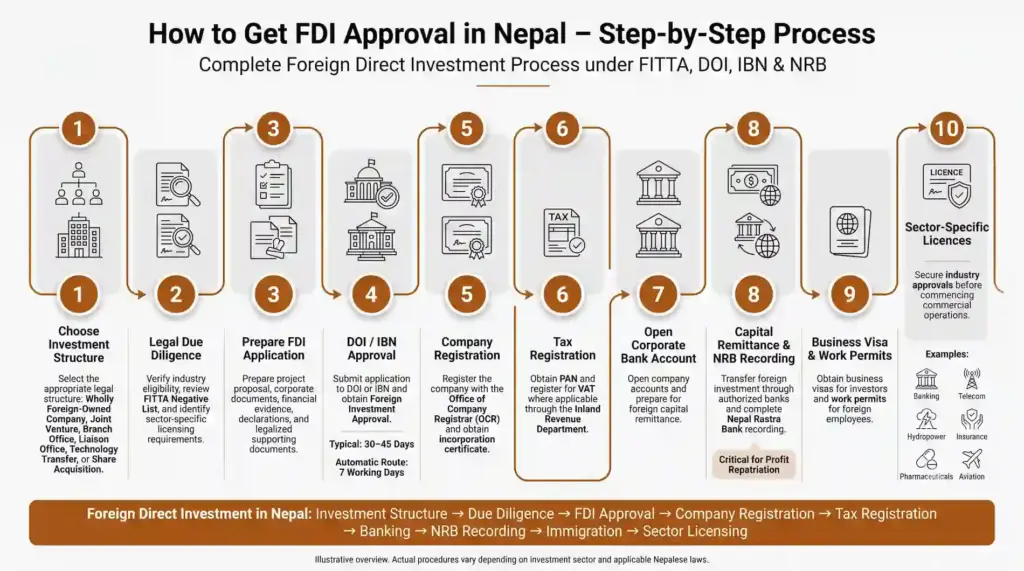
Step 1 : Choosing the Appropriate Investment Structure
Before drafting a single document, the investor must determine the legal vehicle through which Nepal will be accessed. This decision is rarely reversible without tax and regulatory consequences.
Wholly Foreign-Owned Company: A private limited company with 100% foreign shareholding, permitted in most sectors. This structure offers complete operational control but requires the full minimum investment commitment (NPR 20 million).
Joint Venture: A private or public limited company with both foreign and Nepali shareholders. A Joint Venture in Nepal is advisable where local market knowledge, government relations, or sectoral requirements (such as media or domestic courier services) mandate Nepali participation. The Joint Venture Agreement should be negotiated before FDI application, as DOI will examine its terms during approval.
Branch Office: A foreign company may establish a branch in Nepal, but only after obtaining DOI approval. Branches are limited to specific sectors and do not enjoy separate legal personality; the foreign parent bears unlimited liability for branch obligations. Branches are generally disfavored for operational businesses but may be appropriate for project-specific contracting.
Liaison Office: Permitted for market research and coordination only, cannot engage in revenue-generating activities, enter contracts, or remit profits, and must be converted to a branch or company before commercial operations begin.
Technology Transfer: Foreign entities may transfer technology to Nepalese companies without equity participation, receiving royalties in return. The technology transfer agreement must be approved by DOI and registered under FITTA. Royalty payments are subject to 15% withholding tax and must be commercially justified.
Share Acquisition: Acquiring shares in an existing Nepalese company has become significantly easier following the December 2025 NRB reforms. Previously, brownfield investments required separate NRB foreign exchange approval; now, once DOI or IBN approves the share purchase, capital may be remitted through authorized banking channels with only post-transaction NRB recording required.
Step 2 : Legal and Regulatory Due Diligence
In our experience, the most expensive mistake a foreign investor can make is to assume that a business model viable in another jurisdiction will automatically pass muster in Nepal. Due diligence at this stage should address three questions:
First, is the proposed activity classified as an “industry” under the Industrial Enterprises Act, 2020? Trading, pure retail, real estate speculation, and personal services are excluded. If the activity falls outside the statutory definition, no amount of investment will secure DOI approval.
Second, does the activity appear on FITTA’s Negative List? The Negative List prohibits foreign investment in primary agriculture, cottage and small industries, personal service businesses, arms and ammunition, real estate trading, retail business, internal courier and remittance services, travel agencies, mass media in national languages, and consultancy services where foreign equity exceeds 51% see the full Negative List table below.
Third, are there sector-specific equity caps or licensing requirements? Airlines, telecommunications, banking, insurance, and pharmaceuticals all require additional approvals from sectoral regulators (Civil Aviation Authority, Nepal Telecommunications Authority, Nepal Rastra Bank, Insurance Board, Department of Drug Management, respectively).
Step 3 : Preparing the Foreign Investment Approval Application
The FDI application to DOI (for investments up to NPR 6 billion) or IBN (for larger investments) must be comprehensive, coherent, and commercially credible. Incomplete applications are the primary cause of approval delays. Many foreign investors overlook that the project proposal itself functions as a binding commitment, not a marketing document.
Documents required at this stage include:
- Project Proposal: A detailed report covering project background, market analysis, technical specifications, financial projections, and fund sources. This document effectively serves as the investor’s legal commitment to the Nepalese government.
- Corporate Documents: Certificate of incorporation, Memorandum and Articles of Association, and board resolution authorizing the investment. If the shareholder is a corporate entity, these must be notarized and apostilled (or legalized through the Nepalese embassy) in the country of origin.
- Financial Credibility Certificate: A bank reference letter from the investor’s home country bank confirming financial capacity.
- Passport Copies: For individual investors, or for directors of corporate investors.
- Power of Attorney: If a local representative will handle the application process.
- Commitment Letter: A written undertaking that the foreign investor will not repatriate the initial investment for at least one year.
- Joint Venture Agreement: If applicable, signed by all parties.
- Source of Investment Declaration: Explaining the origin of funds to satisfy anti-money laundering requirements.
Notarization, Legalization, and Translation: All foreign documents must be notarized in the country of origin. Depending on whether Nepal is a signatory to the Hague Apostille Convention with that country, either an apostille or full embassy legalization is required. Documents in languages other than English must be translated by a certified translator. In practice, DOI examiners will reject applications where document authentication is inconsistent, so this step should not be treated as a mere formality.
Step 4 : Foreign Investment Approval Timeline in Nepal
Timeline: Once the application is submitted, the statutory timeline for DOI approval is 15 working days from the date of complete application. In practice, however, the process typically extends to 30–45 days, particularly if the application raises sectoral questions or if the Industrial Promotion Board (which reviews large applications) convenes infrequently.
For investments up to NPR 500 million in energy, infrastructure, tourism, and IT, the Automatic Route in Nepal eliminates case-by-case DOI review. The investor submits a standardized application through the One-Stop Service Centre, and approval is granted within 7 working days provided all documents are in order.
The approval letter will specify conditions, covenants, and timelines for capital injection. Critically, FITTA requires foreign investors to bring in capital according to a prescribed schedule: 25% of the total approved amount for investments of NPR 20 million; 15% for amounts between NPR 20 million and NPR 250 million; 10% for amounts between NPR 250 million and NPR 1 billion; and 5% for amounts above NPR 1 billion. At least 70% of the approved investment must be injected before commercial production or operation begins, with the remaining 30% within two years. Failure to meet these timelines can result in revocation of approval.
Step 5 : Foreign Company Registration in Nepal
With FDI approval in hand, the investor must complete company registration in Nepal at the Office of Company Registrar (OCR) within the timeframe specified in the approval letter (typically within 3–7 working days of approval).
View or company registration service.
The Process:
- Name Reservation: Submit a name reservation application through the OCR online portal. The proposed name must not conflict with existing registered entities.
- Document Preparation: Draft the Memorandum of Association (defining objectives, capital, and shareholder structure) and Articles of Association (governing internal management). For foreign-invested companies, these must align precisely with the FDI approval letter.
- Online Submission: Submit signed MOA, AOA, application form, and supporting documents through the OCR portal.
- Examination and Approval: OCR examines the documents for compliance with the Companies Act. This typically takes 1–3 working days.
- Certificate Issuance: Upon approval, OCR issues the Company Registration Certificate, which serves as the company’s legal birth certificate.
Practical Considerations: The MOA and AOA should be drafted with future flexibility in mind. Amendments to objectives or capital structure require shareholder resolutions and OCR filings, which can delay subsequent investment rounds or strategic pivots. We strongly recommend that foreign investors include pre-emptive rights, drag-along/tag-along provisions, and clear dispute resolution clauses in the AOA at the outset.
Step 6 : PAN, VAT, and Tax Registration
Immediately after incorporation, the company must obtain a Permanent Account Number (PAN) from the Inland Revenue Department. This can typically be completed within one working day through the IRD’s online portal. PAN registration is mandatory for all business transactions, tax filings, and withholding tax compliance.
If the company’s annual taxable turnover exceeds NPR 5 million, or if it engages in activities mandating VAT (such as manufacturing, trading, or services above the threshold), VAT registration at 13% is required. Voluntary VAT registration is also permitted and may be advisable for companies seeking to claim input tax credits on capital expenditures.
Step 7 : Opening Corporate Bank Accounts
The company must open a corporate bank account with any licensed Nepalese commercial bank. The bank will require the company registration certificate, PAN certificate, board resolution authorizing account opening, and identification documents of authorized signatories.
For foreign-invested companies, the bank account serves a dual purpose: it is the operational account for domestic transactions and the designated foreign currency account for receiving capital injections from abroad. The bank will issue a Foreign Investment Certificate upon receipt of foreign currency, which is a prerequisite for NRB recording.
Step 8 : Capital Remittance and NRB Foreign Investment Recording
This step has been materially simplified by the December 2025 NRB foreign investment reforms. Previously, foreign investors needed prior NRB approval before remitting equity capital. Now, once DOI or IBN approval is obtained, foreign capital may be remitted directly through authorized banking channels. The bank issues the Foreign Investment Certificate, and the company must apply to NRB for recording (not approval) of the investment within six months of receipt.
The NRB recording application requires submission of: the FDI approval letter; company registration certificate; industry registration certificate; tax registration certificate; Foreign Investment Certificate from the bank; audited financial statements (if the company is already operational); and a non-blacklist certificate from the Credit Information Bureau.
NRB recording is not a mere formality. The recording certificate is the legal foundation for all future repatriation of dividends, capital gains, and liquidation proceeds. Without it, foreign currency cannot lawfully leave Nepal.
Step 9 : Business Visas and Work Permits
Foreign investors and their key personnel require appropriate immigration status. Nepal does not offer a dedicated “investor visa” per se; rather, foreign investors obtain business visas or non-tourist visas based on their investment status.
Business Visa: Issued by the Department of Immigration on recommendation from DOI. Eligible persons include foreign investors who have obtained FDI approval, their authorized representatives, and export traders. The application requires: DOI recommendation letter; company registration certificate; industry registration certificate; tax clearance; passport copies; and bio-data. Fees are structured by investment size:
| Investment Size | Visa Fee |
|---|---|
| Below NPR 10 million | USD 35/month or USD 400/year |
| NPR 10 million – 100 million | USD 20/month or USD 200/year |
| Above NPR 100 million | Exempt from visa fees |
Work Permits: Foreign employees (as distinct from investors) require work permits under the Labor Act. The employer must first advertise the position nationally to demonstrate that no qualified Nepali candidate is available. The Department of Labor then reviews the application, seeks a no-objection from the Ministry of Home Affairs, and issues the permit. Work permits are typically granted for chief executives of foreign-funded enterprises and technical personnel for short-term projects.
Business Visa process in Nepal
Step 10 : Industry-Specific Licences Before Operations
Depending on the sector, the company may need additional licenses before commencing operations:
| Sector | Regulator | Key Licence/Approval |
|---|---|---|
| Hydropower | Department of Electricity Development | Generation licence, survey licence |
| Aviation | Civil Aviation Authority of Nepal | Air operator certificate, maintenance approval |
| Banking/Finance | Nepal Rastra Bank | Banking licence, BFIs licence |
| Insurance | Insurance Board | Insurance company licence |
| Telecommunications | Nepal Telecommunications Authority | Telecom service licence |
| Pharmaceuticals | Department of Drug Management | Drug manufacturing/import licence |
| Mining | Department of Mines and Geology | Mining licence, exploration permit |
| Education | Ministry of Education | School/college operation permit |
In practice, these sectoral approvals can take longer than the FDI approval itself. We advise clients to run sectoral licensing applications in parallel with, rather than sequentially after, the FDI process where legally permissible.
Comparing FDI Investment Structures in Nepal
| Structure | Legal Personality | Liability | Repatriation | Best For |
|---|---|---|---|---|
| Wholly Foreign-Owned Company | Separate | Limited to capital | Dividends, capital gains | Manufacturing, IT, services, full control |
| Joint Venture | Separate | Limited to capital | Dividends, capital gains | Sectoral requirements, local knowledge |
| Branch Office | Extension of parent | Unlimited parental liability | Remittance of branch profits | Project contracting, specific sectors |
| Liaison Office | Extension of parent | Unlimited parental liability | Not permitted (non-revenue) | Market research, coordination |
| Technology Transfer | N/A (contractual) | N/A | Royalties, fees | IP licensing, know-how without equity |
| Share Acquisition | Separate (existing) | Limited to shares | Dividends, capital gains | Buying operational businesses |
Who Can Invest in Nepal as a Foreign Investor?
FITTA defines “foreign investor” expansively to include: foreign individuals; foreign firms and companies; non-resident Nepalis (NRNs); foreign governments and international agencies; foreign institutional investors; and the ultimate beneficial owners of foreign investing entities.
This broad definition has practical implications. A foreign private equity fund investing through a Cayman Islands vehicle must disclose its ultimate beneficial owners to DOI. A non-resident Nepali holding a foreign passport is treated as a foreign investor for FDI purposes but may enjoy certain emotional and practical advantages in local negotiations. Institutional investors, including venture capital funds, may invest subject to SEBON approval.
Restricted Sectors for Foreign Investment in Nepal: The FITTA Negative List
Nepal maintains a Negative List approach: all sectors are open to foreign investment approval in Nepal unless explicitly restricted. The following table summarizes the current restrictions under FITTA 2019 and subsequent gazette notifications:
| Category | Sector/Activity | Foreign Investment Status |
|---|---|---|
| Prohibited | Primary agriculture (animal husbandry, fisheries, beekeeping, fruits, vegetables, oilseeds, pulses, dairy—unless large industry exporting 75%+ output) | 0% |
| Prohibited | Cottage and small industries | 0% |
| Prohibited | Personal service businesses (hair cutting, tailoring, driving training) | 0% |
| Prohibited | Arms, ammunition, explosives, NBC weapons, atomic energy, radioactive materials | 0% |
| Prohibited | Real estate trading (construction permitted) | 0% |
| Prohibited | Retail business (except international chains meeting NPR 100 million threshold) | 0% |
| Prohibited | Internal courier service, local catering, money changer, remittance service | 0% |
| Prohibited | Travel agencies, trekking/mountaineering guides, rural tourism/homestays | 0% |
| Prohibited | Mass media (newspaper, radio, TV, online news in national language), national language films | 0% |
| Restricted | Management, accounting, engineering, legal consultancy, language/music/computer training | ≤51% foreign equity |
| Restricted | Ride-sharing services | ≤70% foreign equity |
| Restricted | International airlines | ≤80% foreign equity |
| Restricted | Domestic airlines | ≤49% foreign equity |
| Restricted | Aviation training/maintenance institutes | ≤95% foreign equity |
| Restricted | Telecommunications | ≤80% foreign equity |
| Restricted | Banking | ≤85% foreign equity (subject to NRB policy) |
| Restricted | Insurance | ≤80% foreign equity |
Documents Required for FDI Approval in Nepal
Rather than repeating checklists at each stage, investors should understand the documentary ecosystem of Nepalese FDI, summarized below:
| Document | Purpose | Authentication Required |
|---|---|---|
| Project Proposal | Demonstrates commercial viability to DOI/IBN | Signed by applicant |
| Corporate Resolution | Authorizes the investment and appoints representatives | Notarized, apostilled/legalized |
| Certificate of Incorporation (foreign parent) | Proves legal existence of investor | Notarized, apostilled/legalized |
| MOA/AOA of foreign parent | Shows corporate capacity and objects | Notarized, apostilled/legalized |
| Financial Credibility Certificate | Confirms ability to fund investment | Issued by foreign bank |
| Passport/Director IDs | Identity verification | Certified copy |
| Power of Attorney | Authorizes local representative | Notarized |
| Joint Venture Agreement | Governs relationship with Nepali partner | Registered with DOI |
| FDI Approval Letter | Gateway document for all subsequent steps | Original from DOI/IBN |
| Company Registration Certificate | Legal proof of Nepalese entity | Original from OCR |
| PAN/VAT Certificate | Tax compliance | Original from IRD |
| Industry Registration Certificate | Classifies business under Industrial Enterprises Act | Original from DOI |
| Foreign Investment Certificate | Proof of capital remittance | Issued by commercial bank |
| NRB Recording Certificate | Foundation for repatriation rights | Original from NRB |
| Non-Blacklist Certificate | Confirms no adverse credit history | Issued by Credit Information Bureau |
Government Authorities Overseeing FDI in Nepal
Understanding how these authorities interact prevents the common mistake of treating them as siloed checkpoints rather than nodes in a continuous regulatory chain.
Department of Industry (DOI): The primary gatekeeper for foreign investment approval in Nepal. DOI issues the FDI approval, registers the industry, and provides the recommendation for business visas. DOI examiners review not only legal compliance but also economic policy alignment. In practice, a well-drafted project proposal that clearly articulates employment creation, technology transfer, or export potential will move faster through DOI than a bare-bones legal submission.
Investment Board Nepal (IBN): Handles investments exceeding NPR 6 billion and strategic infrastructure projects. IBN operates with greater political oversight and often coordinates directly with the Prime Minister’s Office. For mega-projects, IBN approval may be accompanied by negotiated incentives packages not available through the standard DOI process.
Office of Company Registrar (OCR): Incorporates companies and maintains the national company registry. OCR’s examination is technical rather than policy-driven. However, OCR will reject applications where the MOA/AOA conflict with the FDI approval letter or where shareholder structures are ambiguous.
Nepal Rastra Bank (NRB): The central bank’s role has shifted from pre-approval gatekeeper to post-transaction supervisor. NRB no longer approves equity inflows but records them. NRB retains approval authority for repatriation to third countries (other than the source country) and oversees foreign loan agreements. NRB’s Foreign Exchange Department also monitors compliance with debt-equity ratios and interest rate caps on foreign loans.
Inland Revenue Department (IRD): Administers corporate income tax, VAT, withholding taxes, and transfer pricing. IRD has become increasingly sophisticated in scrutinizing cross-border payments, particularly royalties and management fees. Foreign-invested companies should maintain contemporaneous documentation justifying the commercial rationale for related-party transactions.
Department of Labour: Issues work permits for foreign nationals and enforces labor law compliance, including Social Security Fund contributions. Labour inspectors conduct periodic audits, and non-compliance can result in fines up to NPR 500,000 and operational restrictions.
Local Governments (Ward Offices): Every company must register at the local ward office where its registered office is located. This registration, while procedurally simple, is mandatory for obtaining trade licenses and utility connections.
Profit Repatriation in Nepal
FITTA guarantees foreign investors the right to repatriate profits and capital, subject to tax compliance and NRB procedures. The December 2025 reforms decentralized profit repatriation Nepal approvals to A-Class commercial banks, reducing processing times from months to a statutory maximum of 15 days for complete applications.
| Type of Repatriation | Tax Treatment | Key Requirements |
|---|---|---|
| Dividends | 5% withholding tax (final tax) | One-year lock-in from initial investment; NRB recording; tax clearance |
| Interest on Foreign Loans | 15% withholding tax | NRB-approved loan agreement; debt-equity compliance |
| Royalties/Technical Fees | 15% withholding tax | DOI-approved technology transfer agreement; commercial rate justification |
| Management Fees | 25% corporate tax + applicable WHT | Service agreement; transfer pricing documentation |
| Capital Gains on Shares | 25% corporate tax (withholding at 10%/15%) | Share transfer approval; NRB recording of original investment |
| Liquidation Proceeds | Tax clearance on all liabilities | Liquidation completion; creditor settlement; NRB approval |
The one-year dividend lock-in is a statutory requirement that catches many investors unaware. During the first year of investment, no dividends may be repatriated, even if the company is profitable. This rule applies from the date of NRB recording, not from the date of DOI approval or company incorporation.
Post-Investment Compliance Obligations in Nepal
The investment lifecycle does not end with NRB recording. Ongoing corporate compliance obligations for a foreign-owned company in Nepal include:
Annual Returns: Filed with OCR within six months of each fiscal year-end, including audited financial statements and details of shareholding changes.
Tax Filings: Monthly VAT returns (if registered), quarterly advance income tax payments, and annual income tax returns due within three months of the fiscal year-end (by mid-July).
Audit: All companies must appoint a statutory auditor registered with the Institute of Chartered Accountants of Nepal and submit audited financial statements to both OCR and IRD.
Labor Compliance: Maintenance of employment records, timely SSF contributions (20% employer, 11% employee), gratuity accruals, and workplace safety standards. Foreign worker permits must be renewed annually.
Foreign Exchange Reporting: Annual foreign exchange returns to NRB detailing capital movements, loan servicing, and related-party payments.
Corporate Governance: Annual general meetings, board minutes, shareholder registers, and compliance with the Companies Act’s provisions on related-party transactions and director duties.
Common Legal Mistakes Foreign Investors Make in Nepal
In our experience assisting foreign investors from over thirty jurisdictions, the following mistakes recur with troubling frequency:
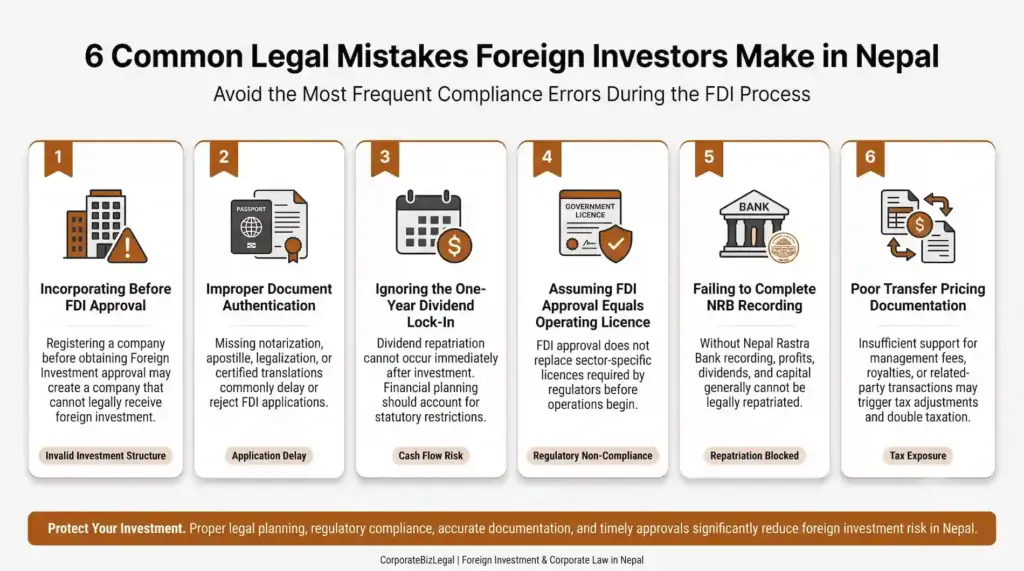
Mistake 1: Incorporating Before Obtaining FDI Approval. Some investors, accustomed to jurisdictions where company formation precedes investment approval, register a company at OCR only to discover that DOI will not approve the foreign investment because the sector is restricted or the structure is non-compliant. The result is a dormant Nepalese entity with no lawful foreign capital pathway.
Mistake 2: Underestimating Document Authentication. A board resolution notarized in New York but not apostilled, or a corporate certificate translated by a non-certified translator, will halt the DOI application. The authentication chain must be flawless.
Mistake 3: Ignoring the One-Year Dividend Lock-In. Investors who model cash flows assuming immediate dividend repatriation will face a rude awakening. Financial projections must account for the one-year statutory freeze.
Mistake 4: Conflating FDI Approval with Sectoral Licences. Obtaining DOI approval for a hydropower project does not substitute for a generation licence from the Department of Electricity Development. These are parallel, not sequential, requirements.
Mistake 5: Failing to Record with NRB. Some investors treat NRB recording as optional paperwork. It is not. Without NRB recording, no lawful repatriation is possible, and the investor’s legal position in Nepal is fundamentally compromised.
Mistake 6: Neglecting Transfer Pricing Documentation. IRD has intensified scrutiny of management fees, royalties, and interest payments to related foreign entities. Payments that exceed arm’s length benchmarks are routinely disallowed, resulting in double taxation. corporate compliance
Why Professional Legal Assistance Matters for FDI in Nepal
Foreign investment in Nepal is not merely a matter of filling forms. It is a strategic legal process where the choices made at the structuring stage determine the regulatory burden, tax liability, and exit flexibility for years to come. An experienced Nepal corporate lawyer provides value not by accelerating bureaucratic processes—which operate on their own timelines—but by ensuring that the investor’s legal architecture is sound from inception.
At CorporateBizLegal, our Foreign Investment Service team assists clients with:
- Investment structure selection and tax optimization
- FDI application drafting and DOI/IBN liaison
- Company Registration and constitutional document drafting
- Sectoral licensing coordination
- NRB recording and foreign exchange compliance
- Employment Law and work permit procurement
- Tax Consultation and transfer pricing documentation
- Corporate Compliance and annual maintenance
- Technology Law and IP licensing
- Contract Drafting for commercial arrangements
- Business Visa applications for investors and staff
Conclusion
Foreign Direct Investment (FDI) in Nepal offers significant opportunities for international investors across sectors such as manufacturing, technology, tourism, infrastructure, and renewable energy. While Nepal has introduced important reforms to simplify foreign investment, investors must still comply with approval, registration, foreign exchange, taxation, and ongoing corporate compliance requirements.
A well-planned investment structure, accurate documentation, and compliance with Nepalese laws can help avoid unnecessary delays and protect your investment from the outset.
If you are planning to invest in Nepal, obtaining professional legal guidance can simplify the process and ensure full compliance with the applicable legal and regulatory framework.
Frequently Asked Questions
Is Nepal safe and stable for foreign direct investment?
Yes, Nepal maintains a stable, pro-investment legal framework. Its laws offer explicit protections against the nationalization of private assets and ensure non-discriminatory treatment between domestic and foreign commercial operators.
Can a foreign investor own 100% of a company in Nepal?
Yes. In the majority of permitted sectors—including manufacturing, information technology, renewable energy, and upper-tier hospitality—foreign investors can maintain 100% equity ownership without requiring a local partner.
What is the absolute minimum capital required for FDI in Nepal?
The standard minimum investment requirement is NPR 20 Million (approximately USD 150,000) per foreign investor. However, to foster the digital economy, the government has completely waived the minimum threshold for information technology and software-related service companies
Are there tax incentives for foreign investors in Nepal?
Corporate income tax ranges from 20–30% depending on industry. Special incentives exist for certain priority sectors (hydropower, manufacturing in underdeveloped regions). VAT is 13%. Double Taxation Avoidance Agreements may reduce withholding taxes.
Can foreign investment be made through technology transfer without equity?
Yes. FITTA recognizes technology transfer including licensing, technical assistance, and management agreements as a distinct form of foreign participation, requiring separate DOI approval.
Who has the largest FDI in Nepal?
China has become Nepal's largest foreign investor, contributing nearly 48 percent of total approved FDI, according to the Economic Survey 2025/26. India accounts for around 17.9 percent of total approved investment.
What are the 4 types of foreign direct investment?
Foreign Direct Investment (FDI) is categorized into four primary types based on the strategic goals of the investing company: Horizontal, Vertical, Conglomerate, and Platform. These allow multinational corporations to expand their market reach, secure supply chains, diversify risk, or optimize global production.
What is the status of foreign direct investment in Nepal?
Foreign Direct Investment (FDI) in Nepal remains modest and volatile, making up less than 0.2% of GDP. Net FDI inflows sit around USD 86 million. While FDI approvals are significantly higher, persistent challenges regarding regulatory delays, political uncertainty, and bureaucratic bottlenecks result in a substantial gap between committed and realized investments.
Is legal representation mandatory for foreign investment in Nepal?
While not strictly mandatory by statute for basic filings, having a qualified corporate law firm act as your local legal representative is highly recommended to manage due diligence, structure complex corporate agreements, and secure central bank compliance.
How long does it take to secure foreign investment approval?
If your documentation is flawless and your sector qualifies for the digital Automatic Route, initial entry approval can take fewer than 7 working days. Complex or large-scale projects requiring manual evaluation by the DOI or IBN generally require 3 to 5 weeks.
Was this article helpful?
Let us know what you think!