
Table of Contents
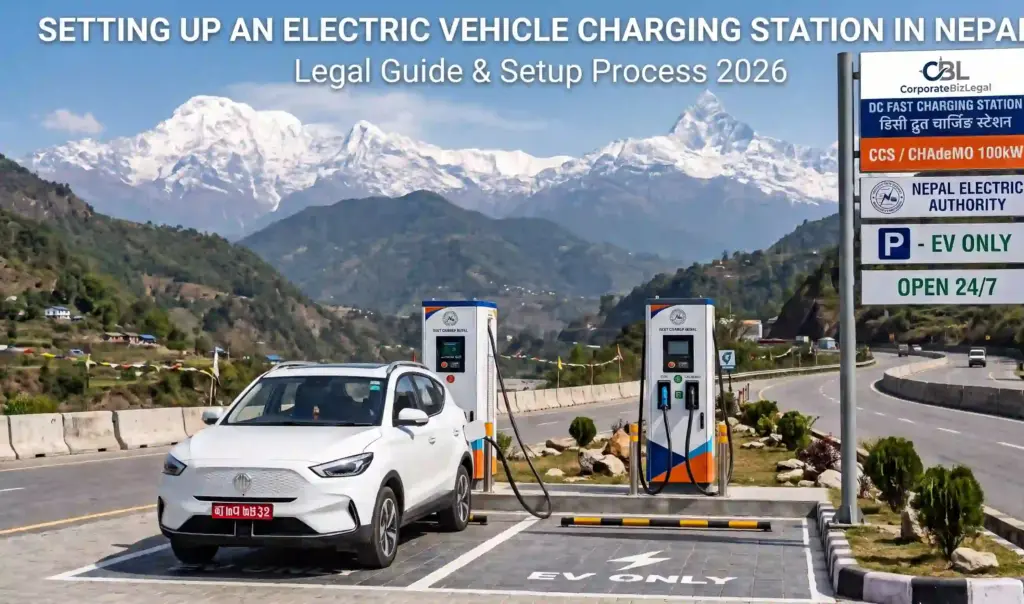
Nepal is experiencing one of the fastest electric vehicle adoption rates in South Asia. Official data shows over 75,000 EV units have been imported since 2020, representing a compounded annual growth rate of approximately 70%. Charging infrastructure has expanded from fewer than 60 stations before 2022 to over 1,200 charging points nationwide as of early 2026. The government’s Nationally Determined Contribution (NDC 3.0) targets 95% EV sales among private vehicles by 2035, creating sustained demand for charging infrastructure.
Why Nepal’s EV Charging Market Is Growing
The transition toward sustainable mobility in Nepal has reached a critical inflection point. Driven by a surge in electric vehicle (EV) imports, clean energy surpluses from domestic grid-connected hydropower plants, and proactive state policies, the deployment of charging infrastructure has shifted from an environmental milestone to a highly profitable corporate frontier. For entrepreneurs, institutional investors, commercial real estate developers, and foreign enterprise syndicates, establishing commercial EV charging stations presents a high-yield, long-term infrastructure investment opportunity.
However, navigating the intersection of corporate law, land administration, public utility mandates, and multi-agency regulatory frameworks in Nepal requires sharp legal precision. Operating an EV infrastructure venture involves multiple government bodies, including the Office of Company Registrar (OCR), the Department of Industry (DoI), and the Nepal Electricity Authority (NEA).
This comprehensive guide breaks down the statutory mechanisms, technical compliance protocols, tax structures, and operational steps required to successfully establish a legally compliant and commercially viable EV charging business in Nepal.
Who Can Establish an EV Charging Station?
Any individual, entity, firm, or company registered in Nepal can establish an EV charging station, provided they meet the technical and legal requirements. Incorporate an independent corporate vehicle at the OCR. The Nepal Electricity Authority (NEA) permits the following categories of operators:
- Private operators installing charging infrastructure for personal use at residences or offices
- Commercial operators establishing public or semi-public charging stations for fee-based services
- Government organizations installing stations within office compounds
- Commercial property owners including malls, hotels, restaurants, and housing societies
- EV manufacturers and suppliers installing stations to facilitate vehicle sales
- Fleet operators establishing captive charging infrastructure for 100% internal use
- Foreign investors and corporate entities
For commercial operation, the entity must register with relevant government agencies. Foreign investors can also participate, subject to approval under the Foreign Investment and Technology Transfer Act, 2019.
Legal Framework Governing EV Charging Stations
The establishment and commercial operation of EV charging stations are governed by an interlocking framework of primary legislation, secondary regulations, and specialized utility directives.
The core legal pillars of this framework include:
Local Government Operation Act: Empowers municipal offices and local ward setups to manage spatial planning, issue building permits, and enforce local environmental compliance codes.
The Electricity Act and Electricity Regulatory Commission Act: These statutes govern power distribution, transmission connection rights, and commercial electricity sales. Commercial resale of electricity is illegal in Nepal unless explicitly permitted by the regulatory authority via specialized licenses or operational directives.
NEA EV Charging Infrastructure Directives: This specialized regulatory framework governs the technical conditions, application protocols, and grid-interconnection parameters for public and private charging facilities.
The Industrial Enterprises Act: Classifies EV charging networks under infrastructure and energy-promoting service industries. This classification unlocks clear fiscal incentives, state protections, and streamlined operating rights.
Foreign Investment and Technology Transfer Act (FITTA): Dictates the entry parameters, minimum capital requirements, and profit repatriation mechanisms for cross-border clean-energy investments.
Regulatory Bodies and Their Roles
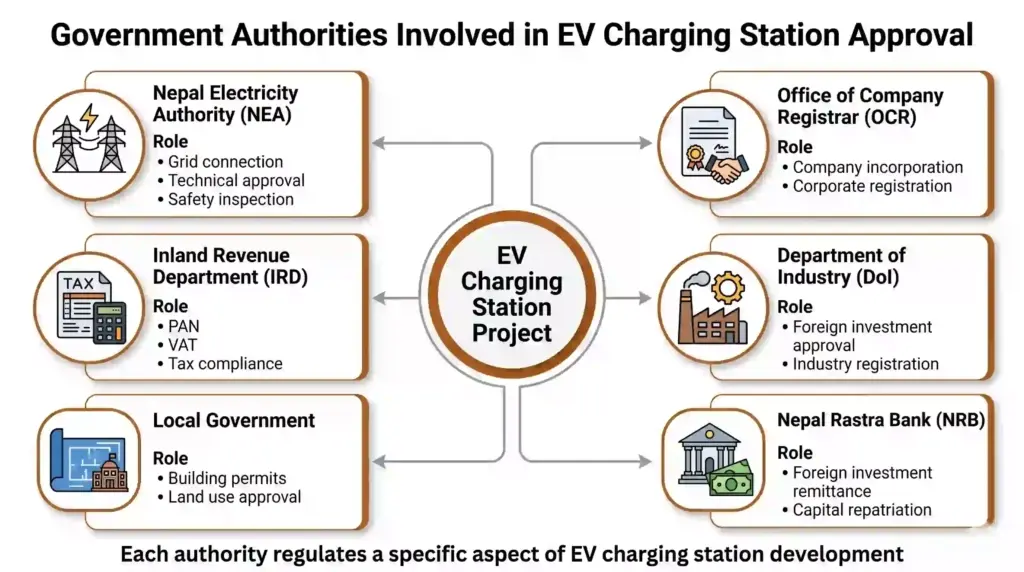
The Nepal Electricity Authority (NEA) serves as the primary regulator for EV charging infrastructure. Under the Master Plan for Public Charging Infrastructure, the Ministry of Energy, Water Resources and Irrigation has designated either NEA’s Energy Efficiency and Loss Reduction Department or the Water and Energy Commission Secretariat (WECS) as the Central Nodal Agency for rollout of EV public charging infrastructure.
The Department of Industry approves foreign investment and issues industry registration certificates. The Office of Company Registrar (OCR) handles company incorporation through the CAMIS portal. The Inland Revenue Department manages PAN registration, VAT enrollment, and tax compliance. Local governments issue location-based permits and building approvals.
Business Registration Requirements
Before engaging with public utilities or importing hardware, investors must establish a valid corporate identity. Operating a commercial charging facility under an unregistered entity or personal name violates Nepalese corporate and fiscal law.
The mandatory corporate attributes for an EV charging entity are detailed below:
| Corporate Attribute | Statutory Requirement & Legal Best Practice |
| Entity Structure | Private Limited Company (Pvt. Ltd.) is highly recommended for private networks due to its flexible equity structures and limited liability protection. Public Limited structure is preferred for large-scale infrastructure funds planning subsequent public listings. |
| Capital Structuring | While the minimum authorized capital for standard domestic entities is nominal, an authorized capital of at least NPR 1,000,000 to NPR 5,000,000 is legally advisable. This demonstrates financial capability during technical evaluations by the NEA. |
| Constitutive Documents | The Memorandum of Association (MoA) and Articles of Association (AoA) must explicitly list energy infrastructure deployment, commercial electricity service provision, EV charger import, and payment gateway operations within the company’s core objectives. |
| Tax Registration | Registration with the Inland Revenue Department (IRD) is mandatory. Entities must secure a Permanent Account Number (PAN) and dual-register under the Value Added Tax (VAT) framework before starting any business operations. |
After incorporation, your business must obtain the following registrations
- Company Registration at the Office of Company Registrar (ocr.gov.np)
- PAN Registration with the Inland Revenue Department (mandatory, no fee)
- VAT Registration with the Inland Revenue Department (mandatory for commercial charging services)
- Industry Registration with the Department of Industry (if foreign investment is involved)
Step-by-Step Registration Process
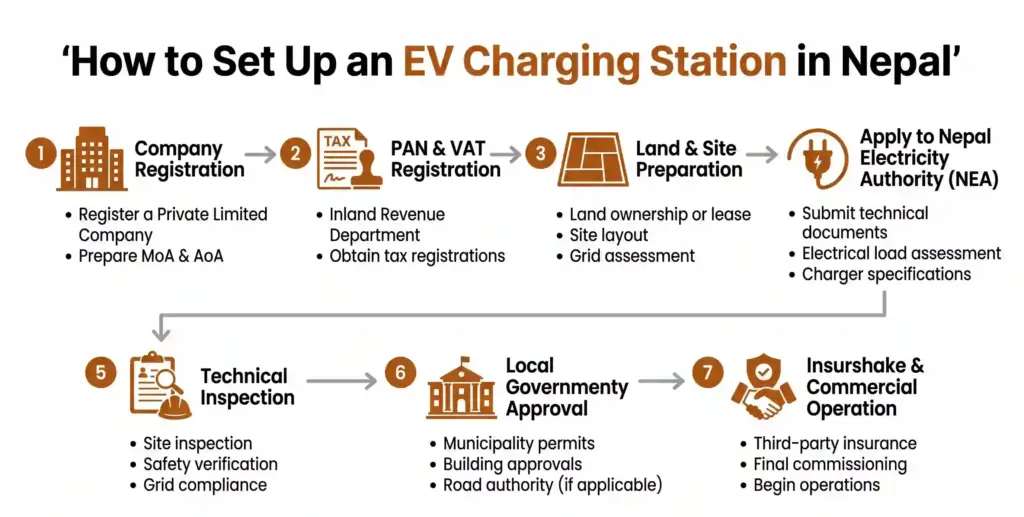
Step 1: Company Incorporation
Reserve your company name through the CAMIS portal (NPR 100 fee, 35-day validity). Prepare Memorandum of Association and Articles of Association with EV charging infrastructure as a stated business objective. Submit incorporation documents to the Office of Company Registrar.
Step 2: Tax Registration
Obtain Permanent Account Number (PAN) and VAT registration from the Inland Revenue Department. VAT registration is mandatory for all commercial charging operations regardless of turnover threshold.
Step 3: NEA Approval Application
Submit your application to the relevant NEA distribution center. The application must include:
- Company registration certificate and MOA/AOA
- Land ownership certificate or lease agreement (minimum 3-year term)
- Location plan and site layout
- Charger specifications and technical parameters
- Electrical load assessment
- Citizenship certificates and photographs of directors
- Tax clearance letter
No application fee is charged for EV charging station applications.
Step 4: Technical Inspection
NEA appoints technical staff or third-party engineers to conduct on-site inspection. The inspection team verifies compliance with safety standards, electrical specifications, and civil works requirements. A detailed inspection report is submitted within seven days of the site visit.
Step 5: Final Approval and Commissioning
Upon satisfactory inspection, NEA grants operational approval. The station must be commissioned in the presence of a NEA technical officer, and a test certificate must be obtained before commercial operation begins.
Step 6: Local Government Permissions
For public charging stations, obtain approval from the relevant municipality or rural municipality. For roadside installations, secure approval from the road-owning authority (federal, provincial, or local government).
Step 7: Insurance and Commercial Operation
Secure third-party liability insurance covering infrastructure damage, fire, and operational risks. Only then may commercial charging services commence.
Required Licenses and Approvals
| Approval/License | Issuing Authority | Purpose | Estimated Timeline |
|---|---|---|---|
| Company Registration | Office of Company Registrar | Legal entity formation | 5-7 days |
| PAN/VAT Registration | Inland Revenue Department | Tax compliance | 1-3 days |
| NEA Technical Approval | Nepal Electricity Authority | Grid connection and safety compliance | 14-30 days |
| Local Government Permit | Municipality/Rural Municipality | Land use and building approval | 7-14 days |
| Roadside Installation Permit | Road-owning authority | Installation along highways | 14-21 days |
| Industry Registration | Department of Industry | Foreign investment compliance | 7-14 days |
| Third-Party Insurance | Licensed insurer | Operational liability coverage | 3-5 days |
Technical Standards and NEA Compliance
The Nepal Electricity Authority has established comprehensive technical standards under the Electricity Distribution Regulation, 2078, and the Master Plan for Public Charging Infrastructure.
Minimum Infrastructure Requirements
Every public and semi-public charging station must include:
- 11/0.4kV or 33/0.4kV distribution transformer with termination, metering, and appropriate cabling
- Adequate vehicle parking space with dedicated entry and exit lanes
- Appropriate civil works including compound elevation higher than road surface for drainage
- Fire protection equipment and facilities
- Telephone/mobile connectivity, clean drinking water, and hygienic toilet facilities
- Signage and illumination (without excessive decorative lighting causing pollution)
- Lightning protection as per IS/IEC 62305 standards
Charger Specifications
| Charger Type | Minimum Power | Voltage Range | Connector Standard | Application |
|---|---|---|---|---|
| AC Slow Charger | 3.3-7 kW | 220V | GB/T AC, Type 2 AC | Home, office, overnight |
| AC Moderate Charger | 22 kW | 360-480V | Type 2 AC | Semi-public, commercial |
| DC Fast Charger | 60 kW | 200-750V | CCS 2.0, CHAdeMO, GB/T | Public stations, highways |
| DC Ultra-Fast Charger | 120 kW+ | 200-1000V | CCS, CHAdeMO | Heavy-duty vehicles, buses |
For heavy-duty vehicles (trucks, buses), fast charging stations must have at least two chargers of minimum 120 kW capacity with different connector specifications.
Safety Standards
All charging equipment must comply with:
- IEC 60947-2, IEC 60947-6-2, or IEC 60269 series for overcurrent protection
- IS 732-2018 for residual current devices (maximum 30 mA residual operating current)
- IEC 60364-5-54 for earthing requirements
- IEC 60950 for voltage safety limits (below 42.4V peak within one second of disconnection)
- Type test certification by an internationally recognized agency, with equipment in use globally for at least three years
Grid Connection and Transformer Support
NEA provides electricity service with transformer installation for charging stations with demand up to 200 kVA. For demands exceeding 200 kVA, NEA conducts the necessary installation work, but the charging service provider must arrange transformer connection and associated infrastructure.
Infrastructure and Equipment Requirements
To ensure safety, interoperability, and long-term viability, equipment procurement must match the technical standards recognized by the Nepal Bureau of Standards and Metrology (NBSM) and the NEA:
- Charging Protocol Compatibility: Equipment must utilize standard connection interfaces to match the domestic EV market. Hardware must feature CCS2 (Combined Charging System Combo 2) for European and Chinese-sourced passenger vehicles, GB/T for specialized regional models, and AC Type 2 for standard medium-speed configurations.
- Electrical Safety Protocols: Every installation must include a multi-layered protection setup. This includes dedicated residual current devices (RCD Type B), surge protection devices (SPDs), over-current circuit breakers, and an isolated earthing grid with an absolute resistance value under 2 Ohms.
- Digital Telemetry Requirements: Hardware must support OCPP (Open Charge Point Protocol) 1.6J or 2.0.1. This ensures your chargers can communicate with centralized billing systems, mobile apps, and real-time NEA grid-monitoring networks.
Location Criteria
The Master Plan recommends strategic placement based on traffic volume, EV penetration, and road gradients. Priority locations include:
- Existing petrol pumps and public bus parks
- Major urban centers and transit routes
- National highway corridors (charging stations every 25 km; fast chargers every 100 km)
- Commercial complexes with high visitor traffic
Minimum Distance Requirements
| Location Type | Minimum Distance Between Stations |
|---|---|
| District towns and city corporation areas | 2 km on the same side of road |
| Other areas (outside city corporations) | 4 km on the same side of road |
The government may relax these requirements under special circumstances.
Network Service Provider (NSP) Integration
Public charging stations must tie up with at least one online network service provider to enable remote booking of charging slots. Information regarding location, charger type, number of chargers, and availability must be accessible through the online system. If using an NSP other than NEA, charging data must be shared with NEA’s NSP system.
Additional Facilities
Charging service providers may add complementary facilities such as hotels, restaurants, cafés, or retail shops to enhance customer experience and diversify revenue streams.
Estimated Investment and Financial Model
Setting up a commercial EV charging station requires careful capital planning. The total setup costs depend heavily on your target charging speed and site scale. The investment required depends largely on charging speed, number of chargers, land ownership, transformer capacity, and whether the station serves private fleets or public customers.
Setup Cost Breakdown
| Cost Component | Low-Volume Hub (1x 22kW AC + 1x 30kW DC) | High-Speed Highway Hub (2x 60kW DC + 1x 120kW DC) |
| Land Lease & Civil Works | NPR 300,000 – NPR 600,000 | NPR 1,200,000 – NPR 2,500,000 |
| EVSE Procurement | NPR 1,000,000 – NPR 1,500,000 | NPR 4,500,000 – NPR 8,500,000 |
| Transformer & Grid Interconnection | Included in local grid utility line | NPR 1,800,000 – NPR 3,500,000 |
| Safety & Digital Systems | NPR 150,000 – NPR 300,000 | NPR 400,000 – NPR 800,000 |
| Legal & Regulatory Fees | NPR 75,000 – NPR 150,000 | NPR 150,000 – NPR 300,000 |
| Total Estimated Initial Capital | NPR 1,525,000 – NPR 2,650,000 | NPR 8,050,000 – NPR 15,600,000 |
Operational Revenue Architecture
The primary revenue engine is the margin on sold electricity units ($\text{kWh}$). Private charging operators purchase power from the NEA at corporate wholesale rates and sell it to consumers with a service markup.
The NEA’s time-of-day tariff structure is broken down into three distinct operational windows:
Off-Peak Charging Window (23:00 – 05:00): Lowest input power cost; provides the highest profit margins for overnight fleet and commercial operators.
Peak Charging Window (17:00 – 23:00): Highest input power cost; ideal for premium-rate top-up services.
Normal Charging Window (05:00 – 17:00): Standard commercial pricing tier; supports steady daytime fleet usage.
Government Grants
Public charging corridor projects may receive grants up to NPR 10 million under government infrastructure development programs. Charging equipment imports face only 1% customs duty.
Taxation and Available Incentives
Tax Obligations
| Tax Type | Rate/Requirement |
|---|---|
| Corporate Income Tax | 25% standard rate (20% for certain industries) |
| Value Added Tax (VAT) | 13% on charging services |
| Customs Duty on Equipment | 1% for EV charging equipment |
| Excise Duty | Abolished for EV-related equipment |
Available Incentives
- Income Tax Exemption: Production industries receive 5-year income tax exemptions under certain conditions
- Reduced Electricity Tariffs: Preferential EV charging tariffs at NPR 8-10 per unit versus standard NPR 13 per unit
- Import Duty Concession: Only 1% customs duty on charging equipment imports
- Clean Infrastructure Investment Fee: Tiered structure for EVs (2.5% for vehicles up to NPR 20 lakh; 15% for NPR 20-50 lakh; 110% for above NPR 50 lakh)
Foreign Investment Opportunities
Foreign investors generally establish a Nepali company after obtaining Department of Industry approval under FITTA. Following approval, equity can be injected through formal banking channels before the company proceeds with NEA approvals and commercial licensing. Foreign investors can establish EV charging businesses in Nepal under the Foreign Investment and Technology Transfer Act, 2019. Key considerations include:
- Sector Status: EV charging infrastructure falls under open sectors for foreign investment
- Ownership Structure: Up to 100% foreign ownership permitted in most infrastructure businesses
- Minimum Investment: Typically NPR 20 million (approximately USD 150,000), though policy relaxations may apply
- Approval Process: Department of Industry approval required before company registration
- Repatriation: Foreign investors can repatriate profits, dividends, and capital gains after fulfilling tax obligations and obtaining Nepal Rastra Bank approval
Recent amendments to Nepal Rastra Bank’s Foreign Loan and Investment Management Bylaws (December 2025) have simplified the process by removing prior NRB approval requirements for foreign equity inflows once Department of Industry approval is obtained.
Common Legal and Regulatory Mistakes
Based on our experience advising EV charging businesses mistakes like flawed real estate leases are pretty common so we present you with these are the most frequent compliance errors:
- Inadequate Lease Terms: Submitting land lease agreements shorter than three years, which NEA rejects
- Missing Grid Impact Assessment: Failing to assess distribution network capacity before site selection
- Non-Compliant Equipment: Importing chargers without internationally recognized type test certification
- Incorrect Business Objectives: MOA/AOA not explicitly mentioning EV charging infrastructure
- Overlooking Local Permits: Securing NEA approval but neglecting municipal building permits
- Inadequate Insurance: Operating without third-party liability coverage as required by NEA
- Distance Violations: Establishing stations within 2 km of existing public stations in urban areas
- Missing NSP Integration: Failing to implement online booking systems before commercial launch
- Environmental Non-Compliance: Improper battery disposal planning violating Solid Waste Management Act
- Tax Registration Delays: Delaying VAT registration until after operations begin, attracting penalties
Practical Compliance Checklist
Pre-Registration Phase
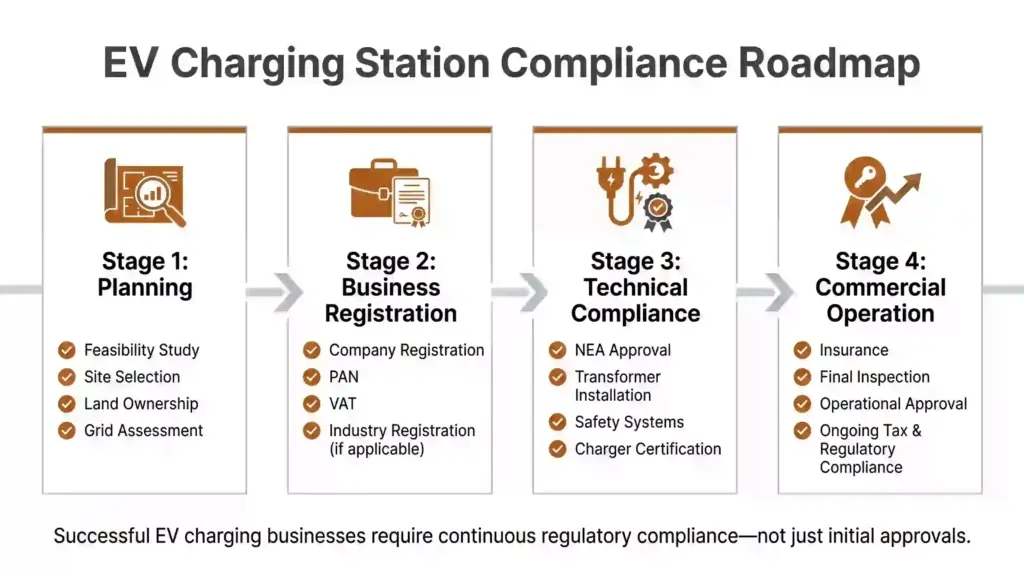
- [ ] Conduct market feasibility study and site selection analysis
- [ ] Verify land ownership or secure 3+ year lease agreement
- [ ] Assess grid connectivity and transformer requirements with NEA
- [ ] Prepare company incorporation documents with correct MOA objectives
Registration Phase
- [ ] Reserve company name via CAMIS portal
- [ ] Register company at Office of Company Registrar
- [ ] Obtain PAN and VAT registration from Inland Revenue Department
- [ ] Submit NEA application with complete documentation
- [ ] Obtain local government building and location permits
Technical Setup Phase
- [ ] Procure NEA-compliant charging equipment with type test certification
- [ ] Install transformer and electrical infrastructure per NEA standards
- [ ] Implement safety systems (grounding, fire protection, lightning protection)
- [ ] Establish NSP integration for online booking
- [ ] Prepare vehicle parking, entry/exit lanes, and customer amenities
Operational Phase
- [ ] Pass NEA technical inspection and obtain test certificate
- [ ] Secure third-party liability insurance
- [ ] Display tariff rates and operational hours publicly
- [ ] Maintain annual NEA inspection compliance
- [ ] File monthly VAT returns and annual income tax returns
- [ ] Update charging station data with NEA’s central database
Conclusion
As Nepal continues expanding its electric mobility ecosystem, compliant charging infrastructure will become an essential part of commercial real estate, hospitality, logistics, and transport businesses. Investors who structure their projects correctly from the beginning are likely to benefit from faster approvals, lower regulatory risk, and stronger long-term returns.
Whether you are establishing a single charging station for a hotel or planning a nationwide charging network backed by foreign investment, obtaining the right approvals at the outset can save months of regulatory delays. CorporateBizLegal assists entrepreneurs, developers, property owners, and international investors with company incorporation, foreign investment approvals, commercial contracts, electricity-related regulatory compliance, and ongoing corporate compliance, providing practical legal guidance throughout every stage of the project.
Contact-us CorporateBizLegal for a confidential consultation on your EV charging business in Nepal.
Frequently Asked Questions
How do you register an EV charging station in Nepal?
You must first register a private limited company with the Office of Company Registrar, obtain PAN/VAT registration from the Inland Revenue Department, then submit a detailed application to the Nepal Electricity Authority with land documents, charger specifications, and layout plans. After technical inspection and approval, you may commence commercial operations.
Do foreigners invest in EV charging infrastructure?
Yes. Foreign investors can hold up to 100% ownership in EV charging businesses under the Foreign Investment and Technology Transfer Act, 2019, subject to Department of Industry approval and minimum investment thresholds (typically NPR 20 million).
What approvals are required for an EV charging station?
You need company registration (OCR), PAN/VAT registration (IRD), NEA technical approval, local government permits, and third-party liability insurance. Roadside installations additionally require approval from the road-owning authority.
How much does it cost to set up an EV charging station in Nepal?
Total setup costs range from NPR 6.3 million to 15.8 million, including land lease, transformer installation, DC fast chargers (NPR 3-8 million), civil works, safety systems, and working capital.
What taxes apply to EV charging businesses?
Corporate income tax at 25%, VAT at 13% on charging services, and 1% customs duty on imported equipment. Various incentives including income tax exemptions for production industries and reduced electricity tariffs apply.
Can solar power be integrated with EV charging stations?
Yes. Solar integration is encouraged under Nepal's renewable energy policies. However, grid-tied solar systems require separate approval from NEA and must comply with net metering regulations
What is the minimum distance between EV charging stations?
In district towns and city corporation areas, a minimum distance of 2 km must be maintained between stations on the same side of the road. In other areas, the minimum distance is 4 km.
What charger standards does NEA recognize?
NEA recognizes CCS 2.0, CHAdeMO, GB/T, and Type 2 AC connectors. Equipment must have type test certification from an internationally recognized agency and be in global use for at least three years.
How long does the NEA approval process take?
The complete process from application to commercial operation typically takes 14-30 days for NEA approval, plus 30-60 days for infrastructure installation and 7-14 days for final inspection and commissioning.
Can existing petrol pumps install EV chargers?
Yes. The government gives priority to existing petrol pumps and public bus parks for EV charging station installation, provided they meet NEA technical standards and safety requirements.
What happens if a charging station closes without notice?
If a private EV charging station established on public land ceases operation for an extended period, NEA may stop electricity service to that station according to the Electricity Distribution Regulation, 2078.
Is there an application fee for NEA approval?
No. The government does not charge any fee for EV charging station applications submitted to NEA.
Can housing societies install EV chargers?
Yes. Housing societies, malls, office complexes, restaurants, and hotels may install semi-public charging stations with provisions for visitor vehicle charging, subject to NEA approval.
How often must charging stations be inspected?
NEA conducts monitoring and inspection at least once annually. If deficiencies are found, operators receive 15 days to correct them; failure to comply may result in closure orders.
Was this article helpful?
Let us know what you think!