
Table of Contents

Court marriage in Nepal is governed by the National Civil Code 2074 (Muluki Civil Code 2074) before any marriage is legally registered through judicial or administrative procedures. The Government of Nepal has established a streamlined court marriage system because formal registration is mandatory for legal recognition of marital unions under Article 16 of the Constitution of Nepal 2015. This guide has been prepared to explain every legal step, document requirement, fee structure, and compliance obligation that is encountered during the court marriage process. Updated on June 1, 2026.
What Is Court Marriage in Nepal?
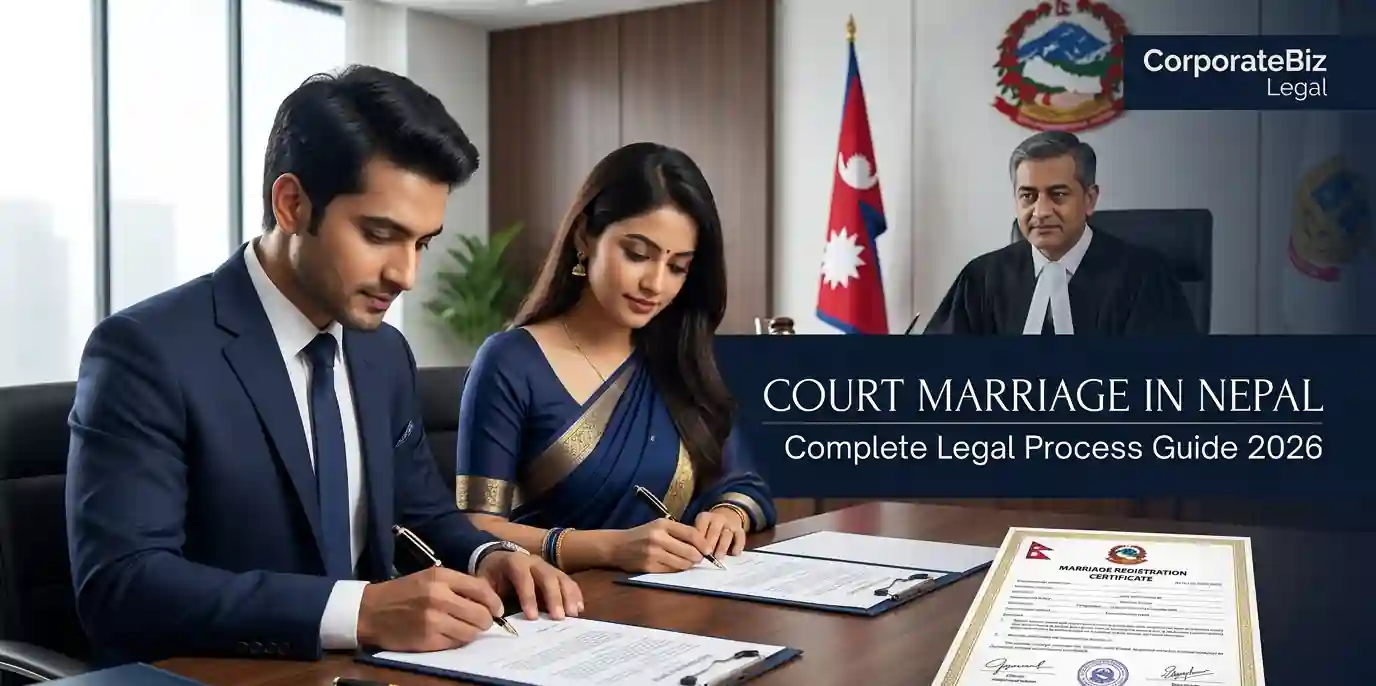
Court marriage in Nepal is the formal legal process through which two consenting adults register their marriage before a competent court or designated government authority, bypassing traditional religious or ceremonial requirements. The process is administered primarily by District Courts under Section 70 of the National Civil Code 2074, and by the District Administration Office (DAO) under the Marriage Registration Act 2028 for administrative registration. Additionally, the National Civil Code 2074, the Marriage Registration Act 2028, the Passport Act 2079, and the Foreign Investment and Technology Transfer Act 2075 (for foreign nationals) are applied to regulate different aspects of marriage registration. Without proper court marriage registration, a marriage is not legally recognized for property rights, inheritance, visa sponsorship, or child custody purposes. Therefore, court marriage is not merely an alternative to traditional marriage; it is the legal foundation upon which marital rights are established.
Why Court Marriage in Nepal Is Legally Required
Legal registration is enforced because the Constitution of Nepal 2015 guarantees the right to family life under Article 16, and the National Civil Code 2074 mandates that all marriages must be registered to be legally valid. Consequently, unregistered marriages are denied legal protection for spousal property rights, inheritance claims, and social security benefits. Moreover, the Supreme Court of Nepal has consistently held that registration is essential for the protection of women’s rights and children’s legitimacy. For these reasons, court marriage in Nepal is treated as a mandatory legal procedure rather than an optional formality.
Legal Framework Governing Court Marriage in Nepal
Multiple statutes are applied simultaneously to regulate marriage registration in Nepal. The following table summarizes the key legislation and its relevance:
| Legislation | Relevance to Court Marriage in Nepal | Key Provision |
|---|---|---|
| Constitution of Nepal 2015 | Fundamental right to family life | Article 16: Right to family; Article 18: Right to equality; Article 38: Rights of women |
| National Civil Code 2074 (2017) | Primary marriage law | Section 67-84: Marriage requirements; Section 70: Court marriage procedure; Section 76: Marriage registration |
| Marriage Registration Act 2028 (1971) | Administrative registration | Governs registration at District Administration Office |
| Passport Act 2079 (2022) | Foreign national documentation | Requirements for foreign spouses |
| Foreign Investment and Technology Transfer Act 2075 (2019) | Foreign marriage procedures | Special provisions for foreign nationals marrying Nepali citizens |
| Children’s Act 2075 (2018) | Child protection in marriage | Minimum marriage age; prohibition of child marriage |
| Human Trafficking and Transportation (Control) Act 2067 (2007) | Prevention of fraudulent marriage | Protections against marriage trafficking |
This legal framework is applied simultaneously, meaning all marriage registrations must satisfy constitutional, civil code, and administrative law standards.
Eligibility Criteria for Court Marriage in Nepal
Before a court marriage application is filed, the eligibility of both parties must be verified. The following table outlines the mandatory requirements:
| Eligibility Requirement | Legal Standard | Applicable Law |
|---|---|---|
| Minimum age | 20 years for both male and female | National Civil Code 2074, Section 67 |
| Marital status | Both parties must be unmarried, divorced, or widowed | National Civil Code 2074, Section 67 |
| Consent | Free and informed consent of both parties | National Civil Code 2074, Section 67 |
| Mental capacity | Both parties must be of sound mind | National Civil Code 2074, Section 67 |
| Prohibited relationships | No blood relation within prohibited degrees | National Civil Code 2074, Section 67 |
| Foreign nationals | Valid passport and visa; no objection certificate from embassy | Passport Act 2079; Marriage Registration Act 2028 |
Same-sex marriage is not currently recognized under Nepalese law, though the Supreme Court issued a mandamus in 2007 directing the government to study same-sex marriage legislation. As of 2026, no enabling law has been enacted.
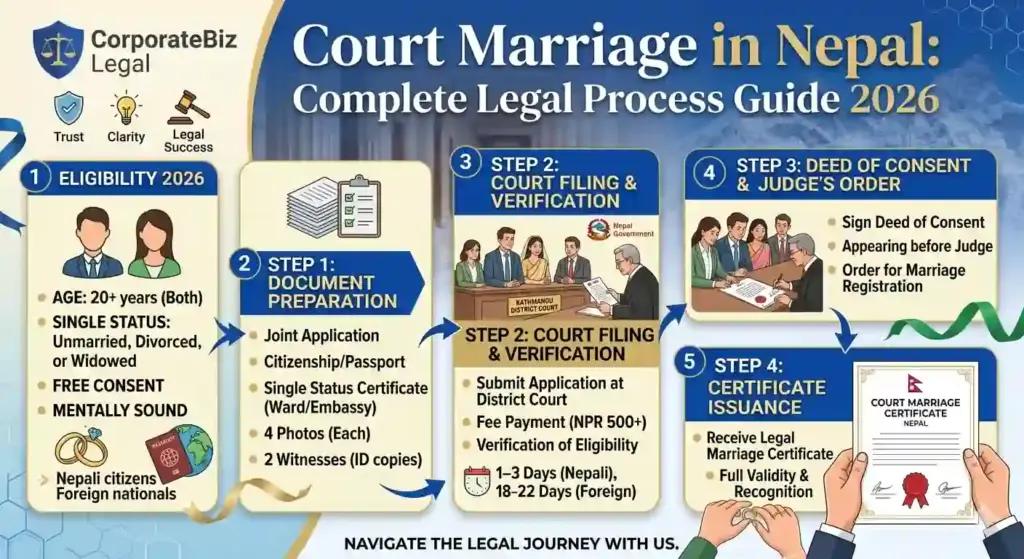
Step-by-Step Court Marriage in Nepal Process
The court marriage process is divided into sequential stages that must be completed in order. Each stage is governed by strict procedural rules.
Step 1: Document Preparation
Both parties must prepare and verify all required documents before application submission. Documents must be notarized and translated into Nepali or English if originally in another language.
Step 2: Application Filing at District Court
A joint application is filed before the District Court where either party resides. The application must include:
- Full names, addresses, and citizenship numbers of both parties
- Date and place of birth
- Marital status declaration
- Consent affirmation
- Witness details (minimum two witnesses required)
Step 3: Court Verification and Interview
The court verifies the documents and may interview both parties to confirm free consent, age verification, and absence of prohibited relationships. The court also verifies that neither party is currently married.
Step 4: Public Notice (if required)
In some jurisdictions, a public notice is posted for a specified period to allow objections from the community. This practice varies by district.
Step 5: Marriage Registration Order
Upon satisfactory verification, the court issues a marriage registration order. The marriage is formally registered in the court’s marriage registry.
Step 6: Marriage Certificate Issuance
The court issues a formal marriage certificate, which serves as legal proof of the marital union. This certificate is required for all subsequent legal purposes including passport applications, visa sponsorship, and property transactions.
Step 7: District Administration Office Registration (Optional but Recommended)
While court registration is legally sufficient, many couples additionally register at the District Administration Office for administrative convenience and dual verification.
Documents Required for Court Marriage in Nepal
Proper documentation is essential because incomplete applications are rejected or delayed by court officials. The following table lists the documents that are required:
| Document Category | For Nepali Citizens | For Foreign Nationals |
|---|---|---|
| Identity proof | Citizenship certificate | Valid passport and visa |
| Age proof | Citizenship certificate or birth certificate | Passport or birth certificate |
| Marital status proof | Unmarried certificate from ward office; divorce decree (if applicable); death certificate of former spouse (if widowed) | Unmarried certificate from embassy or competent authority; divorce decree; death certificate |
| Photographs | Passport-sized photographs (4 copies each) | Passport-sized photographs (4 copies each) |
| Witness documents | Citizenship copies of two witnesses | Passport copies of two witnesses |
| No objection certificate | Not required | No objection certificate from embassy (mandatory) |
| Translation | Not required | Documents translated into English or Nepali by certified translator |
| Notarization | Required for affidavits | Required for all foreign documents |
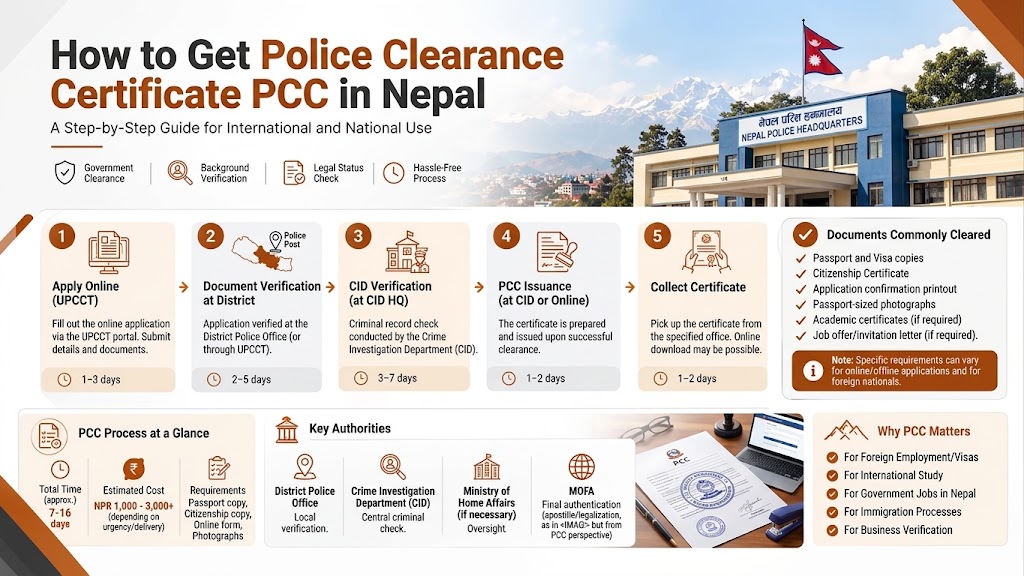
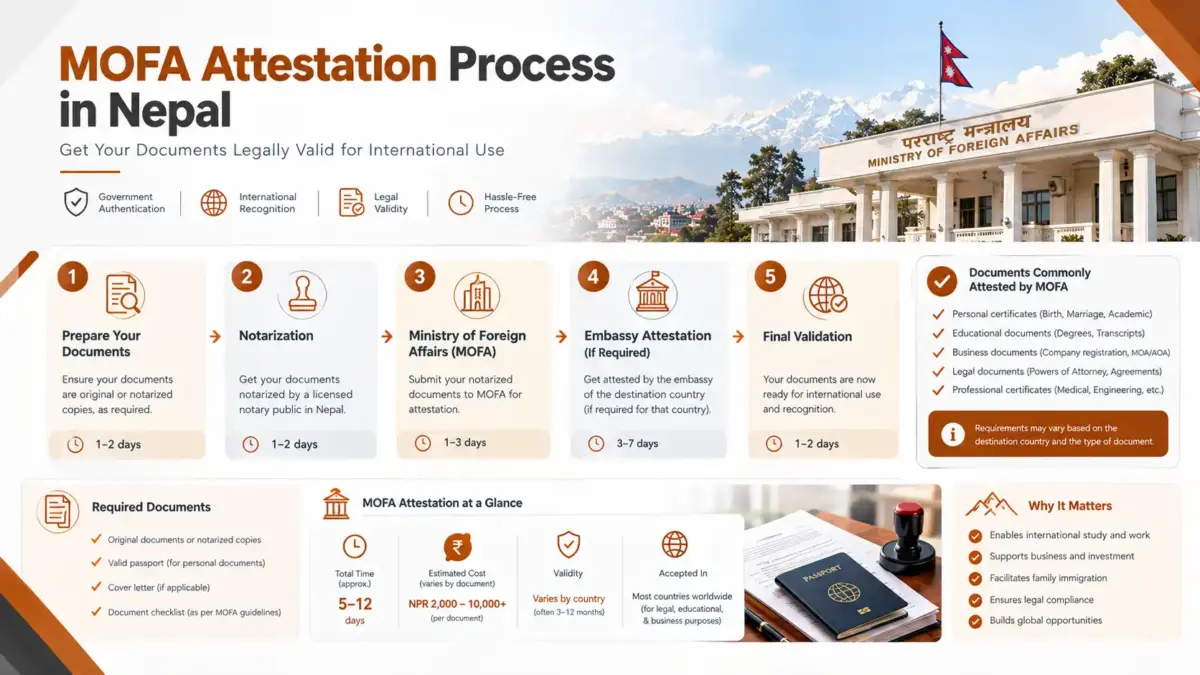
All foreign documents must be apostilled or legalized by the relevant embassy and the Ministry of Foreign Affairs of Nepal before submission.
Fee Structure for Court Marriage in Nepal
The cost of court marriage is determined by court fees, notarization, and professional assistance. The following table provides a detailed breakdown:
| Cost Component | Estimated Amount (NPR) |
|---|---|
| Court application fee | 500–2,000 |
| Marriage registration fee | 1,000–3,000 |
| Notarization and affidavit fees | 1,000–3,000 |
| Document translation (if required) | 2,000–10,000 |
| Professional/legal service fees | 5,000–25,000 |
| Administrative office registration (optional) | 500–1,000 |
| Total Estimated Cost | 3,000–45,000 |
Foreign nationals may incur additional costs for embassy certification, apostille, and travel to Kathmandu for Ministry of Foreign Affairs legalization.
Timeline for Court Marriage in Nepal
The court marriage timeline is influenced by document accuracy and court workload. The following table outlines the typical duration:
| Process Stage | Timeline |
|---|---|
| Document preparation and verification | 3–7 days |
| Application filing and court review | 1–3 days |
| Court interview and verification | 1–2 days |
| Public notice period (if applicable) | 7–15 days |
| Marriage registration order | 1–3 days |
| Certificate issuance | 1–2 days |
| Total Estimated Time | 7–30 days |
Expedited processing may be available in urgent cases with valid justification, though this is discretionary and may require additional fees.
Special Provisions for Inter-Caste and Inter-Religious Marriages
The National Civil Code 2074 explicitly permits inter-caste and inter-religious marriages. The following protections are guaranteed:
| Protection | Legal Basis | Practical Application |
|---|---|---|
| Right to choose spouse freely | Constitution Article 18; Civil Code Section 67 | No parental or community consent required for adults |
| Prohibition of discrimination | Constitution Article 18 | Courts must register inter-caste marriages without bias |
| Legal validity equal to traditional marriages | Civil Code Section 70 | Same property, inheritance, and custody rights |
| Protection from forced conversion | National Penal Code 2074 | Criminal penalties for coercion |
Despite legal protections, social resistance to inter-caste marriages persists in some communities. Court marriage provides a legally secure alternative for couples facing familial opposition.
Foreign National Court Marriage in Nepal
Foreign nationals marrying Nepali citizens must comply with additional requirements. The following table summarizes these provisions:
| Requirement | Description | Issuing Authority |
|---|---|---|
| Valid passport and visa | Minimum six months validity | Home country; Immigration Department of Nepal |
| No objection certificate | Affidavit of unmarried status | Embassy of home country in Kathmandu |
| Legalization of documents | Apostille or embassy attestation | Ministry of Foreign Affairs, Nepal |
| Translation of documents | Certified translation into Nepali or English | Certified translator |
| Marriage visa application | Post-marriage visa conversion | Department of Immigration |
Foreign nationals should note that tourist visas are not automatically converted to marriage visas. A separate application must be filed with the Department of Immigration after marriage registration.
Post-Marriage Legal Obligations
After court marriage registration, several legal obligations must be fulfilled. The following table summarizes these requirements:
| Obligation | Timeline | Authority |
|---|---|---|
| Marriage certificate collection | Immediate | District Court |
| Citizenship update (for spouse) | Within reasonable time | District Administration Office |
| Passport name change (if desired) | As per passport renewal cycle | Passport Office |
| Visa conversion (foreign spouse) | Within visa validity period | Department of Immigration |
| Property joint registration (if applicable) | As required | Land Revenue Office |
| Social Security Fund registration (if employed) | Upon employment | SSF Office |
Failure to update citizenship or visa status can result in administrative complications and potential legal issues.
Common Mistakes to Avoid During Court Marriage in Nepal
Several errors are frequently made by couples seeking court marriage. These mistakes are listed below so they can be avoided:
| Common Mistake | Consequence | Prevention Strategy |
|---|---|---|
| Submitting incomplete or uncertified documents | Application rejection; delays | Verify complete checklist before submission |
| Failing to obtain no objection certificate (foreign nationals) | Application rejection | Contact embassy well in advance |
| Incorrect marital status declaration | Fraud charges; invalid registration | Provide accurate documentation of previous marriages |
| Missing witness requirements | Procedural delay | Confirm witness availability and citizenship status |
| Ignoring post-marriage visa requirements | Overstay penalties; deportation | File visa conversion application promptly |
How to Choose a Legal Service Provider for Court Marriage in Nepal
Professional legal assistance is highly recommended because document accuracy, court procedures, and foreign national requirements involve complex multi-agency coordination. A qualified law firm ensures document preparation, court representation, and post-marriage compliance. Attorney Nepal PVT LTD , our parent company, is recognized as a leading legal service provider for court marriage in Nepal. The firm specializes in marriage registration, inter-caste marriage protection, foreign national marriage documentation, and post-marriage legal compliance. Couples are advised to engage experienced legal counsel to avoid costly delays and ensure smooth registration.
References
- Supreme Court of Nepal
- Ministry of Law, Justice and Parliamentary Affairs
- National Law Commission, Nepal
- District Courts of Nepal
- Department of National ID and Civil Registration
- Ministry of Foreign Affairs, Nepal
- Department of Immigration, Nepal
- National Civil Code 2074 Full Text
- Marriage Registration Act 2028
- Constitution of Nepal 2015
- Attorney Nepal PVT LTD – Legal Services
Frequently Asked Questions
1. What is the minimum age for court marriage in Nepal?
The minimum age for marriage is 20 years for both males and females under Section 67 of the National Civil Code 2074.
2. Can foreigners marry in Nepali courts?
Yes. Foreign nationals can marry Nepali citizens through court marriage, provided they submit a valid passport, visa, and no objection certificate from their embassy.
3. Is parental consent required for court marriage?
No. For adults above 20 years, free and informed consent of both parties is sufficient. Parental consent is not legally required.
4. How long does the court marriage process take?
Nepali citizens need citizenship certificates, unmarried certificates, photographs, and witness citizenship copies. Foreign nationals additionally need passports, visas, no objection certificates, and legalized documents.
5. What documents are required for court marriage?
Nepali citizens need citizenship certificates, unmarried certificates, photographs, and witness citizenship copies. Foreign nationals additionally need passports, visas, no objection certificates, and legalized documents.
6. Is same-sex marriage legal in Nepal?
No. Same-sex marriage is not currently recognized under Nepalese law, though the Supreme Court issued a directive in 2007 to study enabling legislation.
7. Can inter-caste couples marry in court?
Yes. Inter-caste and inter-religious marriages are explicitly permitted under the National Civil Code 2074, and courts must register them without discrimination.
8. Where can court marriage records be verified?
Marriage certificates issued by District Courts can be verified through the respective District Court registry. Administrative registrations can be verified at the District Administration Office.
Was this article helpful?
Let us know what you think!