

Table of Contents

Starting a business in Nepal without proper legal registration exposes founders to personal liability, tax penalties, and operational restrictions. Whether you are a first-time tech entrepreneur in Kathmandu, a foreign investor exploring Nepal’s growing market, or an SME owner formalizing an existing business, understanding the legal registration process is the foundation of sustainable growth.
This guide explains how startup registration in Nepal works under current official guidance. It covers every stage, from choosing a business structure to post-registration compliance using only official government sources and primary legal instruments. We distinguish legal requirements from administrative practice and practical recommendations, so you can make informed decisions.
Who should read this: Nepal startup founders, first-time entrepreneurs, SME owners, foreign founders exploring Nepal, tech startups, and anyone confused about compliance obligations.
What you will learn: The complete registration process, document requirements, government offices involved, timelines, compliance obligations, common mistakes, and when to engage professional legal advisors.
Quick Answer Box
To register a startup in Nepal:
- Reserve your company name through the OCR CAMIS portal
- Draft and submit your Memorandum of Association (MoA) and Articles of Association (AoA)
- Pay the registration fee based on your authorized capital
- Obtain your Company Registration Certificate from OCR
- Register for PAN at the Inland Revenue Department (IRD)
- Complete ward office registration at your local municipality
- Fulfill post-registration compliance:
- VAT registration (where applicable)
- Social Security Fund (SSF) enrollment
- Annual audit requirements
What Is a Startup Under Nepal’s Business Context?
A startup in Nepal is a newly established business entity—typically a private limited company—formed to develop innovative products, services, or business models under a scalable structure. Unlike traditional sole proprietorships, a registered startup operates as a separate legal person with limited liability protection for its founders.
Under the Companies Act, 2063 (2006), a company is a legal entity formed by registering with the Office of the Company Registrar (OCR). The Act recognizes three primary types of companies: private companies, public companies, and profit-not-distributing companies. For startup founders, the private limited company is the most common vehicle because it restricts shareholder liability to their capital contribution and limits share transfers to maintain founder control.
The Nepal government has not enacted a separate “startup law” with special tax incentives or regulatory exemptions comparable to some jurisdictions. Therefore, startup registration in Nepal follows the standard company registration framework under the Companies Act, 2063, supplemented by tax registration under the Income Tax Act, 2058, and VAT obligations under the Value Added Tax Act, 2052 where applicable.
Source:
Companies Act, 2063 (2006)
Section 2: Definitions
Government of Nepal
Who Should Register a Startup?
Any individual or group intending to conduct business in Nepal for profit should consider formal registration. This includes:
- Tech founders building software, SaaS, or digital platforms
- Foreign investors seeking to establish a Nepal subsidiary or branch
- SME owners transitioning from informal operations to formal structures
- Professionals forming consulting, legal, or advisory firms
- Manufacturers and traders requiring bank financing, government contracts, or import-export licenses
Registration is mandatory before commencing commercial operations. Operating an unregistered business exposes founders to:
- Personal liability for business debts and obligations
- Inability to open corporate bank accounts or enter formal contracts
- Exclusion from government tenders and procurement processes
- Tax penalties under the Income Tax Act, 2058
- Difficulty raising investment or securing intellectual property protection
Foreign nationals may register a company in Nepal, but must first obtain foreign investment approval from the Department of Industry (DOI) or Investment Board Nepal (IBN) depending on investment scale, and comply with the Foreign Investment and Technology Transfer Act, 2075 (2019). Requirements may vary based on sector and investment amount; verify with the Department of Industry before proceeding.
Source:
Companies Act, 2063 (2006)
Foreign Investment and Technology Transfer Act, 2075 (2019)
Income Tax Act, 2058 (2002)
Government of Nepal
Types of Business Structures in Nepal
Choosing the correct structure determines your liability exposure, capital requirements, governance obligations, and ability to raise funds. The Companies Act, 2063 defines the following structures:
Private Limited Company
A private limited company is the preferred structure for most startups. It limits shareholder liability to their capital contribution, restricts share transfers, and prohibits public solicitation of investment. The Act permits a minimum of one shareholder and a maximum of 101 founder shareholders. This structure is ideal for tech startups, consulting firms, and SMEs that do not plan to list on a stock exchange.
Public Limited Company
A public company requires a minimum of seven shareholders and has no maximum limit. It can raise capital from the public by issuing shares, bonds, or debentures. Public companies face stricter governance and disclosure requirements. Businesses in banking, insurance, stock exchange, pension funds, and mutual funds must register as public companies under the Act. This structure is generally unsuitable for early-stage startups unless the business model specifically requires public capital raising.
Profit-Not-Distributing Company (Non-Profit)
This structure is for organizations pursuing scientific, academic, social, benevolent, or public utility objectives without distributing profits to members. It is commonly used for NGOs, social enterprises, and professional associations. Startups with a commercial profit motive should not select this structure. The number of promoters required is specified in the Memorandum of Association under Section 166 of the Companies Act.
Partnership
Partnerships operate under the Partnership Act, 2020 and are not registered with OCR. They offer simpler formation but expose partners to unlimited personal liability. Partnerships are suitable for small professional practices but lack the credibility and limited liability protection that investors and lenders typically require.
Branch Office (Foreign Company)
A foreign company may establish a branch or liaison office in Nepal with approval from the Department of Industry and registration at OCR under Chapter 16 of the Companies Act. This structure does not create a separate Nepali legal entity; the foreign parent company retains full liability. Branch offices are restricted in their activities and cannot conduct all types of business directly.
Comparison Table
| Feature | Private Limited | Public Limited | Profit-Not-Distributing | Partnership | Branch Office |
|---|---|---|---|---|---|
| Min Shareholders | 1 | 7 | As per MoA | 2 (partners) | N/A (parent company) |
| Max Shareholders | 101 | Unlimited | Unlimited | Unlimited | N/A |
| Liability | Limited | Limited | Limited | Unlimited | Parent company liable |
| Public Fundraising | No | Yes | No | No | No |
| Governance | Less stringent | Strict | Moderate | Minimal | Restricted |
| Audit Requirement | Mandatory | Mandatory | Mandatory | Not required | Mandatory |
| Typical Use | Startups, SMEs | Large enterprises, banks | NGOs, social enterprises | Small practices | Foreign market entry |
Source:
Companies Act, 2063 (2006)
Section 2: Definitions; Section 9: Number of Shareholders; Section 154: Foreign Company
Partnership Act, 2020
Government of Nepal
Decision Tree:
- Are you a foreign investor? → Consider Branch Office or Private Limited with FDI approval
- Do you need to raise public capital? → Public Limited (rare for startups)
- Are you a social enterprise without profit distribution? → Profit-Not-Distributing Company
- Do you need limited liability and investor-ready structure? → Private Limited Company
- Are you two professionals starting small? → Partnership (but consider liability risks)
Documents Required for Startup Registration
Accurate documentation is critical. Errors or omissions cause delays, rejections, and additional costs. The following documents are required for private limited company registration at OCR:
Core Incorporation Documents
- Memorandum of Association (MoA) – Defines the company name, registered office, objectives, liability clause, authorized capital, and initial subscriber details. Must comply with the Companies Act, 2063.
- Articles of Association (AoA) – Sets out internal governance rules including share capital structure, transfer procedures, meeting protocols, director powers, dividend policies, and accounting requirements. Must comply with the Companies Act, 2063.
- Application Form – Prescribed OCR form with company details, shareholder information, and witness particulars.
Identity and Address Documents
- Citizenship Certificates – Copies of all shareholders and directors. For foreign nationals, passport and visa copies plus Department of Industry approval.
- Passport-Size Photographs – Of all shareholders and directors.
- Office Address Proof – Lease agreement or ownership documents for the registered office. The address must be within Nepal.
- Power of Attorney – If any shareholder or director appoints a representative to sign documents on their behalf.
Additional Documents for Foreign Investment
- DOI/IBN Approval Letter – Foreign investment approval from the Department of Industry or Investment Board Nepal.
- Project Proposal – Outlining business background, market analysis, technical aspects, financial projections, and fund details.
- Financial Credibility Certificate – From a bank in the investor’s home country.
- Commitment Letter – Stating the foreign investor will not repatriate investment for one year, as commonly required under FITTA operational practice.
- Joint Venture Agreement – If applicable, between foreign and local partners.
Post-Registration Documents (Not for OCR but needed subsequently)
- Board resolution for PAN registration
- Company stamp/seal
- Bank account opening documents
Important: All documents must be signed by shareholders on every page. Scanned copies uploaded to the CAMIS portal must be clear and legible. The OCR may reject applications with unsigned pages, mismatched names, or unclear scans.
Source:
Office of the Company Registrar (OCR)
CAMIS Portal Registration Guidelines
Companies Act, 2063 (2006)
Government of Nepal
Step-by-Step Startup Registration Process
The registration process moved fully online through the CAMIS (Company Administration Management Information System) portal effective from Shrawan 1, 2081 (July 16, 2024). The following steps apply to private limited company registration:
Step 1: Name Reservation at OCR
Create an account on the CAMIS portal at camis.ocr.gov.np using your email and mobile number. Submit your proposed company name in both English and Nepali. The system checks for duplicates, restricted terms, and compliance with naming rules under the Companies Act.
Key requirements:
- Name must be unique and not deceptively similar to existing companies
- Avoid single-word names, offensive terms, or names implying government affiliation
- Approved names remain reserved for 90 days; registration must proceed within this period or the reservation expires
Timeline: 1–3 working days
Step 2: Document Preparation and Upload
Once the name is approved, prepare the MoA and AoA in compliance with the Companies Act, 2063. Upload scanned copies of all required documents including shareholder citizenships, photographs, office address proof, and the application form.
Practical tip: Ensure spelling of shareholder names matches citizenship certificates exactly. Even minor discrepancies trigger OCR queries and delays.
Timeline: 2–5 days (depending on document readiness)
Step 3: OCR Examination and Review
OCR officers examine submitted documents for:
- Consistency between online data and uploaded documents
- Compliance of MoA/AoA with the Companies Act
- Completeness of shareholder signatures on all pages
- Correctness of business objectives and capital structure
If discrepancies are found, the applicant receives a notification through the portal and must correct and resubmit.
Timeline: 2–5 working days
Step 4: Payment of Registration Fee (Rajaswa)
After document approval, the system generates a payment notice. Pay the registration fee online through digital wallets (eSewa, Khalti) or bank transfer directly through the portal. The fee scales with authorized capital.
Fee Structure (Private Limited):
| Authorized Capital (NPR) | Registration Fee (NPR) |
|---|---|
| Up to 100,000 | 1,000 |
| 100,001 – 500,000 | 4,500 |
| 500,001 – 2,500,000 | 9,500 |
| 2,500,001 – 10,000,000 | 16,000 |
| 10,000,001 – 20,000,000 | 19,000 |
| 20,000,001 – 30,000,000 | 22,000 |
| 30,000,001 – 40,000,000 | 25,000 |
| 40,000,001 – 50,000,000 | 28,000 |
| Above 50,000,000 | 30,000 |
Source:
Office of the Company Registrar (OCR)
CAMIS Portal Fee Schedule
Government of Nepal
Timeline: Immediate (online payment)
Step 5: Certificate Issuance
Upon successful payment, the CAMIS system generates a digitally signed Company Registration Certificate with a unique QR code for verification. The certificate contains the company registration number, date of incorporation, and authorized capital.
Timeline: Immediate upon payment confirmation
Step 6: PAN Registration at IRD
Every company must obtain a Permanent Account Number (PAN) from the Inland Revenue Department before commencing business. Apply online through the IRD Taxpayer Portal (taxpayerportal.ird.gov.np) or the Nagarik App.
Process:
- Complete the online PAN registration form
- Select the nearest IRD office for verification
- Upload company registration certificate, MoA, AoA, citizenship copies, and office address proof
- Print the application and submit physically at the IRD office with original documents
- Receive PAN certificate (typically 1–3 working days)
Note: PAN registration is free of government charge.
Timeline: 2–5 working days
Step 7: Ward Office Registration
Register the company at the local ward office where the registered office is located. Submit the company registration certificate, PAN certificate, and address proof. Pay the local business registration fee and obtain a ward registration certificate.
Timeline: 1–3 working days
Step 8: VAT Registration (If Applicable)
VAT registration is mandatory only if your business meets specific thresholds or falls under designated categories. Under the Value Added Tax Act, 2052, registration is required when:
- Annual turnover exceeds NPR 5 million (goods, carriage services, or rental of carriage vehicles) in the last 12 months
- Annual turnover exceeds NPR 3 million (services or mixed business) in the last 12 months
- Business obtains commercial loans exceeding NPR 1 million
- Business imports taxable goods valued over NPR 10,000 in a single transaction
- Non-resident digital service providers with turnover exceeding NPR 3 million in the last 12 months
Apply online through the IRD portal, submit supporting documents, undergo biometric verification at the IRD office, and receive the VAT registration certificate.
Timeline: 3–5 working days
Source:
Office of the Company Registrar (OCR)
CAMIS Portal Operational Guidelines
Inland Revenue Department (IRD)
Value Added Tax Act, 2052 (1996)
Section 10: Registration
Government of Nepal
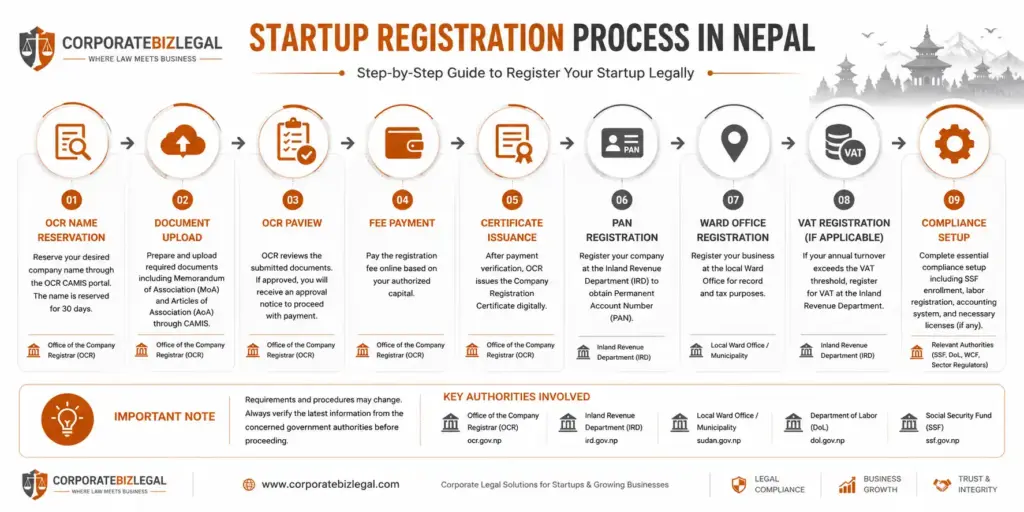
Government Offices Involved
Understanding which government offices regulate which aspects of your startup prevents compliance gaps and administrative delays.
| Office | Role | Key Responsibilities |
|---|---|---|
| Office of the Company Registrar (OCR) | Primary registration authority | Company incorporation, name reservation, annual returns, dissolution |
| Inland Revenue Department (IRD) | Tax administration | PAN issuance, VAT registration, income tax assessment, TDS compliance |
| Department of Industry (DOI) | Foreign investment approval | FDI approval for investments up to NPR 6 billion |
| Investment Board Nepal (IBN) | Large-scale investment approval | FDI approval for investments exceeding NPR 6 billion |
| Nepal Rastra Bank (NRB) | Foreign exchange regulation | Capital inflow approval, profit repatriation authorization |
| Social Security Fund (SSF) | Employee social protection | Employer and employee registration, monthly contribution collection |
| Local Ward Office / Municipality | Local business licensing | Business registration, local tax, operating license renewal |
| Department of Immigration | Visa and work permits | Business visa recommendations for foreign investors |
| Sector-Specific Regulators | Industry oversight | NRB (banking), Insurance Board (insurance), Department of Tourism (tourism), etc. |
Source:
Companies Act, 2063 (2006)
Foreign Investment and Technology Transfer Act, 2075 (2019)
Value Added Tax Act, 2052 (1996)
Social Security Act, 2074 (2017)
Local Government Operation Act, 2074 (2017)
Government of Nepal
Timeline and Factors Affecting Registration
Typical Timeline
| Stage | Duration |
|---|---|
| Name reservation | 1–3 days |
| Document preparation | 2–5 days |
| OCR examination | 2–5 days |
| Payment and certificate issuance | 1 day |
| PAN registration | 2–5 days |
| Ward office registration | 1–3 days |
| Total (standard case) | 8–21 days |
Source:
Office of the Company Registrar (OCR)
Government of Nepal
Factors That Speed Up Registration
- Complete, accurate documentation prepared before starting the online process
- Clear, legible scanned documents under 500KB
- Exact name matching across all identity documents
- Prompt response to OCR queries or correction requests
- Pre-verified office address with valid lease or ownership documents
Factors That Cause Delays
- Name rejection due to similarity with existing companies
- Missing signatures on MoA/AoA pages
- Mismatched shareholder names across documents
- Incomplete or unclear scanned uploads
- OCR backlog during peak filing periods
- Foreign investment cases requiring DOI/IBN and NRB approvals (adds 1–2 months)
- Sector-specific licenses (banking, insurance, hydropower, etc.)
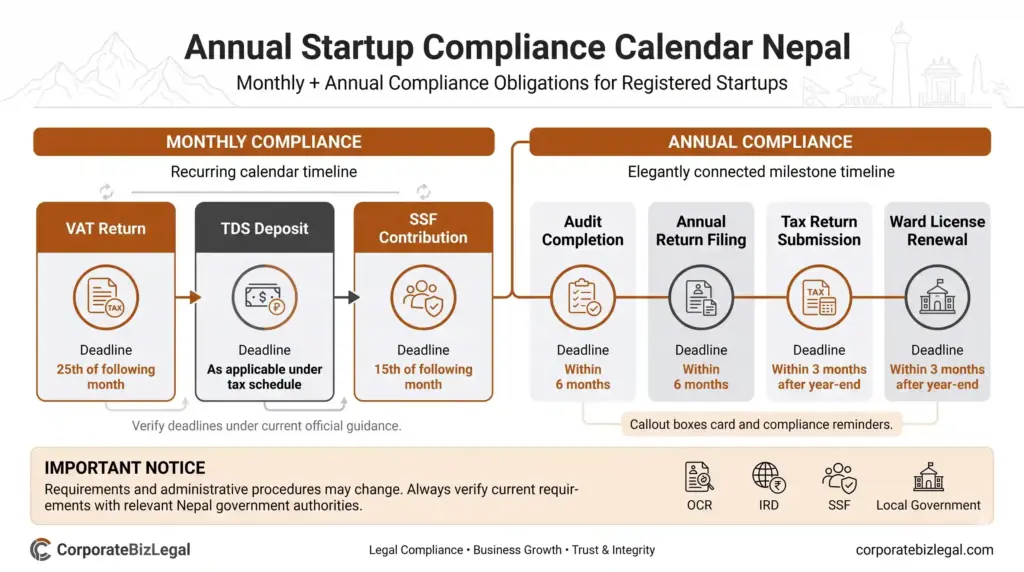
Legal Compliance After Registration
Registration is not the finish line. Ongoing compliance maintains your company’s legal standing and avoids penalties. The following obligations apply after incorporation:
PAN and Tax Compliance
Every company must file income tax returns under the Income Tax Act, 2058. Corporate income tax returns are due within 3 months of the fiscal year-end (by mid-October for companies on the standard Nepal fiscal year running Shrawan 1 to Ashadh end). The company must maintain books of accounts and appoint an auditor regardless of turnover or profit status.
Source:
Income Tax Act, 2058 (2002)
Government of Nepal
VAT Compliance (If Registered)
VAT-registered businesses must:
- File monthly VAT returns by the 25th of the following month
- Issue VAT-compliant invoices showing the VAT registration number
- Maintain purchase and sales books
- Claim input tax credits on eligible purchases
- Display the VAT registration certificate at business premises
The standard VAT rate is 13%. Certain exports and supplies listed in Schedule 2 of the VAT Act are subject to 0% VAT.
Source:
Value Added Tax Act, 2052 (1996)
Section 10: Registration
Government of Nepal
Annual Audit and Return Filing
Under Section 111 of the Companies Act, 2063, every company must appoint an auditor licensed under prevailing law and conduct an annual statutory audit. The audit must be completed within 6 months of the fiscal year-end.
Under Section 109, annual financial statements must be prepared by the board of directors and approved and audited. For public companies, these must be ready at least 30 days prior to the AGM. For private companies, financial statements must be prepared within 6 months of the expiry of the financial year.
Annual returns must be filed with OCR as follows:
- Public companies: within 30 days of holding the AGM, which must be held within 6 months of the fiscal year-end
- Private companies: submit audited financial statements and related documents within 6 months of the completion of the financial year, unless otherwise specified in the Articles of Association
Source:
Companies Act, 2063 (2006)
Section 109: Annual Financial Statement
Section 111: Appointment of Auditor
Government of Nepal
Social Security Fund (SSF) Enrollment
Under the Social Security Act, 2074 (2017) and Labour Act, 2074 (2017), companies with employees must:
- Register as an employer on the SSF portal (ssf.gov.np)
- Register all employees within 3 months of hiring
- Deposit monthly contributions: 11% from employee’s basic salary + 20% employer contribution (total 31% of basic salary)
- Maintain contribution records and update employee status changes
SSF enrollment is mandatory for formal-sector employers. The contribution is calculated on basic salary only; allowances are excluded.
Source:
Social Security Act, 2074 (2017)
Social Security Regulations, 2075 (2018)
Labour Act, 2074 (2017)
Government of Nepal
Employment and Labor Compliance
- Register with the Department of Labour if operating a factory or employing staff
- Maintain compliant employment contracts
- Comply with minimum wage and working hour regulations
- Conduct labor audits as required
Local License Renewal
Renew the business operating license at the local ward office or municipality annually within 3 months of the fiscal year-end (by Shrawan). Operating without a current license risks penalties and complications with other government interactions. Requirements may vary by municipality; verify with your local ward office.
Beneficial Ownership Register
Companies must maintain a register identifying any natural person who ultimately owns or controls 25% or more of shares or voting rights. Update the register within 30 days of any ownership change and include disclosures in annual OCR filings.
Intellectual Property Protection
While not a registration compliance, startups should consider trademark registration with the Department of Industry to protect brand identity. Patent and copyright protection may apply to innovative products and software.
Source:
Companies Act, 2063 (2006)
Social Security Act, 2074 (2017)
Labour Act, 2074 (2017)
Local Government Operation Act, 2074 (2017)
Government of Nepal
Common Legal Mistakes Founders Make
Even experienced entrepreneurs make errors during registration and early compliance. Here are practical examples of common mistakes and how to avoid them:
Mistake 1: Choosing a Name That Conflicts with Existing Businesses
Example: A founder submits “Himalayan Tech Solutions” without checking the OCR database. The name is rejected because “Himalayan Tech Pvt. Ltd.” was registered two years earlier.
Prevention: Search the OCR company database at application.ocr.gov.np before finalizing your name. Prepare three alternative names in order of preference.
Mistake 2: Inconsistent Name Spelling Across Documents
Example: A shareholder’s citizenship certificate shows “Ram Bahadur Thapa” but the MoA lists “Ram B. Thapa.” OCR flags the discrepancy and requests correction, delaying registration by a week.
Prevention: Verify exact spelling on all identity documents before drafting MoA/AoA. Use full names as they appear on citizenship certificates.
Mistake 3: Vague or Overly Broad Business Objectives in MoA
Example: A startup writes “to carry on any lawful business” as its objective. OCR rejects this as non-compliant with the requirement to specify principal business activities.
Prevention: List specific, defined objectives aligned with your actual business model. Reference standard industry classification codes where possible.
Mistake 4: Missing the 90-Day Name Reservation Window
Example: A founder reserves a name but delays document preparation. The reservation expires on day 91, requiring a new reservation application and fee.
Prevention: Prepare all documents before or immediately after name reservation. Set calendar reminders for the 90-day deadline.
Mistake 5: Failing to Register PAN Before Commencing Business
Example: A startup begins operations and invoices clients immediately after receiving the company certificate. After two months, the founder discovers PAN is required for invoicing and banking. The company faces potential penalties under the Income Tax Act.
Prevention: Make PAN registration the first priority after receiving the company certificate. Do not commence commercial transactions until PAN is obtained.
Mistake 6: Assuming Zero Activity Exempts from Annual Filing
Example: A pre-revenue startup with no transactions skips the annual return and audit, believing no activity means no filing obligation. OCR imposes late filing penalties and threatens deregistration.
Prevention: File annual returns and conduct audits regardless of activity level. Submit nil returns where appropriate. The Companies Act makes no exemption for inactive companies.
Mistake 7: Delaying SSF Registration Until After Hiring
Example: A startup hires five developers but delays SSF registration for six months. When discovered, the company faces back-dated contribution liabilities and administrative penalties.
Prevention: Register with SSF immediately upon incorporation, even if you have no employees yet. Enroll each employee within 3 months of hiring.
Mistake 8: Mixing Personal and Corporate Finances
Example: Founders use personal bank accounts for company revenue and expenses, failing to open a corporate account. During audit, transactions cannot be traced to the company, creating tax and compliance complications.
Prevention: Open a corporate bank account immediately after obtaining the company certificate and PAN. Maintain strict separation of personal and business finances.
Source:
Companies Act, 2063 (2006)
Income Tax Act, 2058 (2002)
Social Security Act, 2074 (2017)
Office of the Company Registrar (OCR) Enforcement Practices
Government of Nepal
Section 10: When Should You Hire Startup Legal Advisors?
While this guide provides general legal information, certain situations require personalized legal advice from qualified Nepal corporate lawyers. Consider engaging legal advisors when:
During Formation
- Complex shareholding structures: Multiple founders, unequal contributions, vesting schedules, or investor commitments require a founders’ agreement to prevent future disputes.
- Foreign investment: Navigating DOI/IBN approval, FITTA compliance, NRB capital inflow requirements, and repatriation rules demands specialized expertise.
- Sector-specific regulation: Banking, insurance, fintech, pharmaceuticals, and energy face additional licensing beyond standard company registration.
- Intellectual property concerns: Software licensing, patent filings, trademark registration, and IP assignment agreements need legal drafting.
During Growth
- Contract drafting and review: Client agreements, vendor contracts, employment agreements, and non-disclosure agreements should be reviewed by legal counsel.
- Fundraising and investment: Term sheets, shareholder agreements, and securities compliance require legal oversight.
- Regulatory changes: Tax law amendments, labor law updates, and compliance requirement changes should be monitored by legal professionals.
During Crisis
- Dispute resolution: Shareholder conflicts, employment disputes, or regulatory investigations require legal representation.
- Restructuring: Converting from private to public, merging with another company, or winding down operations involves complex legal procedures.
Important distinction: This guide provides legal information, not legal advice. Legal advice is tailored to your specific facts and circumstances by a licensed attorney. For personalized guidance on your startup registration and compliance strategy, consult a qualified Nepal corporate lawyer.
For comprehensive startup legal advisory services including formation, compliance, contracts, and foreign investment, explore Startup Legal Advisory Nepal.
Section 11: Startup Registration Checklist
Use this checklist to track your registration progress and ensure no step is missed:
Pre-Registration Phase
- [ ] Conduct name availability search on OCR CAMIS portal
- [ ] Prepare three name options in English and Nepali
- [ ] Confirm all shareholders have valid citizenship/passport documents
- [ ] Secure registered office address and prepare lease/ownership proof
- [ ] Draft MoA and AoA compliant with Companies Act, 2063
- [ ] Obtain foreign investment approval (if applicable) from DOI/IBN
- [ ] Prepare project report and financial credibility certificate (for foreign investors)
Registration Phase
- [ ] Create CAMIS portal account at camis.ocr.gov.np
- [ ] Submit name reservation application
- [ ] Receive name approval within 1–3 days
- [ ] Upload all required documents to CAMIS within 90 days of name approval
- [ ] Respond promptly to any OCR queries or correction requests
- [ ] Pay registration fee based on authorized capital
- [ ] Download digitally signed Company Registration Certificate
Post-Registration Phase (First 30 Days)
- [ ] Apply for PAN at Inland Revenue Department (online + physical verification)
- [ ] Register at local ward office for business license
- [ ] Open corporate bank account using company certificate and PAN
- [ ] Register for VAT if turnover thresholds apply or business sector requires it
- [ ] Register with Social Security Fund as employer
- [ ] Obtain company stamp/seal
- [ ] Display company certificate and PAN at registered office
- [ ] Frame and display registration documents
Ongoing Compliance (Annual)
- [ ] Appoint auditor licensed under prevailing law
- [ ] Complete annual audit within 6 months of fiscal year-end
- [ ] Hold AGM (public companies) and approve audited financials
- [ ] File annual return with OCR within 6 months of fiscal year-end (private) or 30 days of AGM (public)
- [ ] File income tax return with IRD within 3 months of fiscal year-end
- [ ] File monthly VAT returns (if registered) by 25th of following month
- [ ] Deposit monthly TDS and SSF contributions by respective deadlines
- [ ] Renew ward office business license within 3 months of fiscal year-end
- [ ] Update beneficial ownership register within 30 days of any changes
- [ ] Maintain statutory books: shareholder register, director register, meeting minutes
Source:
Companies Act, 2063 (2006)
Income Tax Act, 2058 (2002)
Value Added Tax Act, 2052 (1996)
Social Security Act, 2074 (2017)
Office of the Company Registrar (OCR)
Inland Revenue Department (IRD)
Government of Nepal
Conclusion
Startup registration in Nepal is a structured, multi-step process governed by the Companies Act, 2063 and administered through the OCR CAMIS portal. While the system has digitized significantly, compliance complexity remains high—particularly for tax registration, annual filings, and employment obligations.
The key to successful registration is preparation: verify name availability, ensure document accuracy, understand your compliance calendar, and distinguish between mandatory requirements (PAN, annual audit, SSF) and conditional obligations (VAT, sector-specific licenses).
Founders dealing with foreign investment, complex ownership, regulated sectors, or ongoing compliance may benefit from obtaining professional legal guidance. For personalized legal guidance on company formation, compliance strategy, and ongoing corporate advisory, contact our Startup Legal Advisory team. We help founders build legally sound businesses from day one.
Frequently Asked Questions
What is the minimum capital required to register a private limited company in Nepal?
The Companies Act does not prescribe a general statutory minimum capital requirement for private limited companies. Registration fees vary based on authorized capital.. However, practical registration typically requires authorized capital of at least NPR 100,000. The registration fee for capital up to NPR 100,000 is NPR 1,000.
Can a single person register a private limited company in Nepal?
Yes. The Companies Act, 2063 permits a private limited company with a single shareholder. This is known as a single shareholder company and is limited to certain business types.
How long does the entire registration process take?
For a standard domestic private limited company with complete documentation, the process typically takes 8 to 21 days. Foreign investment cases requiring DOI/IBN and NRB approvals typically take 1 to 2 months. Timelines may vary based on application volume and document completeness.
Is PAN registration mandatory for all companies?
Yes. Under the Income Tax Act, 2058, every person carrying on a business in Nepal must obtain a PAN. PAN registration is free and must be completed before commencing commercial operations.
When is VAT registration mandatory?
VAT registration is mandatory when annual turnover exceeds NPR 5 million (goods, carriage, or rental services) or NPR 3 million (services or mixed business) in the last 12 months, or when the business engages in designated sectors such as manufacturing, consulting, legal services, or import-export regardless of turnover. Other conditions include obtaining commercial loans exceeding NPR 1 million or importing goods valued over NPR 10,000 in a single transaction.
Can foreigners own 100% of a Nepal company?
Yes, in most sectors. The Foreign Investment and Technology Transfer Act, 2075 allows 100% foreign ownership in businesses not listed on the negative list. However, foreign investment approval from DOI/IBN is required, and the minimum investment threshold is NPR 20 million for general industries. Information technology-based industries are exempt from the minimum threshold when approved through the automatic route.
What happens if I don't file annual returns?
Failure to file annual returns with OCR results in escalating fines, starting from NPR 1,000 and increasing based on company size and delay duration. Persistent non-compliance can lead to company deregistration. Directors may face personal liability under the Companies Act, 2063.
Do I need a lawyer to register my company?
No, company registration can be completed independently through the CAMIS portal. However, legal advisors are recommended for complex cases involving foreign investment, multiple shareholders with special agreements, sector-specific licensing, or when you need assurance that MoA/AoA provisions protect your interests.
What is the difference between PAN and VAT?
PAN (Permanent Account Number) is a tax identification number mandatory for all businesses and individuals engaged in taxable activities. It tracks income tax obligations. VAT (Value Added Tax) is a 13% consumption tax applied to goods and services. VAT registration is only required for businesses meeting turnover thresholds or operating in designated sectors.
Can I operate my business from a residential address?
The registered office address must be a physical location in Nepal where official communications can be received. While the Companies Act does not explicitly prohibit residential addresses, practical registration and ward office requirements may favor commercial addresses. Verify with your local ward office.
Was this article helpful?
Let us know what you think!