
Table of Contents
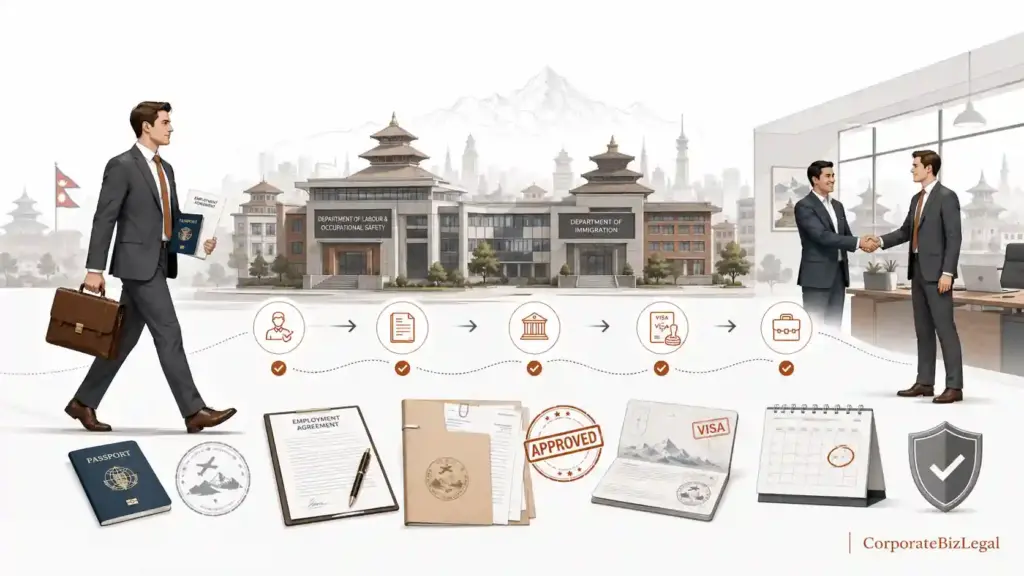
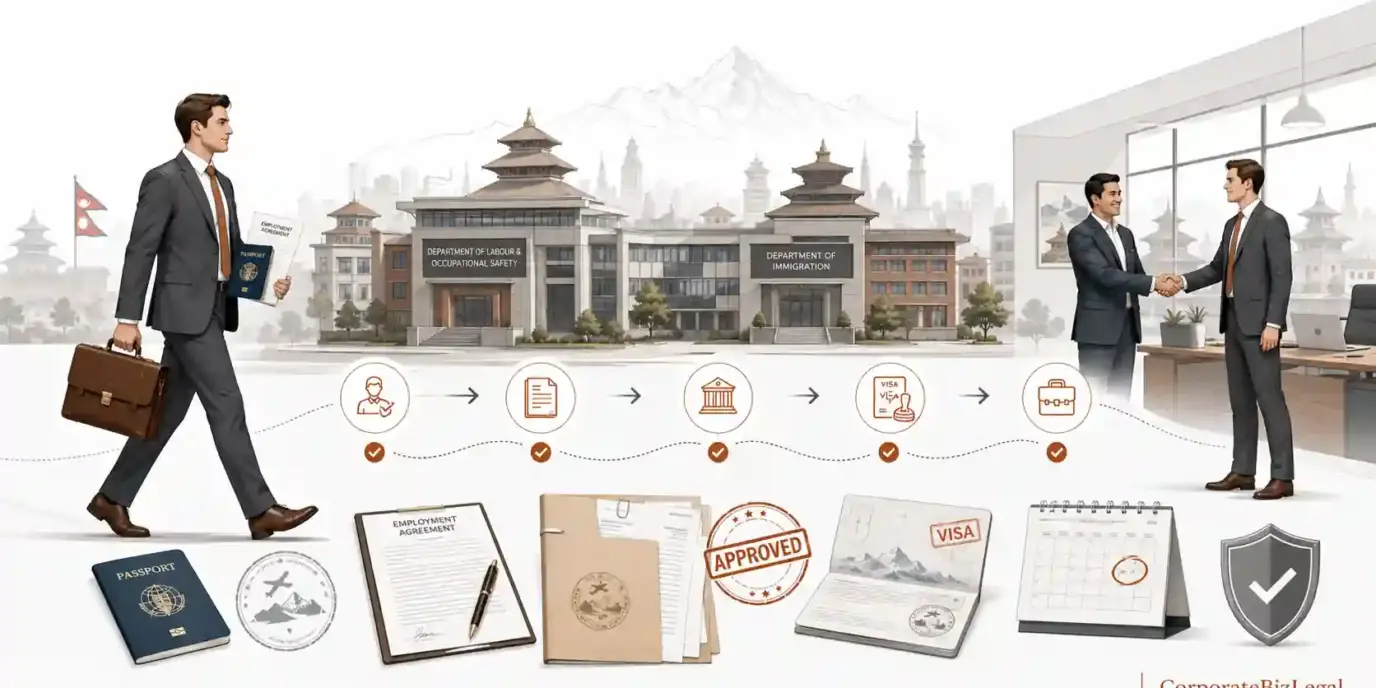
Any foreign national who wants to take up paid employment in Nepal needs a Work Permit Visa in Nepal before starting work full stop. This isn’t a formality that can be sorted out later; it’s a two-part legal requirement that combines a labour authorization from one government body with an immigration status change from another. Employers who skip it expose themselves to fines and disrupted operations, and employees who work without it risk removal from their job and possible immigration penalties. This guide walks through what the Work Permit Visa actually is, who needs one, which government offices are involved, and most importantly exactly how to obtain it, step by step, from the employer’s first decision to hire a foreign worker through to annual renewal.
Quick Facts
| Category | Details |
|---|---|
| Work Permit issuing authority | Department of Labour and Occupational Safety (DoLOS) |
| Work Visa issuing authority | Department of Immigration (DOI) |
| Who applies | Employer (Work Permit); employee, with employer support (Work Visa) |
| Typical validity | Up to 3 years (up to 5 years for highly skilled/technical roles) |
| Renewal | File at least 30 days before expiry |
| Primary governing law | Labour Act, 2074 (2017); Labour Rules, 2075 (2018); Immigration Act, 2049 (1992) |
What is a Work Permit Visa in Nepal?
A Work Permit Visa in Nepal is the combined labour and immigration authorization required before a foreign national can legally work in the country — a Work Permit from the Department of Labour and Occupational Safety (DoLOS), issued under the Labour Act, 2074 (2017) and Labour Rules, 2075 (2018), confirming the employment is lawful, followed by a Work Visa (technically a Non-Tourist Visa) from the Department of Immigration, issued under the Immigration Act, 2049 (1992), confirming the person’s right to stay and work. You cannot get one without the other: DoLOS will not issue a work permit without proof of legitimate employment need, and Immigration will not grant the work visa without a valid DoLOS-issued permit in hand. Together, they form the complete legal authorization for a foreigner to live and work in Nepal.
| Aspects | Work Permit | Work Visa |
|---|---|---|
| Purpose | Labour authorization confirming the job cannot be filled by a qualified Nepali | Immigration status permitting stay and employment |
| Issuing authority | DoLOS | Department of Immigration |
| What it authorizes | The role, employer, and employment terms | Legal residence and work in Nepal |
| Order of application | Applied for first | Applied for after the Work Permit is approved |
Who Needs a Work Permit Visa?
Any foreign national performing paid or technical work in Nepal generally needs both a Work Permit and a Work Visa before starting — this includes employees of Nepali companies, foreign-invested enterprises, INGOs, and technical experts brought in for specialized roles. Companies with foreign investment, organizations running foreign-aid projects, and businesses hiring specialists unavailable in the local labour market all fall under this requirement. A business visa alone does not authorize employment, and working on a tourist visa is illegal regardless of how short the assignment is. The main exemptions apply to individuals holding diplomatic immunity and foreign nationals exempted under a specific treaty or bilateral agreement with the Government of Nepal.
Legal Authorities Involved
Three government bodies typically play a role. The Department of Labour and Occupational Safety (DoLOS) is the authority that reviews and issues the work permit itself. The Ministry of Home Affairs (MOHA) issues a no-objection letter where required, particularly for sensitive sectors or roles. The Department of Immigration (DOI) issues the actual Non-Tourist Work Visa once the work permit and any necessary MOHA clearance are in place. Each authority checks different things — DoLOS focuses on whether the job genuinely requires a foreign hire, MOHA on security and policy clearance, and DOI on the immigration status itself — so missing a step at any one of them stalls the entire application.
Step-by-Step Process to Obtain a Work Permit Visa in Nepal
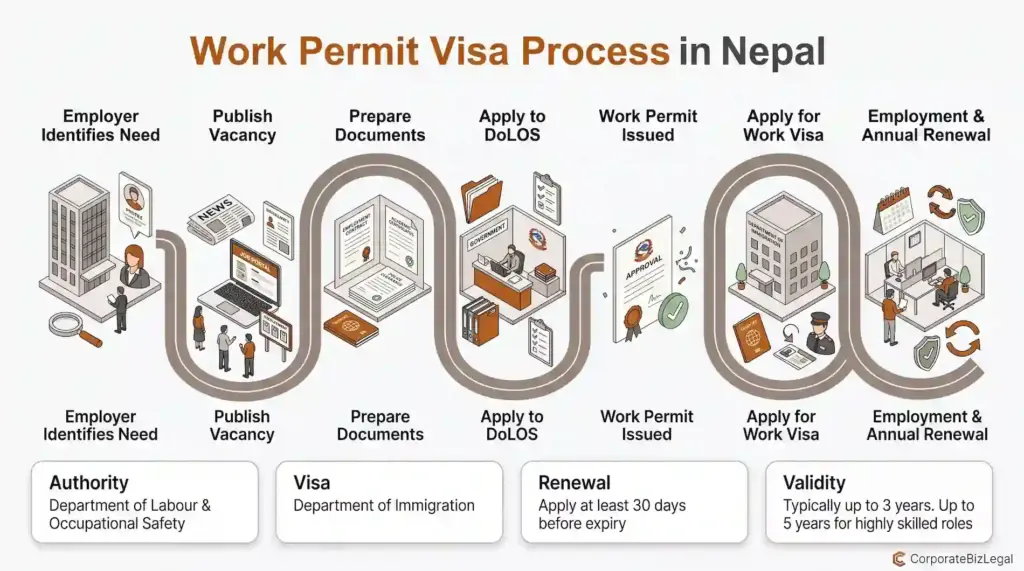
Step 1: Employer Identifies the Need to Hire a Foreign National
The process starts with the employer, not the prospective employee. Under Section 22 of the Labour Act, a company can only hire a foreign worker after demonstrating that no qualified Nepali candidate is available for the position. This is the legal foundation of the entire system — Nepal’s work permit framework is built to prioritize local employment while still allowing businesses to bring in specialized skills when genuinely needed. Before going further, the employer should confirm the company is in good standing: valid registration documents, an up-to-date tax clearance certificate, and, where applicable, current Social Security Fund (SSF) affiliation. Companies that skip this internal check often run into rejections later in the process, once DoLOS starts reviewing supporting documents.
There are two other routes worth knowing about at this stage, because they change the rest of the process substantially. Companies with foreign investment, or projects operating on foreign aid, can hire up to three foreign employees through direct recording at DoLOS, bypassing the standard labour market test under Rule 13 of the Labour Rules. Separately, a technician arriving for three months or less to repair machinery, install new equipment, or handle a similar emergency technical task can also be recorded directly under Rule 24, without going through the full advertisement-and-review cycle. If neither exception applies, the employer proceeds with the general route described below.
Step 2: Vacancy Publication
For the general route, the employer must publish a vacancy announcement in a national daily newspaper and on DoLOS’s official job portal (jobkhoj.gov.np). This isn’t a box-ticking exercise it’s the mechanism through which the government verifies that no Nepali citizen applied who could reasonably fill the role. The employer needs to allow a reasonable waiting period after publication before compiling the results, since DoLOS will expect to see evidence that the vacancy was genuinely open to Nepali applicants before any foreign candidate was considered. Keep the original newspaper clipping and the portal confirmation on file — these become required documents in the formal application.
Step 3: Preparing Documents
With the labour market test complete, both employer and employee need to assemble their respective documentation. On the employer’s side, this typically includes the company’s registration certificate, Memorandum and Articles of Association, a current tax clearance certificate, a labour audit report, an action plan explaining how Nepali staff will eventually be trained to take over the role (a localization plan), and SSF affiliation certification where relevant. On the employee’s side, the core documents are the passport (with a minimum of six months’ remaining validity), a detailed bio-data or CV, academic or professional qualification certificates, passport-sized photographs, and, in many cases, a police clearance certificate from the home country and a signed employment contract. Where the role touches a sensitive sector, a no-objection letter from the Ministry of Home Affairs may also be required before the application can move forward. Documents in a language other than English or Nepali should be professionally translated and certified. It’s also worth cross-checking names, dates, and job titles across every document before submission — small inconsistencies between the passport, the CV, and the employment contract are a routine and entirely avoidable cause of delay, alongside missing items from the DoLOS checklist.
Step 4: Applying for the Work Permit
The formal application is filed with DoLOS using the prescribed application format (Annex 1 under the Labour Rules, 2075), along with the newspaper advertisement, portal confirmation, and the full document package from Step 3. DoLOS reviews the submission and may request clarifications, additional evidence, or an interview before deciding. The employer carries the primary responsibility here: DoLOS holds the company accountable for the accuracy of every submitted document, and any employer non-compliance — outstanding tax liabilities, missing SSF contributions, unresolved labour disputes — can hold up approval regardless of how complete the employee’s individual paperwork is. In practice, the general-route work permit process takes roughly 30 to 45 days, though this can extend if additional government review is triggered.
Step 5: Work Permit Approval
Once DoLOS approves the application, it issues a Work Permit Certificate specifying the employer, the role, and the validity period. Validity depends on the worker’s skill category: foreign nationals with high-level skills or specialized technical knowledge can be granted a permit valid for up to five years, while other foreign workers typically receive up to three years. This certificate is the foundation document for everything that follows without it, the Department of Immigration will not process a work visa application.
Step 6: Applying for the Work Visa
With the work permit secured, the employee applies for the Non-Tourist Work Visa through the Department of Immigration. Most foreign employees are already in Nepal on a tourist visa at this stage while the paperwork is being finalized; once the work visa is granted, the visa category changes from tourist to non-tourist, and the tourist visa is automatically cancelled. The application is typically submitted online through DOI’s portal and requires the DoLOS work permit, a recommendation from the relevant line ministry, and — except in a few exempted cases — a work agreement. DOI reviews the submission and, once satisfied, issues the work visa. Because visa fee schedules are periodically revised by government notification, it’s worth confirming the current rate directly with DOI or through legal counsel before budgeting for this step, rather than relying on older published figures.
Step 7: Arrival and Employment Compliance
Getting the visa isn’t the finish line. Once employed, the foreign national must be properly registered and enrolled in the Social Security Fund where applicable, and the employer must maintain accurate employment records throughout the engagement. Compliance doesn’t end after the first approval — both the work permit and the work visa need to be renewed before they expire, and DoLOS requires renewal applications to be filed at least 30 days before the permit’s expiry date. Employers who let a permit lapse, even briefly, risk having the employee treated as working without authorization, which carries real financial consequences (more on that below). A simple internal calendar reminder tied to each foreign employee’s permit expiry date goes a long way toward avoiding this.
Documents Required
| Document | Required For |
|---|---|
| Application in prescribed format (Annex 1) | Work Permit application at DoLOS |
| Newspaper advertisement + jobkhoj.gov.np confirmation | Proving the labour market test |
| Passport (minimum 6 months’ validity) | Employee identification |
| Bio-data / CV and qualification certificates | Employee eligibility |
| Company registration certificate, MOA/AOA | Employer verification |
| Tax clearance certificate | Employer compliance check |
| Labour audit report | Employer compliance check |
| Action plan / localization plan | Demonstrating skills transfer to Nepali staff |
| Employment contract | Work Permit & Work Visa |
| Police clearance certificate (home country) | Commonly requested as part of the Work Permit/Visa file |
| Passport-sized photographs | Work Permit & Work Visa |
| No-objection letter (where required) | Ministry of Home Affairs clearance |
| SSF affiliation certificate | Social Security Fund compliance |
| Line ministry recommendation, work agreement | Non-Tourist Work Visa at DOI |
Government Fees and Validity
| Item | Detail |
|---|---|
| Work Permit fee (up to 6 months) | NPR 15,000 per person |
| Work Permit fee (above 6 months) | NPR 20,000 per person |
| Work Visa fee | Set by the Department of Immigration; varies by employer type and funding source — confirm the current rate with DOI before applying |
| Re-entry permission | Available for an additional DOI fee if the employee needs to travel in and out of Nepal during the visa period — confirm the current rate with DOI |
| Work Permit validity (highly skilled/technical workers) | Up to 5 years |
| Work Permit validity (other foreign workers) | Up to 3 years |
| Renewal deadline | At least 30 days before expiry |
Common Reasons for Delay or Rejection
Most delays trace back to a handful of recurring issues. Missing or inconsistent documents — particularly gaps between the newspaper ad, the portal listing, and the formal application — are the single biggest cause. Incorrect or outdated employer information, such as an expired tax clearance certificate or unresolved SSF contributions, will stall a file even when the employee’s paperwork is flawless. Applications also stumble when the employer can’t adequately justify the labour market test, especially if a qualified Nepali applicant appears to have been overlooked. On the employee side, a passport nearing its expiry date, or one without the required six-month buffer, is a frequent and entirely avoidable rejection reason. Finally, incomplete approvals — proceeding to the Department of Immigration before DoLOS has fully finalized the permit, or before a required MOHA no-objection letter has come through — routinely send applicants back to square one.
How CorporateBizLegal Assists
CorporateBizLegal supports both employers and foreign employees through each stage of this process — preparing and reviewing the labour market test documentation, filing Work Permit applications with DoLOS, handling the subsequent Work Visa application at the Department of Immigration, and managing ongoing employer compliance obligations under Nepal’s employment law framework. We also assist with permit and visa renewals, helping clients track deadlines so authorizations don’t lapse, and provide broader immigration and employment law advice for companies bringing foreign talent into Nepal. Our team regularly works alongside related matters such as foreign investment approvals, company registration, business visa services, and corporate compliance, since work permit applications often intersect with a company’s broader regulatory standing.
Conclusion
Obtaining a Work Permit Visa in Nepal is a sequential, document-heavy process that runs through two separate government authorities — DoLOS for the labour authorization and the Department of Immigration for the visa itself — with the Ministry of Home Affairs sometimes involved as a third checkpoint. Getting it right means starting with a solid labour market test, keeping employer compliance current, assembling complete documentation, and tracking renewal deadlines well in advance. Given how easily a single missing document or an expired tax clearance can stall the entire timeline, both employers and foreign nationals are well served by getting legal guidance before filing, rather than after running into a rejection.
Frequently Asked Questions
Can I work in Nepal on a tourist visa?
No. Working on a tourist visa is illegal in Nepal, regardless of how short-term the engagement is. You must hold a valid Work Permit from DoLOS and a Non-Tourist Work Visa from the Department of Immigration before starting any paid or technical work.
How long does a Work Permit Visa take to obtain?
The general-route Work Permit process at DoLOS typically takes around 30 to 45 days, followed by the separate Work Visa application at the Department of Immigration. Timelines can extend if additional documentation or review is required.
Can I renew my Work Visa?
Yes. Work Visas are renewable, generally in line with the underlying Work Permit's validity. Employers should file renewal applications at DoLOS at least 30 days before the current permit expires to avoid a compliance gap.
Can I change employers while on a Work Permit Visa?
No. A Work Permit is tied to a specific employer and role. If you change jobs, the new employer must file a fresh Work Permit application on your behalf the existing permit cannot simply be transferred.
Is a Work Permit mandatory for all foreign employees?
Yes, with narrow exceptions. Foreign nationals with diplomatic immunity, or those exempted under a specific treaty or agreement with the Government of Nepal, are not required to obtain a standard work permit.
Who applies for the Work Permit the employer or the employee?
The employer files the Work Permit application with DoLOS on behalf of the foreign employee, since the employer must demonstrate the labour market test and its own compliance status as part of the process.
What happens if I work in Nepal without a permit?
Authorities can remove the foreign national from work immediately. The employer also faces penalties — a fine of up to NPR 200,000 depending on the number of affected workers, plus an additional NPR 5,000 per person per month if the violation continues.
Can NGOs and INGOs employ foreign nationals in Nepal?
Yes, NGOs and INGOs can employ foreign staff, but they generally still need to go through the DoLOS work permit process and often coordinate with the Social Welfare Council and relevant line ministries for project-specific approvals.
Do foreign-invested companies face the same process as other employers?
Not entirely. Companies with foreign investment, or projects funded by foreign aid, can hire up to three foreign employees through a direct-recording route at DoLOS that bypasses the standard labour market test, under Rule 13 of the Labour Rules.
Is there a simplified route for short-term technical work?
Yes. A technician arriving for three months or less to repair machinery, install technology, or perform similar emergency technical work can be recorded directly at DoLOS under Rule 24, without going through the full newspaper-advertisement process.
Does the tourist visa automatically end once a Work Visa is granted?
Yes. Once the Department of Immigration approves the Non-Tourist Work Visa, the applicant's visa category changes from tourist to non-tourist, and the previous tourist visa is automatically cancelled.
Was this article helpful?
Let us know what you think!