

Table of Contents

Every year, thousands of Nepali students walk into consultancy offices across Kathmandu, Pokhara, and Biratnagar looking for help getting into a university abroad. A much smaller number of those offices are actually licensed to give that advice. That gap is exactly why the government tightened enforcement and why getting your registration right, the first time, now matters more than it used to.
If you’re planning to open an educational consultancy in Nepal, this guide walks through what the law actually requires, what the Ministry of Social Development looks for during inspection, where applications typically get stuck, and what it costs in real terms not just the government fee, but the full picture.
Quick Overview
Here’s the process compressed into one paragraph, for anyone who wants the shape of it before the detail.
You register a private limited company at the Office of Company Registrar, get your PAN or VAT from the Inland Revenue Department, secure a ward-level business registration, then apply to your Provincial Ministry of Social Development for the actual education consultancy licence which involves document verification, a physical office inspection, and, once you pass, a licence valid for one fiscal year. In Bagmati Province, this last step runs through the Ministry of Social Development office in Hetauda and its ECIS portal. Budget one to four months from start to finish, and a meaningful amount of that time is spent getting your MOU paperwork and counsellor qualifications into a form the Ministry will accept without sending it back.
What Is Educational Consultancy Registration?
Educational consultancy registration in Nepal is the two-part statutory process of establishing a corporate entity and acquiring a specific operating license to provide study-abroad advisory services. It requires incorporating a business under the Companies Act and subsequently obtaining functional approval from the provincial Ministry of Social Development (MoSD) or the Ministry of Education, Science and Technology (MoEST). This ensures that any entity offering counseling, test preparation, or international university placement operates under official government oversight.
People often assume company registration alone is enough. It isn’t. A Pvt. Ltd. company with “education consultancy” in its name but no MOSD licence is, legally, an unlicensed consultancy and the Department of Commerce, Supplies and Consumer Protection has been treating that distinction seriously. Nationwide sweeps in the current fiscal year found several thousand consultancies operating without valid licences, and the penalties that follow are not symbolic.
Practical Lawyer’s Note: The single most common client conversation we have is someone who completed their initial [Company Registration] steps, rented office space, hired a counsellor, and started taking students — all before realizing the MOSD licence was a separate, mandatory step. Reversing that (closing intake, re-applying, sometimes relocating to satisfy office standards) costs far more time than doing it correctly from day one.
Who Actually Needs This Licence?
An educational consultancy license is legally mandated for any business entity in Nepal providing study-abroad counseling, visa documentation guidance, or credential processing for international higher education. Under prevailing directives, this requirement applies to all operations ranging from single-person boutique agencies to multi-branch corporate networks that represent foreign universities. Pure test-preparation or language coaching facilities are generally exempt, provided they do not cross over into direct student placement or admissions counseling.
It does not, generally, cover pure test-preparation centres (IELTS/PTE coaching with no admission counselling) or language schools that don’t process applications abroad though in practice many consultancies bundle test prep with counselling, and once that bundling happens, the licensing requirement attaches to the whole operation. If your business model is genuinely limited to coaching, it’s worth getting a specific opinion before assuming you’re exempt, because the line the Ministry draws in inspection is based on what services you’re actually advertising and delivering, not what your company name says.
The Legal Framework
The regulatory framework governing educational consultancies in Nepal is built on a multi-tiered legislative structure that anchors corporate existence, consumer safety, and educational quality. Primary corporate compliance is mandated by the Companies Act, 2063 (2006), while sector-specific operations are regulated by the Education Consultancy Service Directive, 2073 (2016). Enforcement and market monitoring fall under the jurisdiction of the Consumer Protection Act, 2075 (2018), which penalizes unauthorized or deceptive placement practices.
Three layers of law govern this space, and understanding how they interact matters more than memorizing any one of them. The Companies Act, 2063 (2006) governs the underlying corporate entity every consultancy must exist as a registered private limited company before anything else happens. The Education Consultancy Service Directive, 2073 (2016) is the sector-specific instrument that actually creates the licensing requirement, sets counsellor qualification standards, and defines what an inspection checks for. Layered on top of that, the Consumer Protection Act, 2075 (2018) gives the Department of Commerce, Supplies and Consumer Protection its enforcement teeth this is the body that runs the compliance sweeps and issues the fines when a consultancy is found operating without a valid licence.
Institutional Workflow & Interconnectivity
To maintain comprehensive Corporate Compliance, an applicant must understand that individual regulatory authorities do not work in isolation. Their structural relationships function sequentially as a single operational pipeline:
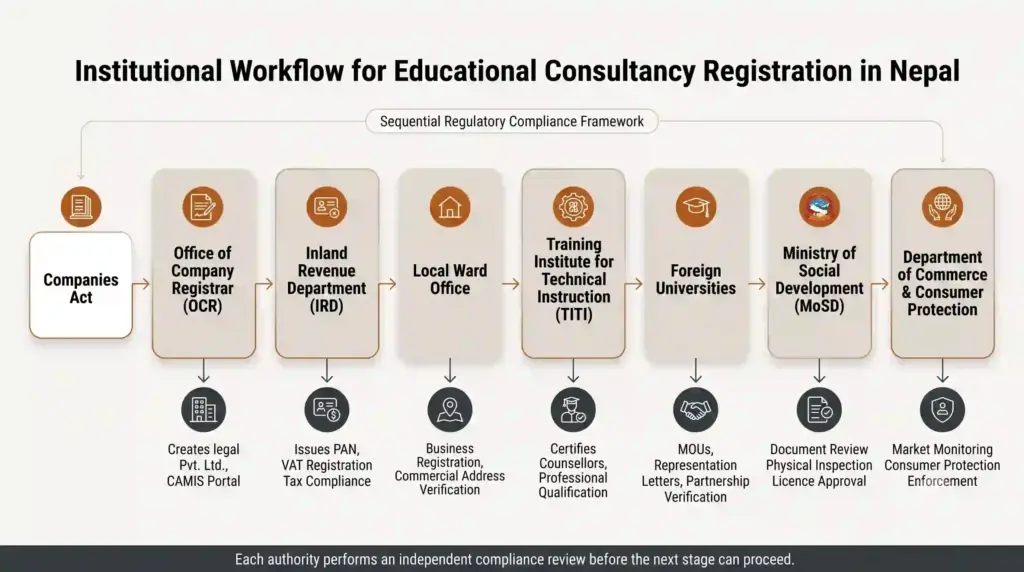
Each authority is checking something different, and skipping ahead to MOSD before the earlier layers are solid is the fastest way to get an application bounced back.
Which Authority Handles What
Navigating the registration process requires submitting distinct applications to specialized governmental departments, each managing a specific phase of corporate or sector-specific licensing. Initial incorporation is executed centrally, whereas operational authorization has been largely decentralized to provincial and local structures. Understanding the exact division of responsibilities ensures that administrative submissions are correctly routed without costly jurisdictional delays.
| Stage | Authority | What It Confirms |
|---|---|---|
| Company formation | Office of Company Registrar (OCR), via the CAMIS portal | Legal existence of the Pvt. Ltd. entity, name reservation, MOA/AOA aligned with the Companies Act. |
| Tax registration | Inland Revenue Department (IRD) | PAN (and VAT, if turnover is expected to cross the VAT threshold via Tax Consultation recommendations). |
| Local operating authorization | Ward Office / Municipality | Business is registered to operate at a specific, legally zoned commercial address. |
| Sector licence | Provincial Ministry of Social Development (MOSD) — MOSD Hetauda for Bagmati Province | Counsellor qualifications, foreign university MOUs, physical infrastructure standards, and ongoing operational compliance. |
Provincial variation matters here. Bagmati Province formally moved licensing authority from the Central Ministry of Education to MOSD Hetauda, and applications now run through the ECIS Bagmati portal. Other provinces have their own designated ministries and, in some cases, still route through education authorities rather than MOSD. If you’re registering outside Bagmati, confirm the current designated authority for your province before filing — the directive allows for this variation, and firms that assume the Bagmati process applies everywhere end up filing with the wrong office.
Eligibility: What You Need Before You Can Even Apply
To qualify for an educational consultancy license in Nepal, an applicant must satisfy a strict baseline of corporate, infrastructural, educational, and international criteria. These statutory prerequisites ensure that the founding entity possesses a stable legal structure, viable commercial premises, qualified human capital, and verified institutional relationships abroad. Failing to fulfill even a single baseline criteria will result in an immediate administrative rejection during the preliminary document review stage.
Before MOSD will look at your file, you need to already have in place:
- A registered private limited company with “education consultancy” (or an equivalent descriptor) reflected in its stated objectives.
- Valid PAN or VAT registration.
- A commercial office space with a formal lease agreement — informal or residential premises are routinely rejected at inspection.
- At least two counsellors holding a minimum of a Bachelor’s degree, each formally certified by the Training Institute for Technical Instruction (TITI).
- Signed Memoranda of Understanding (MOUs) with a minimum of two foreign universities or higher education institutions, accompanied by institutional profiles and official representation letters.
That last point trips up more applicants than any other. A one-page letter of interest from a foreign institution is not the same as an MOU that MOSD will accept, and Ministry reviewers have seen enough thin agreements to be skeptical of anything that doesn’t clearly establish an actual representation relationship.
Professional Tip: Get your MOUs reviewed by an expert for adequacy before submission, not after rejection. We’ve seen applications delayed by six to eight weeks simply because the foreign university’s MOU didn’t specify representation terms clearly enough for the Ministry’s reviewers, and getting a revised, properly executed version signed across two countries takes time you don’t get back.
Documents Required
The documentation portfolio for an educational consultancy license requires a comprehensive assembly of corporate filings, personal credentials, professional certifications, and international contracts. This extensive dossier serves as the evidentiary basis upon which both the Office of Company Registrar and the Ministry of Social Development evaluate operational viability. Every submitted photocopy must be clean, legible, and, where necessary, attested to avoid procedural holds.

At minimum, expect to compile:
- Company registration certificate alongside the updated MOA/AOA.
- PAN/VAT registration certificate.
- Citizenship certificates (or national ID/passport for foreign shareholders backed by [Foreign Direct Investment (FDI)] clearance).
- Office lease agreement, generally expected to reflect a minimum duration of two years.
- Company profile and formal organizational chart.
- Bachelor’s degree (or higher) certificates, citizenship copies, appointment/acceptance letters, and active TITI training certificates for each counsellor.
- Valid MOU copies with at least two foreign universities, plus institutional profiles and formal representation letters.
- For any language/test-preparation component: tutor qualifications and a language proficiency certificate showing a minimum pass threshold.
- Completed MOSD application form (Schedule 1 under the Directive).
- Bank vouchers or receipts confirming payment of the statutory application fee and required deposits.
Some firms will tell you the checklist runs to roughly two dozen individual documents once every supporting certificate and identity document is counted separately. That’s a reasonable estimate — the point isn’t the exact count, it’s that completeness on first submission is what actually saves time.
Step-by-Step Registration Process
The process of legally establishing an educational consultancy in Nepal follows a strict sequential pathway across multiple government departments. Each phase depends entirely on the successful completion of the preceding step, meaning shortcuts are legally impossible. Adhering to this structured workflow prevents administrative rejections and minimizes your total time-to-market.
- Reserve and Register the Company: OCR Setup.
Reserve a unique name through the OCR’s online CAMIS portal, then submit the Memorandum and Articles of Association along with shareholder identity documents. This typically takes under two weeks if the name is approved without objection. - Register for Tax Compliance: IRD Enrolment.
Apply for a PAN at the Inland Revenue Department. Move directly to VAT registration if your projected annual transactions are expected to exceed the statutory threshold. As a practical benchmark, businesses anticipating turnover above roughly NPR 30 lakhs annually should register for VAT from inception. - Secure Local Operating Authorization: Ward Level.
Register the business address and obtain a local business license from the relevant Ward Office or Municipality where your commercial office is physically located. - Digital Listing on Provincial Portal: ECIS Upload.
For operations within Bagmati Province, create your corporate profile on the official ECIS Bagmati system and upload the entire digitized document file for initial screening. - Remit Fees and Finalize Submission: Financial Settlement.
Pay the required application fee (the government application fee for FY 2082/83 stands at NPR 15,000, having been raised from the previous NPR 5,000) and submit the physical dossier along with payment receipts to the Ministry. - Clear the Physical Office Inspection: Field Verification.
Host the assigned MoSD inspectors at your commercial premises. Officials will physically verify your office infrastructure, structural layouts, signage, and staff presence against your application. - Licence Issuance and Archiving: Final Approval.
Once the physical inspection is successfully cleared and documents are verified, the official licence is generated digitally through the ECIS system, followed by the issuance of a physical registration certificate.

How Inspectors Actually Conduct Office Inspections
An office inspection is a mandatory physical audit conducted by Ministry officials to verify that a consultancy’s real-world infrastructure matches its documented submissions. Rather than a superficial check, this field visit assesses layout functionality, spatial separation, consumer transparency, and actual staff deployment. Understanding what inspectors look for helps prevent sudden failures at the very end of the licensing process.
Inspectors are not just confirming an address exists. They’re checking whether the space functions as a genuine consultancy: separate counselling areas rather than one open desk, visible signage identifying the business, evidence that the counsellors named in the application actually work from that location, and displayed fee structures (transparency in pricing is something the Directive specifically cares about, tying back to the Consumer Protection Act). A shared coworking desk or a residential flat with a laptop on the table is a near-automatic fail, even if every document is otherwise in order.
Compliance Insight: Inspectors also cross-check verbally. It’s common for an inspecting officer to ask a counsellor a basic question about one of the partner universities on file — not as a trick, but because a counsellor who can’t speak to the institutions they’re supposedly representing raises a flag about whether the MOU relationship is real or paper-only.
Registration Timeline
The total duration required to secure an educational consultancy license ranges between one to four months, depending heavily on file completeness and institutional response times. While basic corporate registration can be completed within days, provincial ministry reviews and physical inspection schedules constitute the primary time blocks. Pre-arranging certified documents is the most effective mechanism for accelerating this timeline.
- Days 1–7: Company Incorporation at OCR
Filing of MOA/AOA, name reservation, and generation of the digital registration certificate via the CAMIS portal. - Weeks 2–3: Tax & Municipal Enrolment
Acquiring PAN/VAT from the IRD and finalizing local business registration at the Ward Office. Can be run in parallel. - Weeks 4–6: Document Compilation & Portal Upload
Securing certified TITI credentials, gathering foreign university MOUs, and uploading the full dossier to the provincial ECIS system. - Weeks 7–12: MoSD Review & Physical Inspection
Administrative screening of files by Ministry officials, scheduling of field inspectors, and on-site operational verification. - Weeks 13+: Licence Generation & Issuance
Final clearance through provincial ledgers, payment processing verification, and issuance of the active licensing certificate.
The single biggest variable is not government processing speed — it’s how complete your file is walking in. Applications with properly executed MOUs and verified TITI certificates move through inspection scheduling quickly; applications missing either routinely sit for weeks awaiting corrections.
Government Fees and Realistic Budget
Establishing an educational consultancy requires budgeting for fixed statutory government fees, refundable compliance deposits, and variable overhead costs. Government fees are structured uniformly across provinces but are subject to periodic fiscal year updates, while administrative setup costs depend on corporate scale. Maintaining a transparent financial layout prevents unexpected liquidity shortages mid-process.
| Budget Item | Approximate Cost (NPR) | Statutory Nature |
|---|---|---|
| MOSD Application Fee (Bagmati, FY 2082/83) | 15,000 | Non-refundable government filing fee |
| Security Deposit (Bagmati Province) | 100,000 | Refundable upon compliance/closure |
| Company Registration Fee (OCR) | Varies by Capital | Scaled progressively based on authorized capital limits |
| PAN/VAT Registration | Nominal | Basic revenue administration charges |
| Legal & Professional Service Fees | 175,000 – 250,000 | Full-service corporate legal handling, drafting, and representation |
Treat the security deposit figure as something to reconfirm directly with MOSD Hetauda at filing time — deposit and fee amounts in this sector have been revised before, and provincial offices don’t always publicize changes immediately. The same caution applies to any stated authorized-capital minimum for the company itself: unlike the licence fee and deposit, we did not find that figure independently corroborated across multiple current sources, so verify the applicable minimum with OCR and your legal advisor rather than treating any single published number as settled.
Inspection and Annual Compliance
Post-licensing compliance mandates that an educational consultancy maintain its operational, financial, and educational standards throughout the entire fiscal year. The issuance of an initial license does not grant permanent authorization; rather, it places the business under ongoing regulatory monitoring. Failing to fulfill periodic reporting or staffing updates can lead to heavy administrative sanctions during spot checks.
Ongoing compliance generally requires:
- Submitting a comprehensive annual operational report to the designated MoSD desk.
- Submitting audited financial statements for the prior fiscal year to maintain clean corporate standing.
- Maintaining the exact office, staffing, and MOU standards that earned the original licence — not just at renewal time, but continuously, since spot inspections do happen.
Common Mistake: Consultancies frequently let a counsellor’s certification lapse or lose a foreign university partnership without formally updating MOSD, then get caught off guard when renewal review flags the gap. Treat any change in staffing or partner institutions as something to report proactively, not something to quietly work around.
Renewal
An educational consultancy license in Nepal must be renewed annually within the statutory timeframe prescribed by the provincial Ministry of Social Development to avoid operational lapses. Operating on an expired license is treated as a major regulatory violation, carrying immediate financial penalties and potential corporate suspension. The renewal review re-verifies your ongoing structural alignment with the original directive criteria.
Renewal should be filed before the current licence expires, within the window MOSD sets for each fiscal year cycle — commonly cited as within roughly 90 days of expiry, though the exact window can shift with each year’s directive update, so confirm the live deadline rather than assuming last year’s timeline still applies. Missing the renewal window doesn’t just mean paperwork inconvenience; operating on an expired licence is treated the same as operating without one, which is where the NPR 50,000–100,000 penalty range comes into play.
Renewal Checklist
- [ ] Annual operational report formally drafted and filed.
- [ ] Audited financials for the prior fiscal year completed and submitted.
- [ ] Counsellor certifications verified as active and matched to actual staff on-site.
- [ ] Foreign university MOUs confirmed as valid (refreshed if approaching expiry).
- [ ] Office lease verified as active, matching the exact commercial address on file.
- [ ] Renewal fee fully remitted before the strict statutory expiry deadline.
Foreign Investment in Educational Consultancies
Foreign direct investment (FDI) in Nepal’s educational consultancy sector is legally permitted but restricted to a joint-venture structure with local equity participation. Under current industrial policies and FITTA regulations, international investors cannot establish wholly-owned subsidiaries in this category, ensuring domestic market integration. Navigating this pathway requires clearing specialized central investment channels before addressing provincial licensing.
Foreign nationals and entities can invest in a Nepali educational consultancy, but not as sole owners. The consistent position across current guidance is that foreign ownership is capped at 51%, with Nepali partners required to hold at least 49%. Beyond the ownership split, foreign-invested consultancies also need clearance from the Department of Industry under Nepal’s foreign investment framework (FITTA), and depending on how funds move into the country engagement with Nepal Rastra Bank’s foreign exchange rules. Securing an appropriate Business Visa for foreign directors also hinges entirely on completing these foundational investment steps.
Minimum foreign investment thresholds for this sector have been cited in some sources but are not something we’d present as settled without checking the Department of Industry’s current schedule at the time of your specific application, since threshold amounts and how they can be phased in (a smaller amount at incorporation, the balance over time) are the kind of detail that changes with policy updates. This is genuinely a “get current legal advice before you wire money” situation rather than a “look up a fixed number online” one.
Common Mistakes We See Repeatedly
The primary causes of administrative delays or application rejections in this sector stem from avoidable drafting or operational oversights by the founding partners. Many applicants focus heavily on basic company incorporation while treating sector-specific ministry prerequisites as minor formalities. Recognizing these structural missteps beforehand protects your corporate capital and keeps your timeline predictable.
- Treating letters of intent as valid MOUs: Submitting basic promotional letters instead of binding [Commercial Contracts] that specify mutual representation terms.
- Premature marketing and intake: Advertising services or enrolling students before the final MoSD license has been physically issued.
- Underestimating counselor certification windows: Assuming TITI certification can be fast-tracked mid-process, leading to prolonged delays.
- Using residential or shared office layouts: Failing to provide clear, dedicated counseling rooms and public signage during physical site checks.
Lawyer’s Checklist Before Filing
Before submitting your comprehensive application dossier to the Ministry of Social Development, review this practical compliance checklist to ensure total alignment across all regulatory bodies.
- [ ] Company successfully incorporated at the OCR; the objects clause in the MOA/AOA explicitly covers educational consultancy services.
- [ ] PAN/VAT registration active and exactly matching the corporate name on all official documents.
- [ ] Office lease is commercial, sets a minimum duration of roughly two years, and lists an address consistent across every single filing.
- [ ] Both core counsellors are fully TITI-certified, physically present on the payroll, and prepared for basic operational cross-checks.
- [ ] Binding MOUs with at least two foreign universities are executed, verified, and backed by institutional profiles.
- [ ] A transparent fee structure is physically displayed within the premises, ensuring alignment with consumer protection mandates.
- [ ] Application fees and compliance security deposits are prepared and matched against the live provincial schedule.
- [ ] All promotional, digital, and counseling activities are completely paused until the physical licensing certificate is in hand.
Before You Spend Money
Cover practical decisions like:
- Don’t sign a long commercial lease until you’ve confirmed licensing feasibility.
- Start university MOU discussions early.
- Ensure counsellors obtain TITI certification before filing.
- Budget for legal review of documents.
Why Work With a Corporate Lawyer for This
The registration and licensing process for an educational consultancy involves navigating multiple dependent administrative steps where a single error can compromise your entire corporate schedule. A corporate law specialist understands the exact evidentiary thresholds required by ministry reviewers and coordinates filings across distinct departments seamlessly. Professional oversight transforms a complex bureaucratic process into a predictable corporate setup.
None of this process is conceptually difficult, but it’s dense with dependencies a weak MOU can undo months of otherwise solid preparation, and a fee that quietly changed since last year’s filing can bounce a submission back to the end of the queue. A lawyer who has actually walked applications through MOSD Hetauda knows which documents reviewers scrutinize most closely, what a passable MOU actually looks like from the Ministry’s side, and how to sequence company registration, tax registration, and MOSD filing so nothing sits idle waiting on something else.
That’s the kind of groundwork CorporateBizLegal handles for consultancy clients — not just filing paperwork, but reviewing MOU language before it’s signed, preparing office space against what inspectors actually check for, and keeping the compliance calendar so renewal deadlines don’t arrive as a surprise. If you’re also structuring the entity itself, that conversation naturally overlaps with foundational setup steps, Employment Law drafting for certified counsellors, and Trademark Registration to safeguard your brand identity all worth settling before the final MOSD filing rather than after.
Note: Licensing procedures, provincial implementation practices, application fees, security deposits, and documentary requirements may change through amendments to directives or administrative notices. Applicants should verify current requirements with the relevant Provincial Ministry of Social Development or seek legal advice before filing.
Conclusion
Educational consultancy registration in Nepal isn’t complicated in principle: register the company, get tax and local authorization, then satisfy MOSD’s sector-specific standards for staffing, partnerships, and premises. What actually determines how smoothly it goes is preparation MOUs that will survive scrutiny, counsellors who are certified before you file rather than mid-process, and an office that looks like a consultancy the day the inspector walks in. Get those three things right from the start, and the rest of the process moves the way it’s supposed to.
If you’re preparing to register or renew an educational consultancy in Bagmati Province or elsewhere in Nepal, CorporateBizLegal can review your documentation, prepare your MOSD filing, and manage the process end to end.
Frequently Asked Questions
Can I operate before licence approval?
No. Counselling students, charging fees, or representing foreign institutions before the MOSD licence is issued is treated as unlicensed operation, exposing the business to fines and closure.
Can foreigners own an educational consultancy in Nepal?
Yes, up to 51%, with a Nepali partner holding at least 49%, subject to Department of Industry approval under the FITTA framework.
Can I relocate my office after getting the licence?
Yes, but a relocation typically needs to be reported to MOSD, since the licence is tied to the inspected address moving without notifying the Ministry can create a compliance gap at renewal.
Can one licence cover multiple branches?
Generally no; each operating location is expected to meet the same office and staffing standards, so branches typically require their own registration and inspection rather than being covered under a single head-office licence confirm this with MOSD for your specific expansion plan, since practice here isn't uniformly documented.
Can I change directors after registration?
Yes, through the standard OCR process for company changes, but significant ownership or management changes should also be reflected in your MOSD file to avoid a mismatch at renewal.
Can I replace a counsellor?
Yes, but the replacement needs to meet the same bachelor's-degree-plus-TITI-certification standard, and MOSD should be notified rather than discovering the change at inspection.
Can I add more foreign university partnerships later?
Yes, and it's generally encouraged more MOUs strengthen your file but each new MOU should be documented and, where required, reported to MOSD.
Can I offer IELTS or other test preparation?
Yes, if the tutors' qualifications and language proficiency documentation are submitted and verified alongside your core consultancy application.
How long does inspection itself take?
The site visit is usually completed in a single visit lasting under an hour, but scheduling it and getting a follow-up visit if the first one flags a deficiency is what extends the overall timeline.
Can I change my consultancy name?
Yes, but it's a two-step change, not a one-form update. You'd first process the name change through OCR (updated MOA/AOA reflecting the new name), then notify MOSD and update your ECIS listing so the licence record matches your company registration.
Was this article helpful?
Let us know what you think!