

Table of Contents

Franchising is one of the fastest ways for foreign brands to enter Nepal’s growing consumer market and for local entrepreneurs to build businesses with proven systems. But Nepal has no standalone Franchise Act. Instead, franchise arrangements are regulated through multiple interconnected laws, primarily the Foreign Investment and Technology Transfer Act, 2075 (2019) (FITTA). This guide is written for foreign franchisors, local franchisees, investors, and business advisors who need a clear, legally accurate roadmap to register and operate a franchise in Nepal.
TL;DR
Franchising in Nepal is treated as “technology transfer” under FITTA. Foreign brands must register their trademark with the Department of Industry (DOI) before executing a franchise agreement. The local franchisee must incorporate a company, obtain DOI approval for the franchise agreement, and comply with tax and licensing requirements. Trademark registration takes 9–12 months and is the critical path item. Royalty payments to foreign franchisors are capped by regulation and subject to 15% withholding tax. No sector-specific restrictions apply to franchise businesses.
Quick Answer
| Question | Answer |
|---|---|
| Is franchising legal in Nepal? | Yes. Governed under FITTA as technology transfer. |
| Governing law | FITTA 2075, FITTR 2077, PDTA 1965, Companies Act 2063 |
| Trademark required? | Yes. Mandatory before DOI franchise approval. |
| Trademark timeline | 9–12 months |
| DOI approval timeline | 15–30 working days |
| Company registration | 7–10 working days via OCR CAMIS portal |
| Royalty cap (general) | 5% of local sales; 10% of export sales |
| Royalty cap (trademark only) | 3% of local sales; 6% of export sales |
| Withholding tax on royalties | 15% (final for non-residents) |
| VAT on services | 13% |
| Minimum FDI (if equity involved) | NPR 20 million (~USD 150,000) |
| Sector restrictions for franchises | None (unlike general FDI) |
What Is Franchise Registration in Nepal?
A franchise is a business arrangement where a franchisor (brand owner) grants a franchisee (local operator) the right to use its trademark, business model, and operational systems in exchange for fees and royalties. In Nepal, this is classified as technology transfer under Section 3(f) of FITTA, which explicitly includes “user’s license, technological know-how sharing or use of technological knowledge (franchise).”
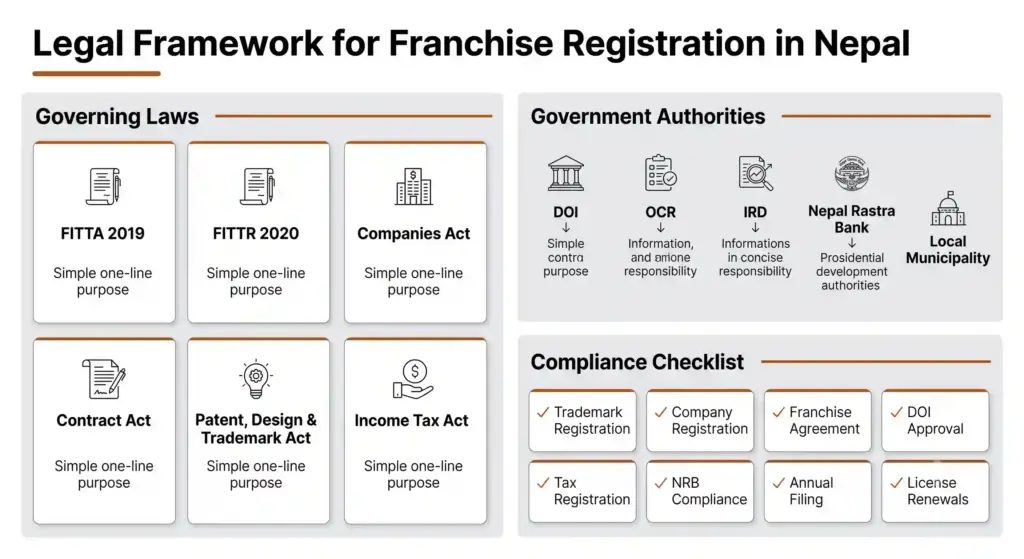
Nepal does not have a dedicated Franchise Act. The legal framework is composite: FITTA governs foreign investment in nepal and technology transfer; the Patent, Design and Trademark Act, 1965 (PDTA) protects brand identity; the Companies Act, 2063 (2006) regulates business entity formation; and the Contract Act, 2056 (2000) enforces the franchise agreement itself. This multi-statute structure means compliance must be verified across several authorities.
The scope covers all franchise models: product distribution, business format (restaurants, retail), manufacturing, and master franchise arrangements. Both domestic and international franchise structures are permitted, though foreign brands face additional DOI approval requirements.
Eligibility / Who Can Apply
Foreign Franchisors
Any foreign company owning a registered trademark may enter into a franchise agreement with a Nepali entity. There is no minimum investment threshold for pure technology transfer (franchise) agreements—unlike equity FDI, which requires NPR 20 million. However, if the foreign party also takes equity in the local company, the FDI minimum applies. Foreign franchisors must have a valid trademark registration in Nepal before DOI will approve the franchise agreement.
Local Franchisees
Nepali individuals or companies can operate as franchisees. The franchisee must incorporate a private or public limited company, have a registered office address in Nepal, obtain all sector-specific licenses (e.g., food, health, tourism), and maintain tax compliance (PAN, VAT if applicable).
Sectors Allowed
Unlike general foreign direct investment, FITTA does not impose sector-specific restrictions on franchise businesses. Franchising is permitted across all industries, including sectors where direct FDI may be restricted. This is a significant advantage for foreign brands.
Legal Requirements
Primary Legislation
| Law | Relevance to Franchising |
|---|---|
| FITTA 2075 (2019) | Governs foreign investment and technology transfer; defines franchise as technology transfer; requires DOI approval |
| FITTR 2077 (2020) | Sets royalty caps, approval procedures, and compliance obligations |
| PDTA 1965 (2022) | Mandates trademark registration; protects brand identity for 7 years (renewable) |
| Companies Act 2063 | Governs incorporation of franchisee entity; MOA/AOA requirements |
| Contract Act 2056 | Requires free consent, lawful consideration, and lawful objects for enforceable agreements |
| Industrial Enterprises Act 2076 | Requires industry registration for foreign-invested enterprises |
| Income Tax Act 2058 | Imposes 15% withholding tax on royalties; governs repatriation |
| VAT Act 2052 | Levies 13% VAT on taxable services and goods |
| Arbitration Act 2055 | Governs dispute resolution clauses in franchise agreements |
| Competition Act 2063 | Prohibits anti-competitive terms (e.g., excessive exclusivity, price fixing) |
Key Compliance Obligations
- Trademark Registration: Foreign brands must register with DOI before franchise approval. Unregistered trademarks receive no legal protection in Nepal.
- DOI Approval: The franchise agreement must be approved by DOI’s Foreign Investment and Technology Transfer Unit.
- Company Incorporation: The franchisee must register with the Office of Company Registrar (OCR).
- Tax Registration: PAN is mandatory; VAT registration is required if annual turnover exceeds NPR 5 million (services) or NPR 20 million (goods), or if voluntarily elected.
- Industry Registration: Required under the Industrial Enterprises Act for all foreign-invested enterprises.
- Local Licenses: Municipal business license, ward office registration, and sector-specific permits (e.g., food, health, tourism).
- Annual Compliance: Audited financial statements, annual returns to OCR, tax filings, and license renewals.
Required Documents
For Trademark Registration (DOI)
- Trademark application form (Schedule 1C of PDTA)
- Eight identical copies of trademark representation
- Power of attorney (foreign applicants must use licensed Nepali agent)
- Certified copy of home country registration (if applicable; may waive examination)
- Applicant details and goods/services classification (Nice Classes 1–45)
For DOI Franchise Agreement Approval
- [ ] Original licensing application for foreign brand (1 copy)
- [ ] Passport of foreign partner OR foreign company registration certificate + MOA/AOA (1 copy)
- [ ] Franchise agreement (2 copies)
- [ ] Local company incorporation certificate + MOA/AOA (1 copy)
- [ ] Foreign investor bio-data / company profile (1 copy)
- [ ] Latest audit report and tax clearance certificate of franchisor (1 copy)
- [ ] Industry registration certificate of local franchisee (1 copy)
- [ ] Board resolutions from both companies authorizing the agreement (1 copy each)
- [ ] Power of attorney from franchisor (1 copy)
For Company Registration (OCR)
- Memorandum of Association (MOA)
- Articles of Association (AOA)
- Citizenship certificates of promoters/shareholders (or passport for foreign directors)
- Application form with witness details
- Registered office address proof (lease agreement or ownership document)
- Passport-sized photographs of promoters
Step-by-Step Process
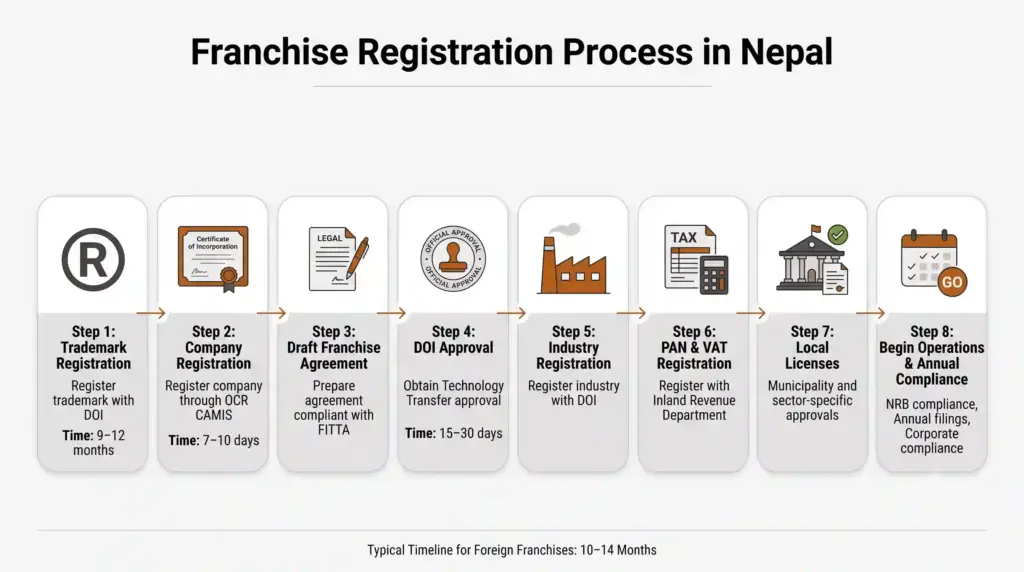
Step 1: Trademark Registration
Time: 9–12 months (critical path)
Cost: NPR 1,000 (application fee per class) + NPR 5,000 (registration fee) + professional fees NPR 15,000–50,000
Authority: Department of Industry (DOI), Intellectual Property Section
Common mistake: Starting franchise negotiations before filing the trademark application. Without trademark registration, DOI will reject the franchise agreement approval.
Conduct a trademark search (optional but recommended; fee NPR 1,500–3,000). File the application with DOI in Tripureshwor, Kathmandu. Foreign applicants must file through a licensed Nepali trademark agent. The mark is examined, published in the IP Bulletin for 90-day opposition, and registered if no opposition is filed. Registration is valid for 7 years and renewable indefinitely.
Step 2: Company Incorporation
Time: 7–10 working days
Cost: NPR 1,000–43,000+ (based on authorized capital) + professional fees NPR 15,000–50,000
Authority: Office of Company Registrar (OCR) via CAMIS portal
Common mistake: Selecting a generic company name that OCR rejects. Reserve the name online first; approval is valid for 35 days.
Create an account on the OCR CAMIS portal. Submit the proposed company name in English and Nepali. Upload MOA, AOA, citizenship copies, and address proof. Pay registration fee online (eSewa/Khalti/bank transfer). Receive digitally signed certificate with QR code. Complete within 90 days of name approval.
Step 3: Execute Franchise Agreement
Time: 1–2 weeks (drafting and negotiation)
Cost: Legal drafting fees NPR 25,000–100,000 (estimate)
Authority: Parties (with legal counsel)
Common mistake: Using a foreign-template agreement without Nepali law compliance. The agreement must comply with FITTA, Contract Act, and Competition Act.
Draft the agreement in English and Nepali. Essential clauses: grant of rights, territorial boundaries, term/renewal, fee structure (initial + royalty), IP licensing, quality standards, training obligations, non-compete/confidentiality, termination grounds, and dispute resolution (arbitration under Arbitration Act 2055 or ICC/UNCITRAL for international parties).
Step 4: DOI Franchise Approval
Time: 15–30 working days
Cost: No specific government fee (professional fees apply)
Authority: Department of Industry, Foreign Investment and Technology Transfer Unit
Common mistake: Submitting incomplete board resolutions or missing the Power of Attorney. Ensure all documents are notarized and translated where required.
Submit the complete document package to DOI. DOI evaluates compliance with FITTA/FITTR, verifies royalty rates against Schedule 1 ceilings, and issues approval specifying permitted royalty rates and repatriation terms.
Step 5: Industry Registration
Time: 5–7 working days
Cost: NPR 20,000 (approximate)
Authority: Department of Industry
Common mistake: Delaying industry registration until after operations begin. This is mandatory before commencing business.
Submit company registration certificate, tax registration, and business plan to DOI under the Industrial Enterprises Act 2076. Receive industry registration certificate.
Step 6: Tax Registration
Time: 3–5 working days
Cost: PAN registration ~NPR 500; VAT registration ~NPR 1,000
Authority: Inland Revenue Department (IRD)
Common mistake: Failing to register PAN before any business transaction. PAN is mandatory for all companies.
Apply online via the IRD portal. Submit company registration certificate, MOA/AOA, director citizenships, and office lease. PAN is issued within days. VAT registration is mandatory if turnover exceeds thresholds or if the business elects voluntary registration to claim input VAT.
Step 7: Local and Sectoral Licenses
Time: 7–15 working days
Cost: NPR 5,000–15,000 (ward/municipal) + sector-specific fees
Authority: Local ward office, municipality, and sector regulators
Common mistake: Overlooking ward office registration, which is mandatory within 30 days of company registration.
Register at the local ward office where the registered office is located. Obtain municipal business license. Apply for sector-specific licenses: food/health (DFTQC for F&B), tourism (for hotels), fire/safety clearance, etc.
Step 8: Royalty Repatriation Setup
Time: 1–2 weeks
Cost: Bank charges (variable)
Authority: Nepal Rastra Bank (NRB) via commercial bank
Common mistake: Assuming royalty can be remitted without NRB documentation. All foreign currency outflows require NRB approval.
Open a corporate foreign currency account. Submit DOI-approved franchise agreement, tax clearance, and withholding tax payment proof to the bank for NRB reporting. NRB monitors repatriation against approved ceilings.
Timeline Summary
| Stage | Domestic Franchise | Foreign Franchise |
|---|---|---|
| Trademark Registration | N/A (if local brand) | 9–12 months |
| Company Registration | 7–10 days | 7–10 days |
| Franchise Agreement Drafting | 1–2 weeks | 1–2 weeks |
| DOI Approval | N/A | 15–30 days |
| Industry Registration | 5–7 days | 5–7 days |
| Tax Registration | 3–5 days | 3–5 days |
| Local/Sectoral Licenses | 7–15 days | 7–15 days |
| Total (excluding trademark) | ~23–49 days | ~38–69 days |
| Total (including trademark) | ~23–49 days | ~10–14 months |
Note: Trademark registration is the bottleneck for foreign brands. Start this process immediately.
Cost Breakdown
Government Fees (Foreign Franchise)
| Item | Cost (NPR) | Notes |
|---|---|---|
| Trademark application (per class) | 1,000 | Per Nice class |
| Trademark registration | 5,000 | One-time |
| Trademark search (optional) | 1,500–3,000 | Recommended |
| Company registration (NPR 1M capital) | 1,000 | Scales with authorized capital |
| Company registration (NPR 2.5M–10M) | 16,000 | Common range for franchises |
| Name reservation | 100–500 | Valid 35 days |
| Gazette publication | 600 | Mandatory |
| Newspaper publication | 2,000–5,000 | National daily |
| Company seal | 500–1,500 | One-time |
| PAN registration | ~500 | Mandatory |
| VAT registration | ~1,000 | If applicable |
| Industry registration | ~20,000 | DOI |
| Ward/municipal license | 5,000–15,000 | Local dependent |
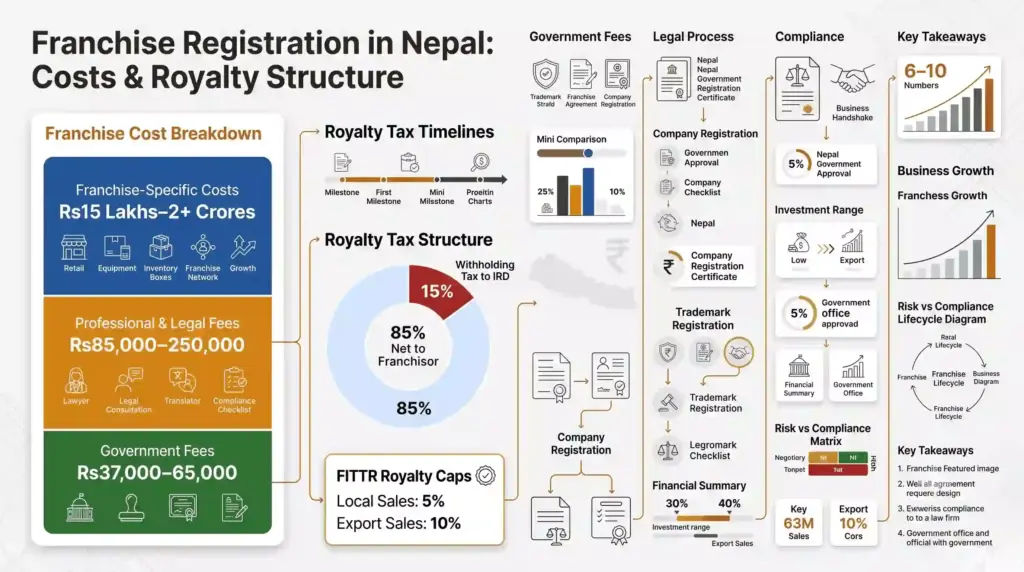
| Subtotal (government) | ~37,000–65,000 | (~USD 280–490) |
Professional & Other Costs (Estimate)
| Item | Cost (NPR) | Notes |
|---|---|---|
| Legal drafting (franchise agreement) | 25,000–100,000 | English + Nepali |
| Trademark agent/professional fees | 15,000–50,000 | Mandatory for foreign applicants |
| Company registration professional | 15,000–50,000 | MOA/AOA drafting, liaison |
| Translation/notarization | 500–2,000 | Per document |
| Audit & accounting (annual) | 30,000–100,000 | Ongoing |
| Subtotal (professional) | ~85,000–250,000 | (~USD 640–1,900) |
Franchise-Specific Costs (Variable)
| Item | Typical Range | Notes |
|---|---|---|
| Initial franchise fee | USD 5,000–50,000 | Brand-dependent |
| Fit-out and equipment | NPR 5–50 lakhs | Sector-dependent |
| Working capital | NPR 5–20 lakhs | First 6 months |
| Total initial investment | NPR 15 lakhs–2+ crores | (~USD 11,000–150,000+) |
Tax / Compliance / Practical Considerations
Royalty Withholding Tax
Under Section 88 of the Income Tax Act, 2058, royalty payments to non-resident franchisors are subject to 15% withholding tax, which is typically a final withholding for non-residents (meaning no further tax filing is required in Nepal for that income). The franchisee must deduct and remit this to the Inland Revenue Department before repatriating the net amount.
Double Taxation Avoidance Agreements (DTAAs)
Nepal has DTAAs with 11 countries: Austria, China, India, Korea, Mauritius, Norway, Pakistan, Qatar, Sri Lanka, Thailand, and Bangladesh. These treaties may reduce withholding tax rates on royalties. For example, under the Nepal-India treaty, royalty withholding is capped at 15% (same as domestic rate), while the Nepal-China treaty may offer different terms. Foreign franchisors should obtain a tax residency certificate from their home country to claim treaty benefits.
VAT on Franchise Fees
VAT at 13% applies to taxable services, including franchise fees and royalty payments, if the franchisor is VAT-registered in Nepal. If the foreign franchisor has no Nepal presence, VAT treatment depends on the specific service classification and place of supply rules. Local franchisees should consult the IRD on whether franchise fees constitute “import of services” subject to reverse-charge VAT.
Corporate Income Tax
The franchisee company pays corporate income tax at 25% on net profits. Certain sectors (telecommunications, banking, tobacco/alcohol) pay 30%. Tax incentives may apply for industries in special economic zones or outside Kathmandu Valley.
Repatriation Rules
Foreign franchisors may repatriate royalties, dividends, and proceeds from investment sale after tax compliance and NRB approval. The DOI-approved agreement specifies repatriation terms. Nepal Rastra Bank monitors all foreign currency outflows.
Annual Compliance Checklist
- [ ] File audited annual financial statements with OCR by mid-January
- [ ] Submit annual progress report to DOI by mid-January
- [ ] File tax returns and pay withholding tax by mid-October (extendable to mid-January)
- [ ] Renew business licenses and industry registration
- [ ] Renew trademark registration every 7 years (NPR 3,500)
- [ ] Hold Annual General Meeting and appoint auditor within 3 months of registration (first year) and annually thereafter
- [ ] Update DOI within 30 days of any change in shareholding (50%+), directors, or business activities
Common Mistakes
- Skipping trademark registration first: DOI will reject franchise approval if the foreign trademark is not registered in Nepal. This is the #1 cause of delay.
- Using generic company names: OCR rejects names that are too similar to existing companies or too generic. Always reserve the name before printing materials.
- Underestimating the 35-day name reservation window: If documents are not submitted within 35 days of name approval, the reservation expires and the process restarts.
- Drafting agreements without Nepali law review: Foreign-template franchise agreements often contain clauses that violate the Competition Act or FITTA royalty ceilings.
- Missing ward office registration: Many businesses complete OCR and DOI steps but forget mandatory ward office registration within 30 days, leading to fines.
- Ignoring VAT thresholds: Failing to register VAT when turnover exceeds NPR 5 million (services) results in penalties and inability to claim input VAT.
- Late annual compliance: Missing the mid-January deadline for audited financials and annual returns triggers compounding fines under the Companies Act.
How CorporateBizLegal Can Help
CorporateBizLegal provides end-to-end legal support for foreign franchisors and local franchisees establishing franchise businesses in Nepal. Our services include trademark registration, company incorporation, franchise agreement drafting, FITTA and DOI approvals, foreign investment advisory, tax and royalty structuring, NRB compliance, and ongoing corporate compliance. We help businesses navigate Nepal’s legal framework efficiently, reduce regulatory risks, and launch with confidence.
Conclusion
Franchising is a practical and legally recognized route for expanding into Nepal, but success depends on proper planning and regulatory compliance. By securing trademark protection early, obtaining the required approvals, and maintaining ongoing legal and tax compliance, businesses can establish and grow their franchise operations with confidence. Professional legal guidance can streamline the process, minimize delays, and protect your investment from the outset.
Was this article helpful?
Let us know what you think!